
Phenological Phacts and Photos with Carl Martland / December 2025
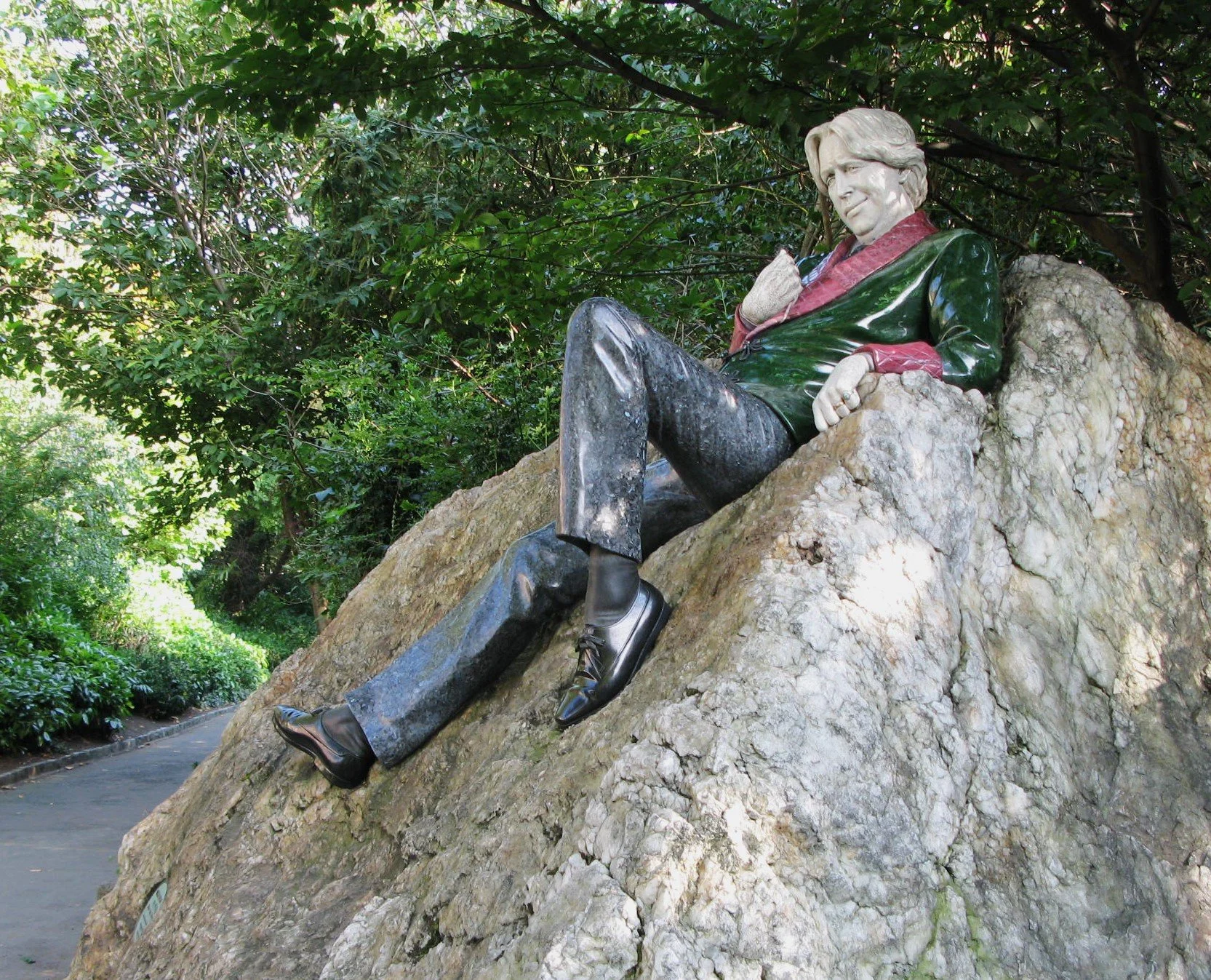
Oscar Wilde in Dublin
The Year in Review
Phenology – “a branch of science concerned with the relationship between climate and periodic biological phenomena (as the migration of birds or the flowering and fruiting of plants).”
Wilde Seasons
This end of the year is a good time for reflection, whether contemplating the great issues of the day or simply enjoying a mug of hot coffee in your favorite chair by the wood stove. In that spirit, instead of seeking some fascinating phacts about nature in December, I have reviewed this year’s phenological essays and selected my favorite photos and observations.
In January, I pondered a major discrepancy in our calendar. We still call many of our months by names that the ancient Romans chose to honor their gods, including Janus, Mars, and the first two Caesars. However, they apparently ran out of names, and we have been left with four months simply called Months 7 to 10. December, the end of our 12-month year, was only Month 10 according to the ancient Romans. Why? Because in Rome, March marked the beginning of spring and the time to plant their crops.
Those of us in the North Country cannot be convinced that March is anywhere close to the beginning of spring, but we do expect redwing blackbirds, woodcock and robins to show up while snow still covers most of the fields. And we can certainly agree with the phenological sentiments expressed so well by Oscar Wilde in “Ravenna”:
Now is the Spring of Love, yet soon will come
On meadow and tree the Summer’s lordly bloom;
And soon the grass with brighter flowers will blow,
And send up lilies for some boy to mow.
Then before long the Summer’s conqueror,
Rich Autumn-time, the season’s usurer,
Will lend his hoarded gold to all the trees,
And see it scattered by the spendthrift breeze;
And after that the Winter Cold and Drear.
So runs the perfect cycle of the year.
This poem was inspired by Wildes’s visit to Ravenna, the ancient capital of the empire after Rome was sacked. He, like many of us in the North Country, understood that the natural year logically begins in spring and ends in the cold darkness of winter. If you visit Dublin, you can spend some time bird-watching in Merrion Square Park, right across from where he once lived and where his statue continues to keep an eye out for the birds.
January - A Bird for Each Month Part I
The January and February essays identified one of my favorite birds for each month. Part I presented birds for January through June, and my overall favorite for this period was the cardinal. I recall seeing my first cardinal back around 1956 when we visited my cousins in Darien, Connecticut. Since cardinals had not yet made it to Rhode Island, I was very excited to see such a colorful bird. I also recall seeing my first cardinal in the North Country about 20 years ago, but my records and photos only confirm four more sightings before 2014. However, over the past ten years, cardinals have not only become regular summer residents, they now show up in the winter. Even the purple finch cannot top the brilliance of a male cardinal sitting in a snow-covered fir tree.
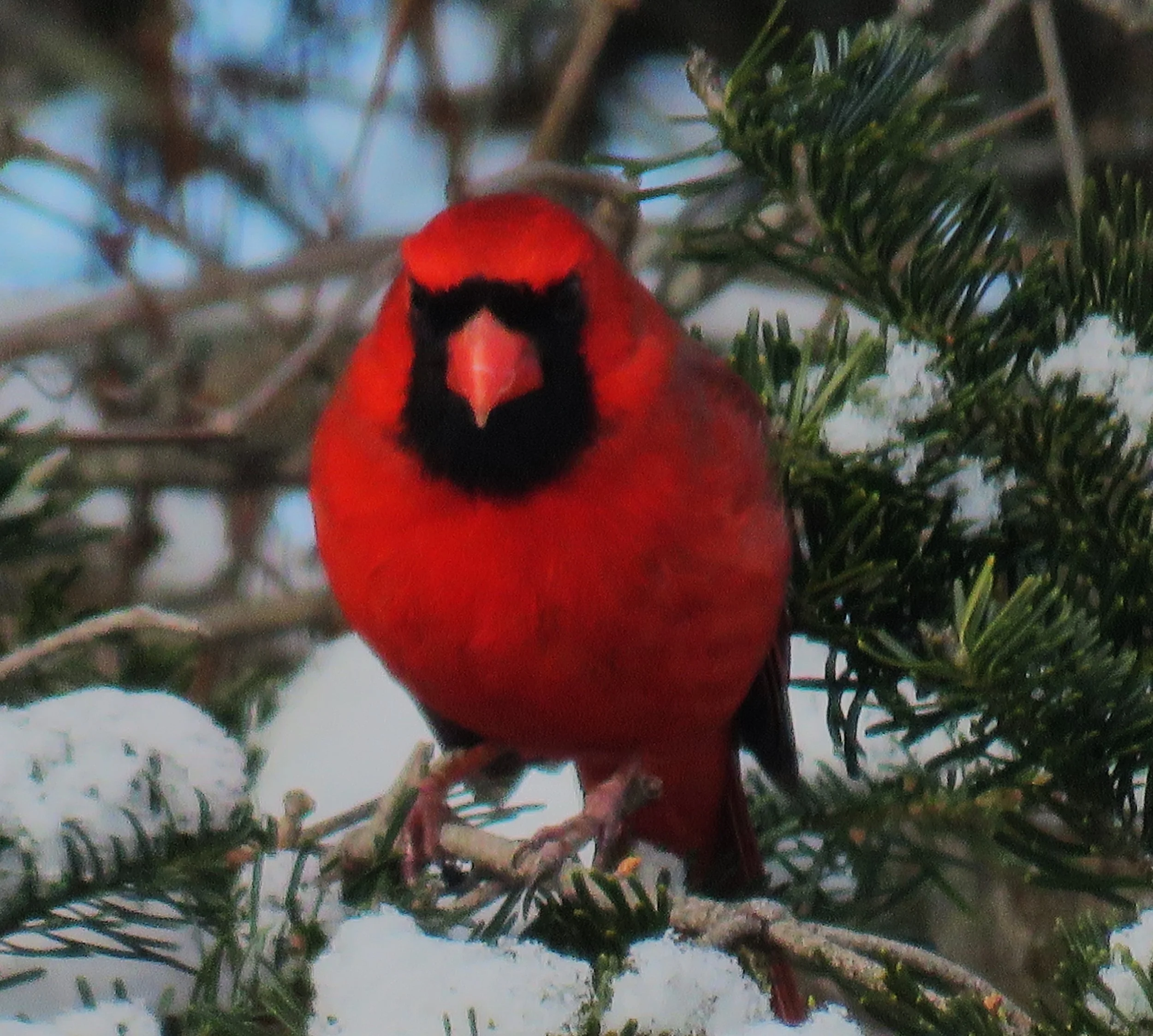
February 14, 2019
A cardinal sat in the fir tree, eyeing the sunflower seeds available in the feeder.
February - - A Bird for Each Month Part II
Part II nominated birds for July through December, and my overall favorite was the chestnut-sided warbler. Warblers typically arrive in Sugar Hill, in mid-May, and many of them will stay all summer. Some, like the black-throated green and the black-and-white warblers look for nests deep in the woods. Others, including the chestnut-sided, prefer the edges of the meadows. Getting a close-up view of this sociable bird is not a problem:
July 23, 1999, 90 degrees, humid, partly cloudy. I saw a chestnut-sided warbler in
an alder near the Upper Meadow. Actually, it saw me first and flew to a branch
about five feet away for a closer look.
If you see a warbler flitting about low alders or willows at the edge of a meadow in July, it may well be a chestnut-sided. If so, be patient, for once it notices you, it may well land a short distance away, and the male will be happy to show off its chestnut-colored flanks.
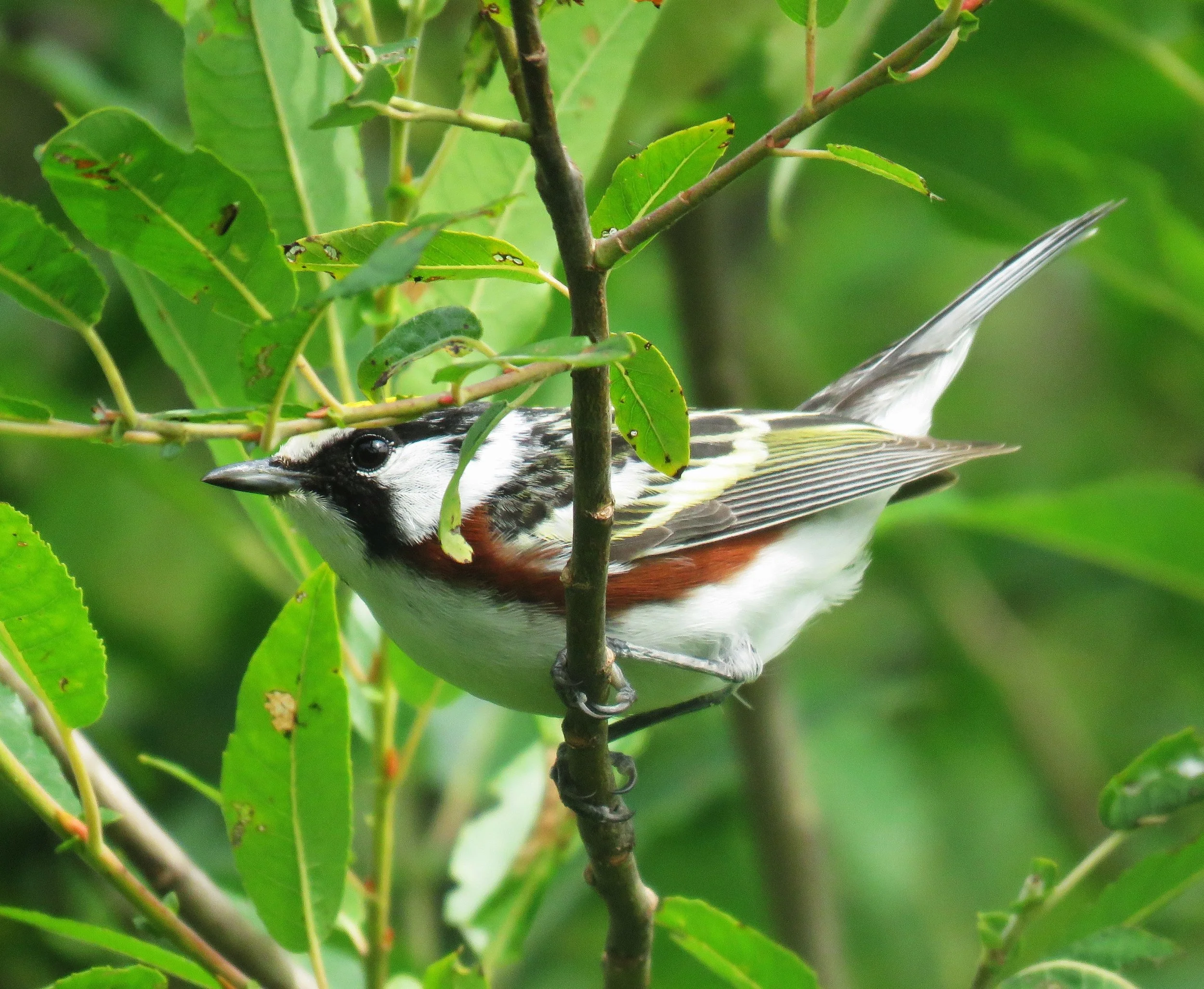
July 28, 2017
A chestnut-sided warbler paused long enough for me to catch his brilliant colors in this photo
March - Jabberwocky Explained
“’Twas brillig” is the start to Jabberwocky, a poem that Lewis Carroll published in 1872 and one that has enchanted generations of kids of all ages ever since. Carroll invented dozens of words for use in this poem, some of which have come into accepted usage, including chortled and galumphed, but most of them seem to most people to be as fantastical as the Jabberwock is supposed to be. However, I believe that this poem, at least the beginning, is an accurate description of what anyone might see around a pond in the beginning of spring, not only in Old England a hundred and fifty years ago, but right now in April in New England. Here are the first two stanzas:
’Twas brillig, and the slithy toves
Did gyre and gimble in the wabe:
All mimsy were the borogoves,
And the mome raths outgrabe.
“Beware the Jabberwock, my son!
The jaws that bite, the claws that catch!
Beware the Jubjub bird, and shun
The frumious Bandersnatch!”
The March PPP identified “slithy toves” as newts squirming around clumps of wood frog eggs (the “wabe”), while the “mimsy borogroves” (painted turtles) basked in the sun and “mome raths” (hooded mergansers) twisted their necks and poked their beaks into their feathers and cleaned themselves up. I then concluded that the Jabberwock must also be a real creature found near the same ponds where the other creatures are found. We also know that this poem tells us what a man said to his son who has taken his vorpal blade and is about to set off to find the Jabberwock. Now, a son could be a grown man, but it seems to me that this son is a boy with a vivid imagination who is heading off on an adventure with the approval of his father. Thus, the jabberwock could not be a bear; even though a bear certainly has jaws that bite and claws that snatch. No father would send his sun out to hunt a bear with a little blade, no matter how vorpal.
My belief is that the Jabberwock is a snapping turtle, which also has jaws and claws with the required abilities. Although a dangerous beast, a snapping turtle will stick its neck out a little too far for its own good, as shown in this photo of one that once crossed my path.
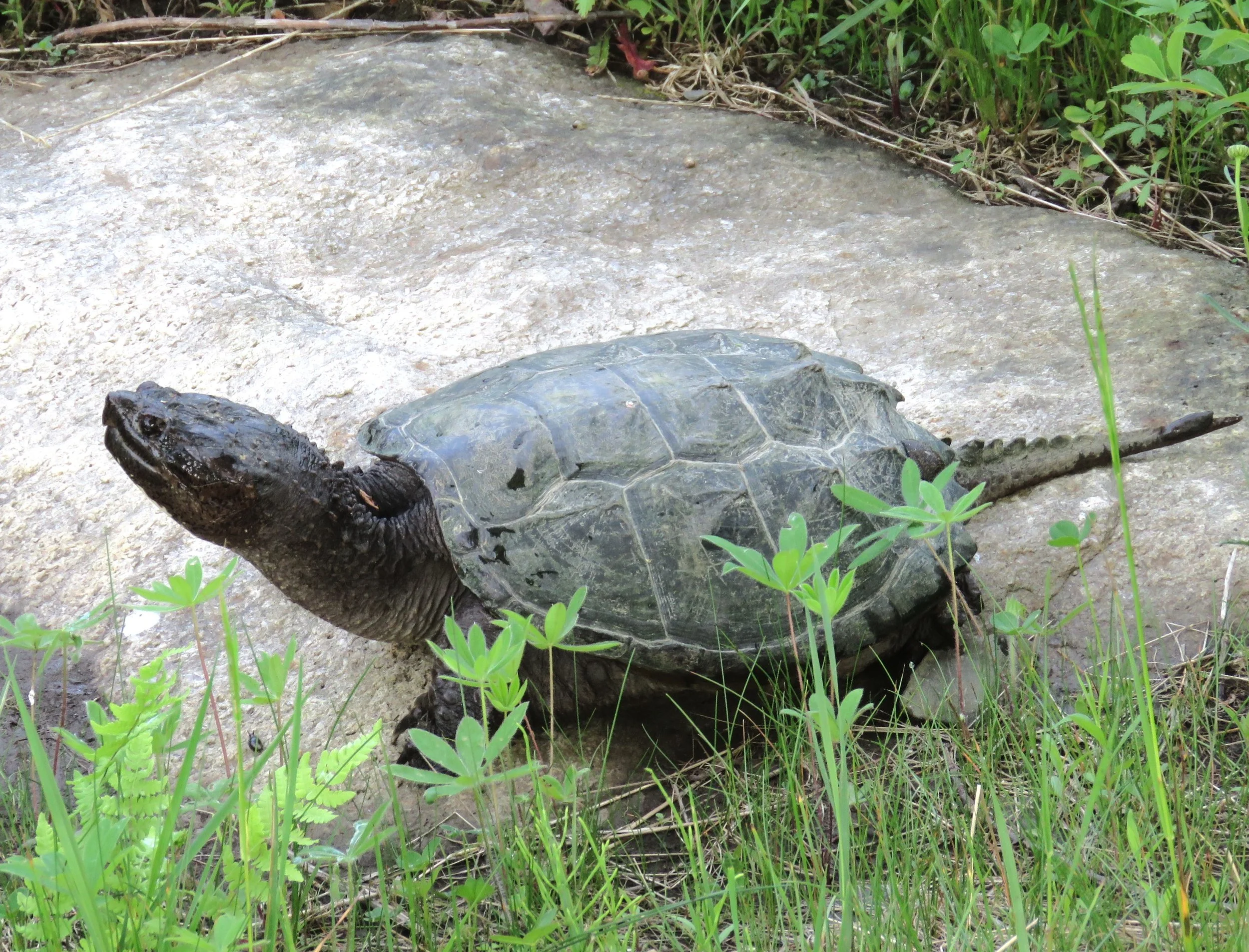
June 18, 2017
90 degrees, sunny. I went out to the solar array, planning to sit for a while in the shade simply enjoying the lupine. Imagine my surprise when a large snapping turtle stepped out onto the flat rock that is just about where I was planning to place my chair. Its shell was about 1 to 1 ½ feet long, its neck was thick, and its attitude toward me was somewhere between indifference and mild scorn. … It slowly advanced along the edge of the clearing and eventually found a suitable place to climb up the dam. For obvious reasons, I made no attempt to follow it!
As is evident in this photo, the long neck of a snapping turtle does provide an obvious target for someone armed with a vorpal blade. Furthermore, I know for a fact that boys have been known to hunt snapping turtles near ponds in New England, so presumably they have done so in Old England. My father grew up in Warwick, Rhode Island, and he told me that he used to capture snapping turtles in potato sacks and then sell them for fifty cents apiece to a neighbor who made turtle soup and marketed patent medicines with allegedly astounding – but unproven - benefits. My father had to use skill and great care to catch the turtles in a sack, because neither he, his brother, nor his father had a vorpal blade.
April - Nesting Season for Mergansers
Mergansers and Canada Geese arrive in Coffin Pond in late March or early April, even with fresh snow on the ground, so long as there is some open water. Common mergansers seek lakes and other large bodies of water, because they like to gather in small flocks. Hooded mergansers join them if they can’t find a small pond with ice out:
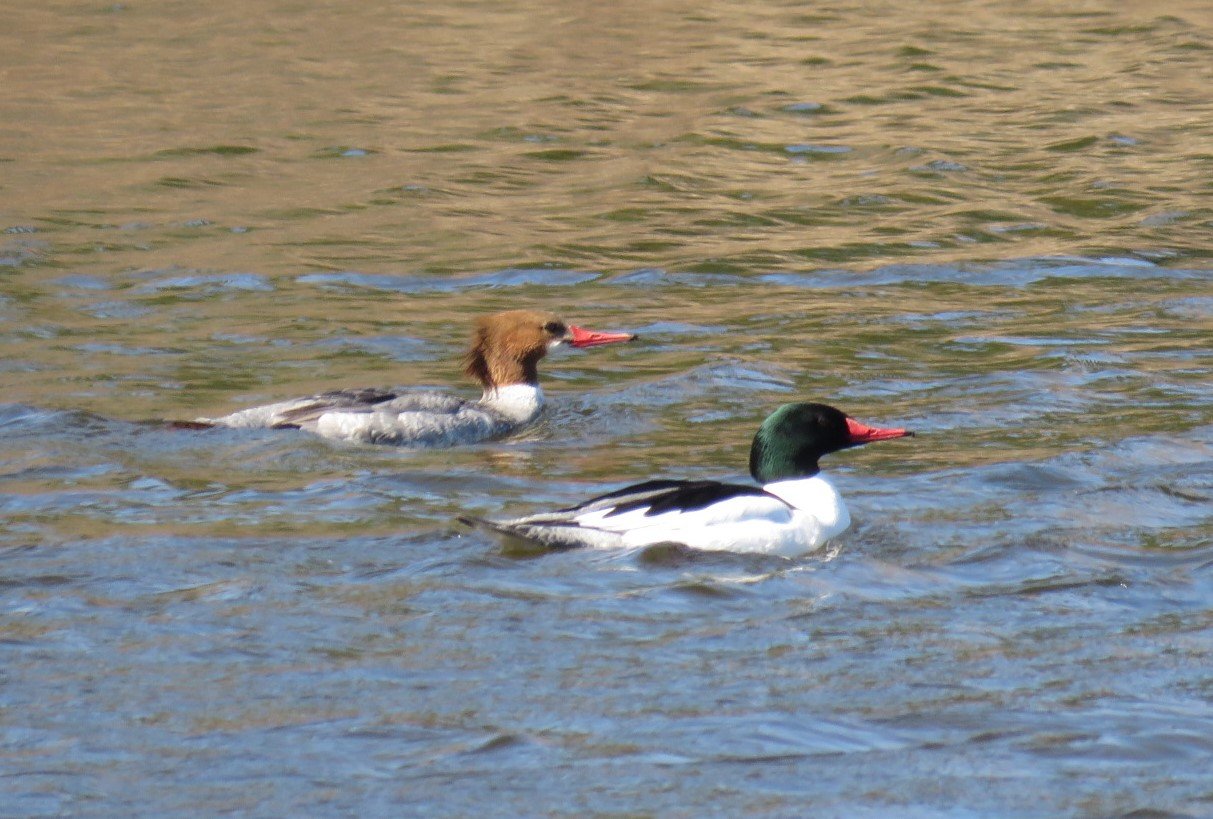
April 24, 2016
A pair of common mergansers at Coffin Pond.
March 25, 2020, 40 degrees, beautiful. We walked out the snow-covered trail next
to Coffin Pond, which was still two thirds iced over. A half dozen hooded mergansers
and a single common merganser were in the pond, while a pair of Canada Geese
floated across the river, eventually climbing out and huddling on the opposite shore,
their necks buried in their feathers.
June – Before the Lupin
In mid-April, the dam, like many of us, is depressed by the ever-lasting snow and ice. By mid-June, the dam, like many of us, is overwhelmed by the sheer variety and brilliance of the lupin. In between, in mid-May, when I walk along the dam, even though the new growth has barely begun, I know to look for the wild strawberries and violets that are usually the first flowers to break through last year’s detritus.
I look carefully for the tiny, easily missed flowers such as the blue-eyed grass, which has single flowers barely a half-inch across on stalks less than a foot tall, and I don’t ignore the beauty of the plentiful, but much maligned dandelion.
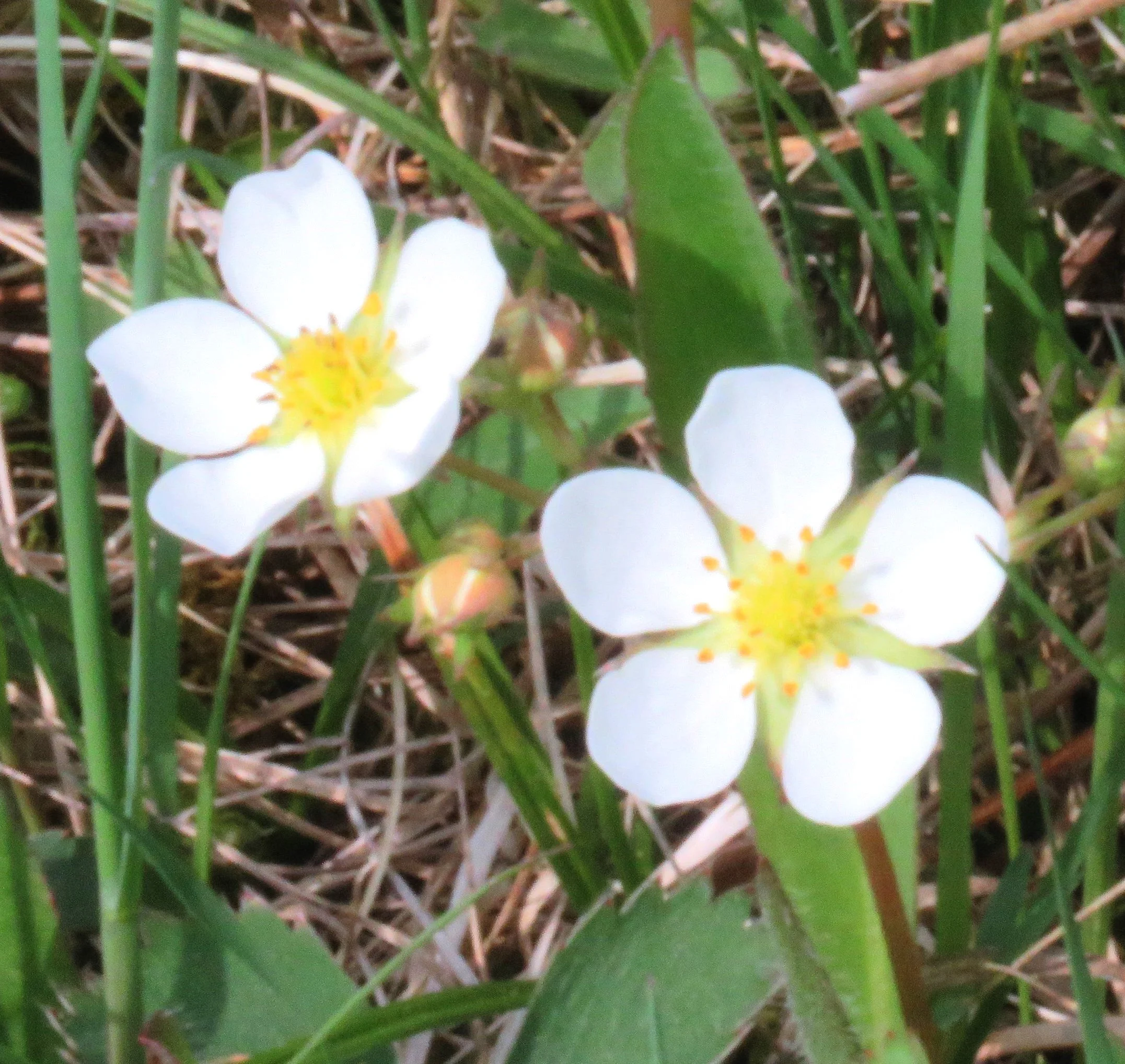
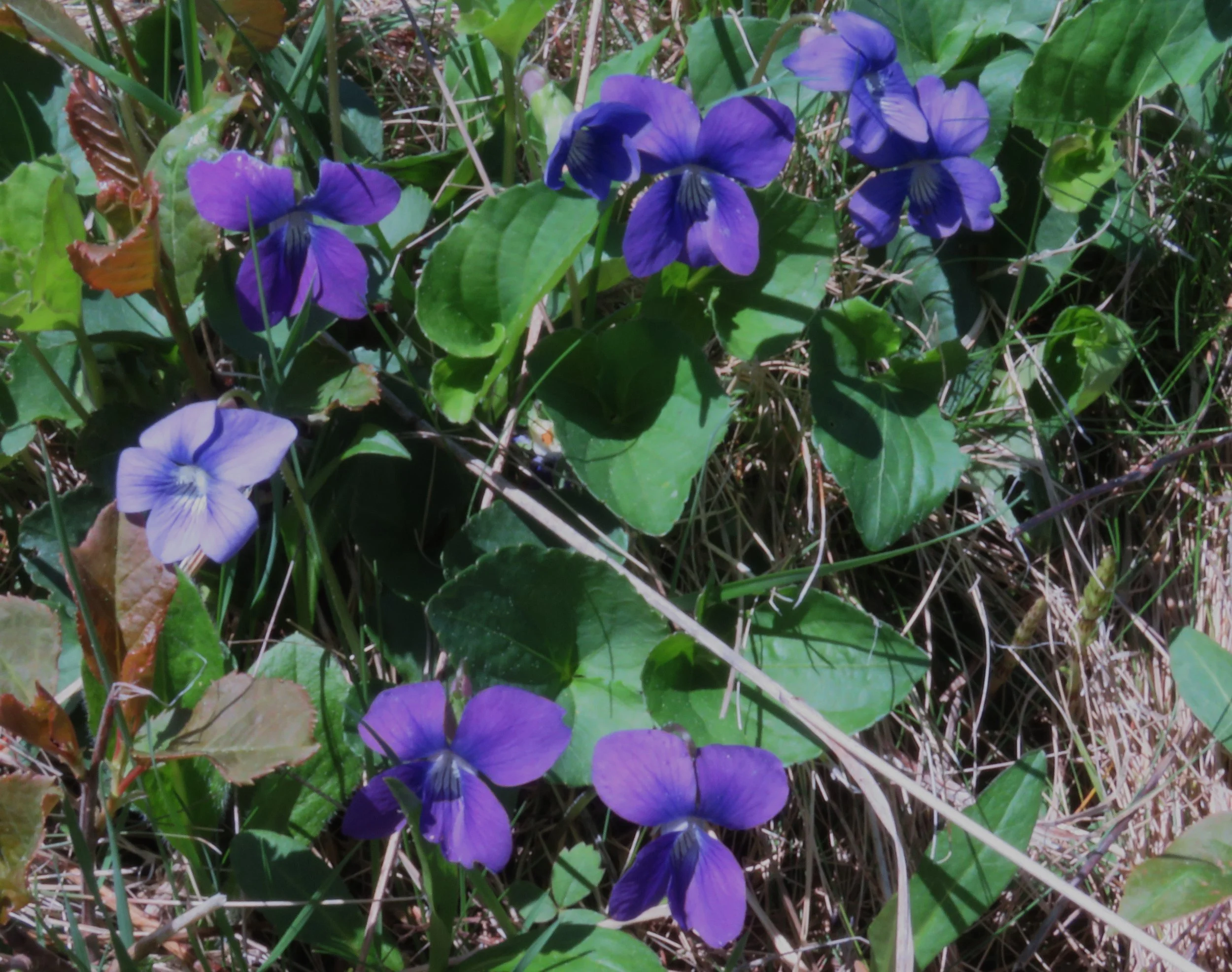
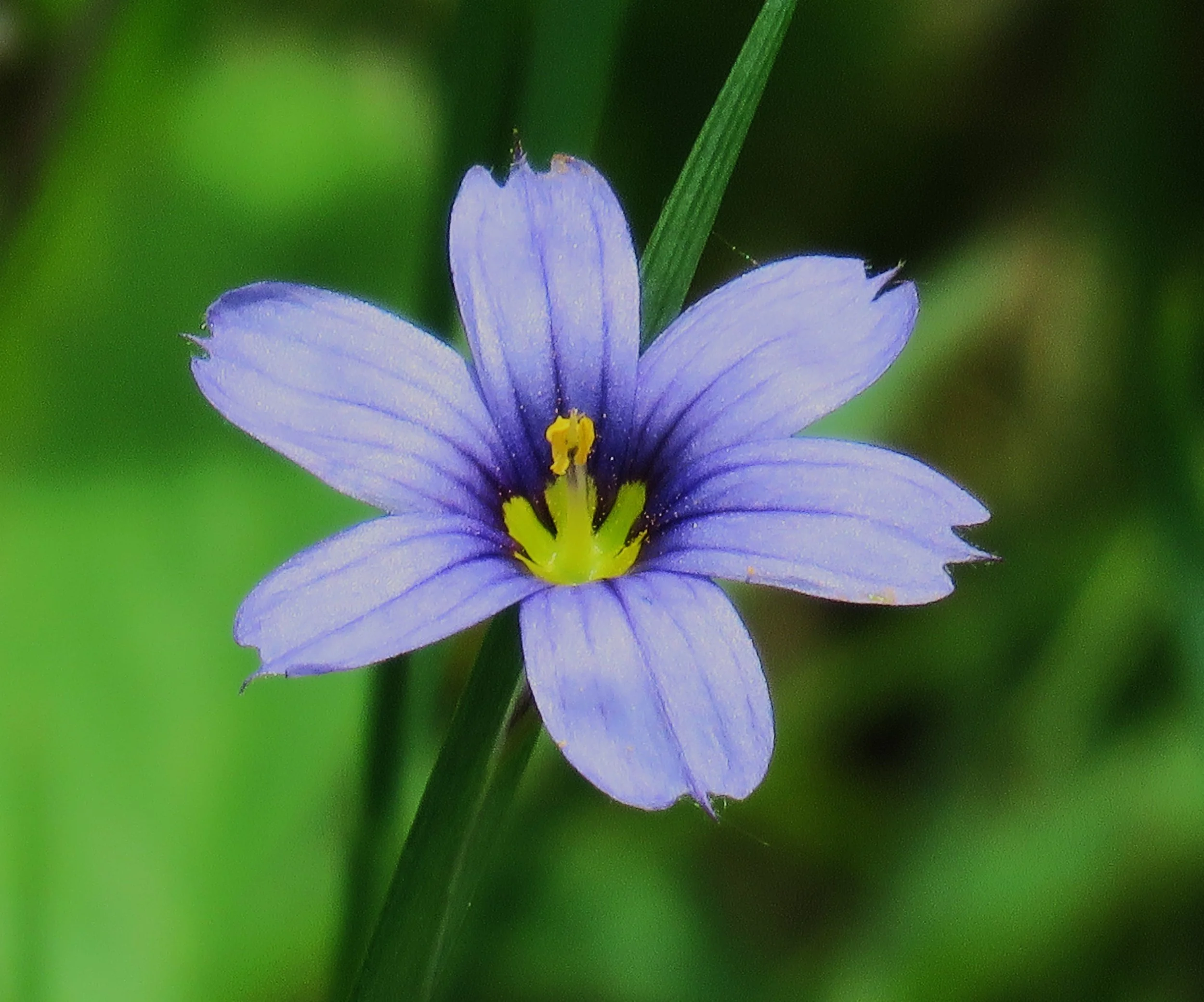
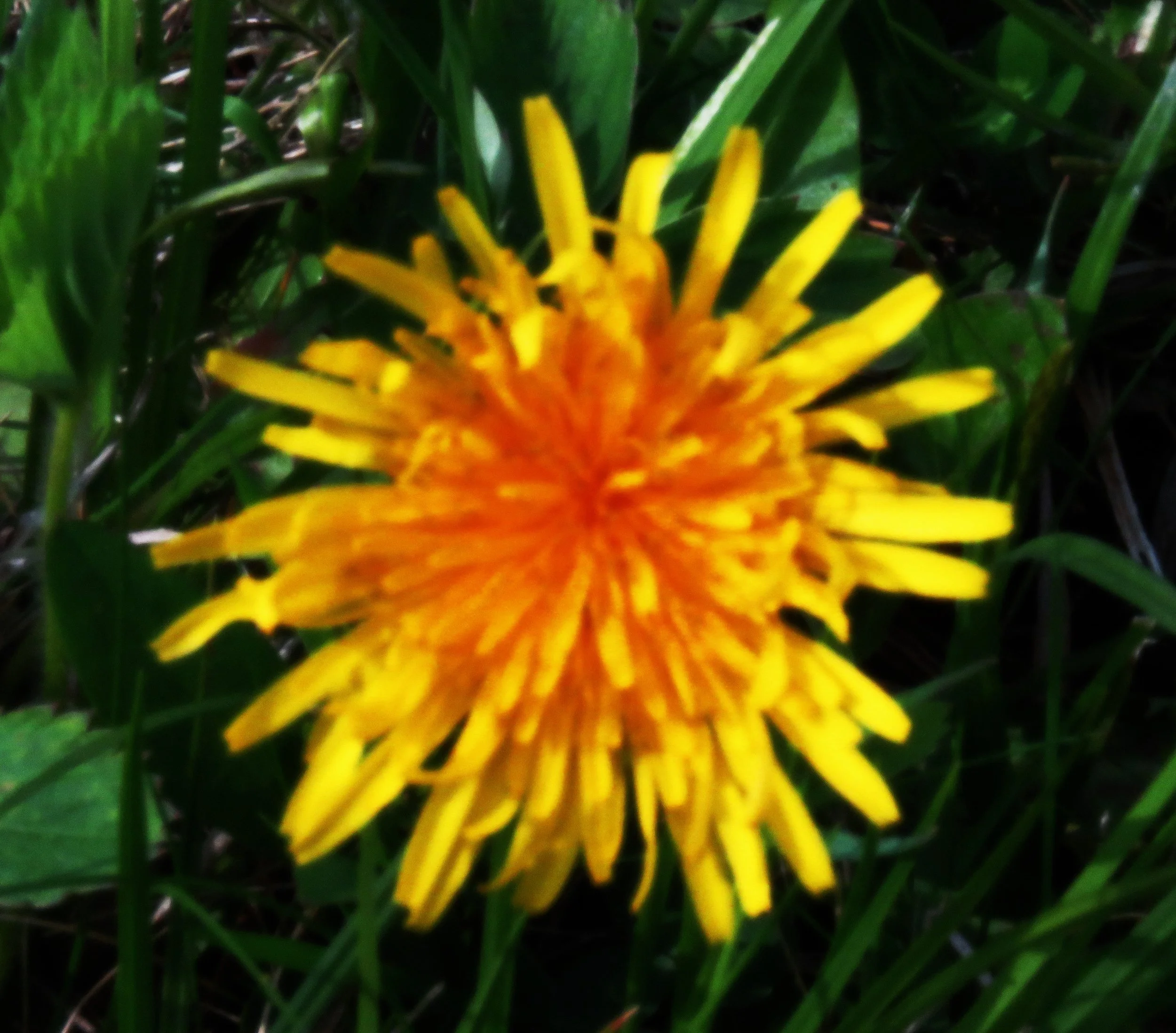
May 13, 2025 - Wild strawberries are the first blooms to be seen along the dam.
May 22, 2025 - A cluster of violets bloom adds a bit of color to the dam.
June 10, 2020 - A few of the tiny flowers atop the stems of blue-eyed grass can be seen in the latter half of May. By June, there may be dozens along the dam.
May 13, 2025 - If you think of dandelions as weeds, you probably haven’t noticed the delightful shades of yellow and orange of their blossoms.
July – Meadowhawks
From mid-July through mid-October, meadowhawks are among the most common dragonflies to be found around the pond. They are highly recognizable because of their size, the males’ red coloring, and their habit of resting frequently. Although only about an inch-and-a-half long, they are colorful, energetic, romantic, and photogenic. On any reasonably warm, dry, and sunny day in late-summer, you are likely to see a dozen or more bright red meadowhawks flying low over the water, resting on a twig, or clinging to the side of a cattail leaf in a heart-shaped wheel formed with their mate.
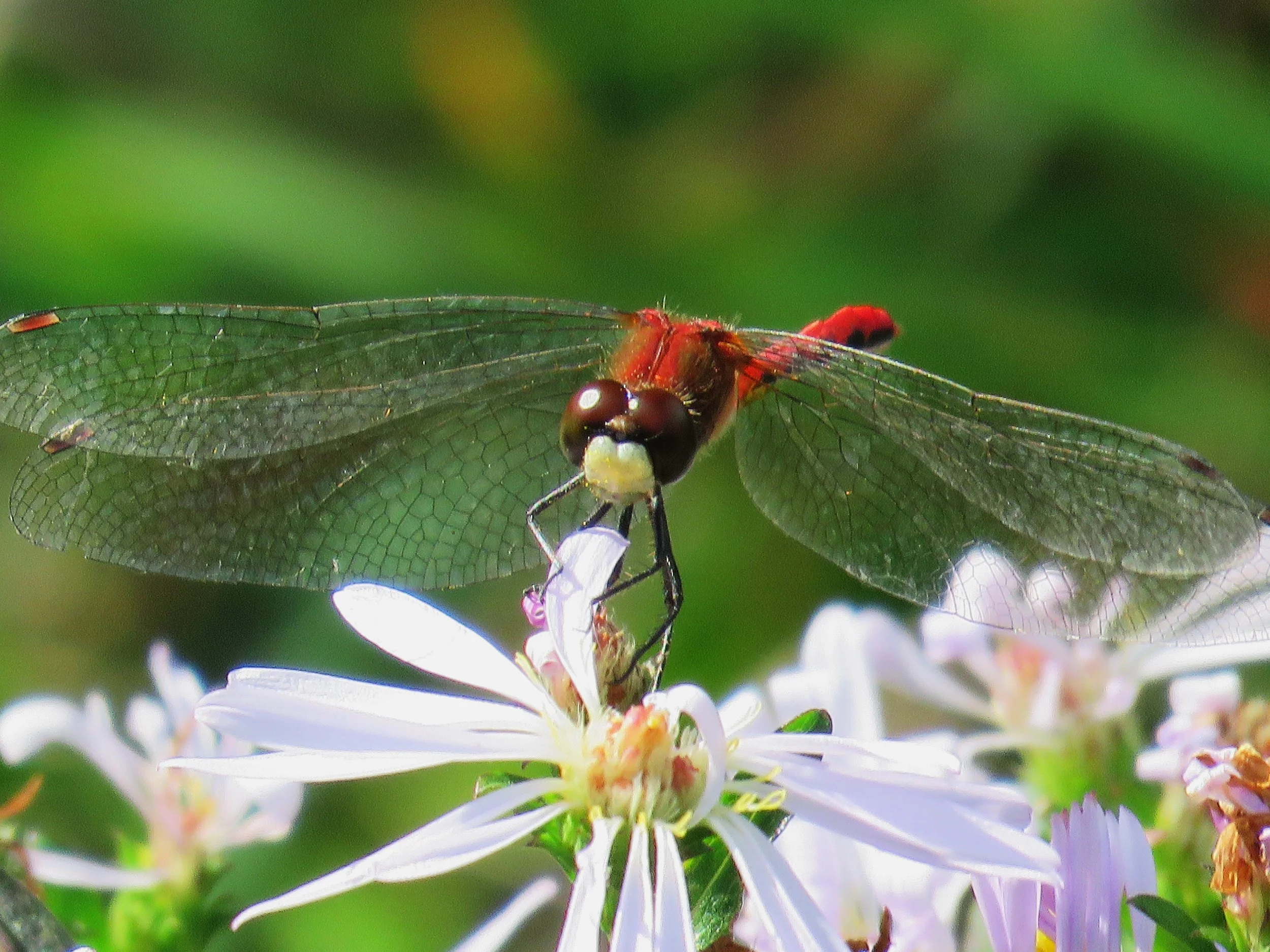
September 18, 2018
White-faced meadowhawks, the first meadowhawks to show up in July, are still active along the dam in mid-September.
White-faced meadowhawks usually arrive at the pond in mid-July, and they might be the only meadowhawks in the neighborhood for the next several weeks. These meadowhawks frequently linger on a twig or a flower stalk for a minute or more, providing plenty of time to zoom in and take pictures from several different angles highlight the variations in color from the dragonfly’s face to the tip of its abdomen.
August – Friendly, Frustrating Fritillaries
Fritillaries are large, colorful butterflies that are commonly seen throughout the North Country in late summer. At first glance, the fritillaries all look the same! In addition to good photos, you need an eye for detail, a guidebook, and perhaps a magnifying glass (for close examination of the photos in the guidebook). And you may also wish you had estimated the wingspan of the butterfly that you have photographed. The difficulty of species identification is why fritillaries are more than a little frustrating.
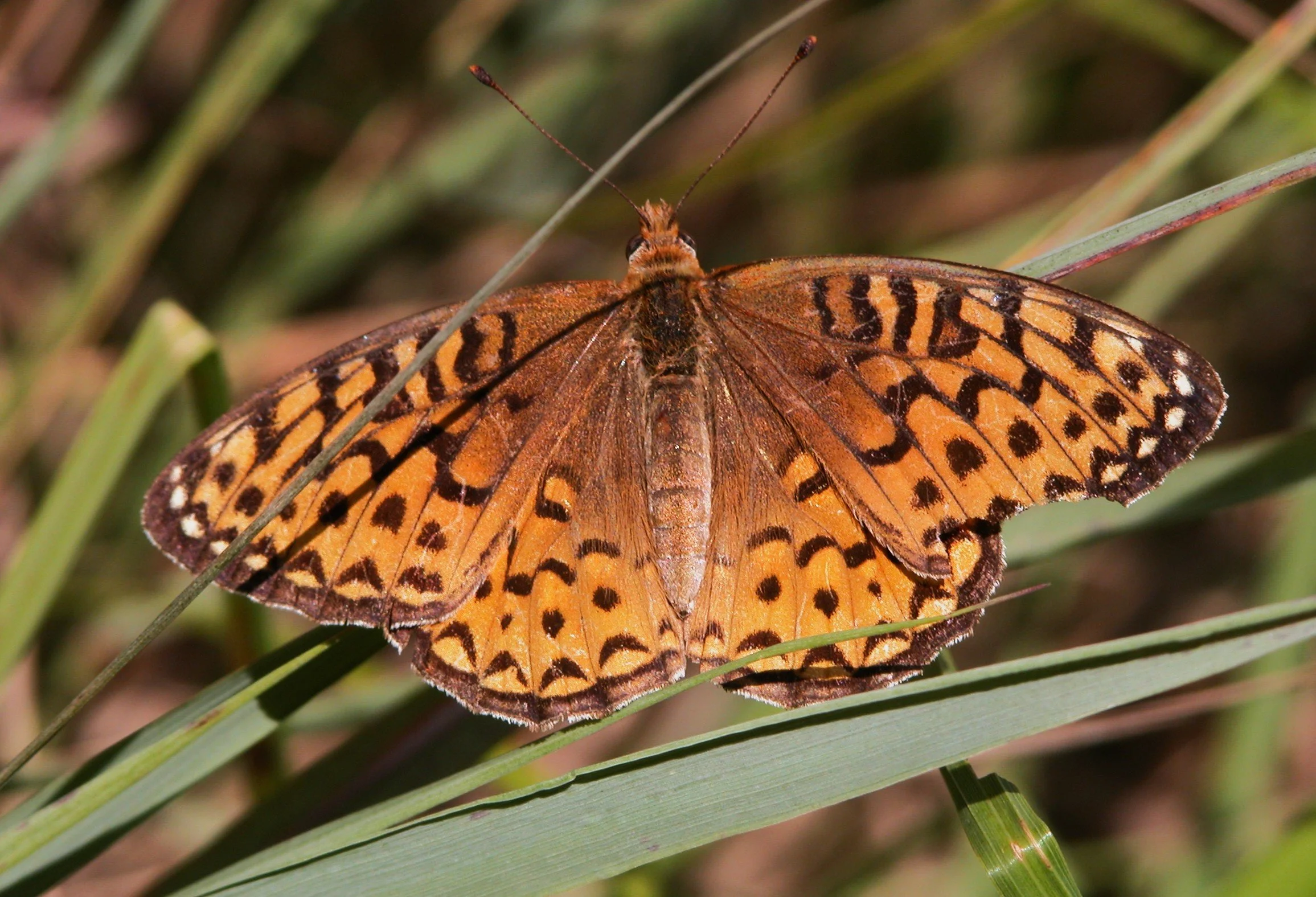
August 17, 2005
This photo of an Atlantis Fritillary captures the pattern of black spots on an orange background that defines fritillaries.
And there is one more reason for frustration. This butterfly and its favorite flower are two of the most difficult words that you could encounter in a spelling bee. Without looking back, can you say what comes after F-R-I-T …? Are you sure about the Ts and Ls? Are you sure whether that letter near the end is an A or an E? In my journal, I found multiple spellings, including frittilery, fritillery, and fritillary. To remember what’s correct, I now use the same method that a fellow consultant used to remember how to spell the tax on imports. Is it tarrif, tariff, or tarriff? Eric said it’s simple to remember: one R, two Fs With the fritillary, it’s one T, two Ls and an A. That’s not so hard, but how on earth are supposed to spell the flower whose name sounds like ACK – IN -NA – SHA?
September – It Begins After Labor Day
So much begins after Labor Day. The apples ripen, and the bears eat them up. Asters and goldenrods create brilliant colors along the roadside and in the fields, while bits of red and yellow appear in the maples and birches. The warblers, sparrows, geese and so many other birds begin their journey to warmer climes. Deer and turkeys worry, or should worry, about the beginning of the hunting season.
For me, a new life also begins after Labor Day, just it always has. As a student and throughout my professional career in university research, Labor Day marked the beginning of a new school year. Now, even though I have been retired for nearly twenty years, Labor Day still marks a new beginning. Summer for retirees is longer than, but not necessarily that much different from the vacations that we used to take. Only after Labor Day is it clear that we were not just having a lengthy vacation. The day after Labor Day, my calendar is still empty. I can do whatever I choose to do. Soon it will be time to pick the apples.
Make it stand out
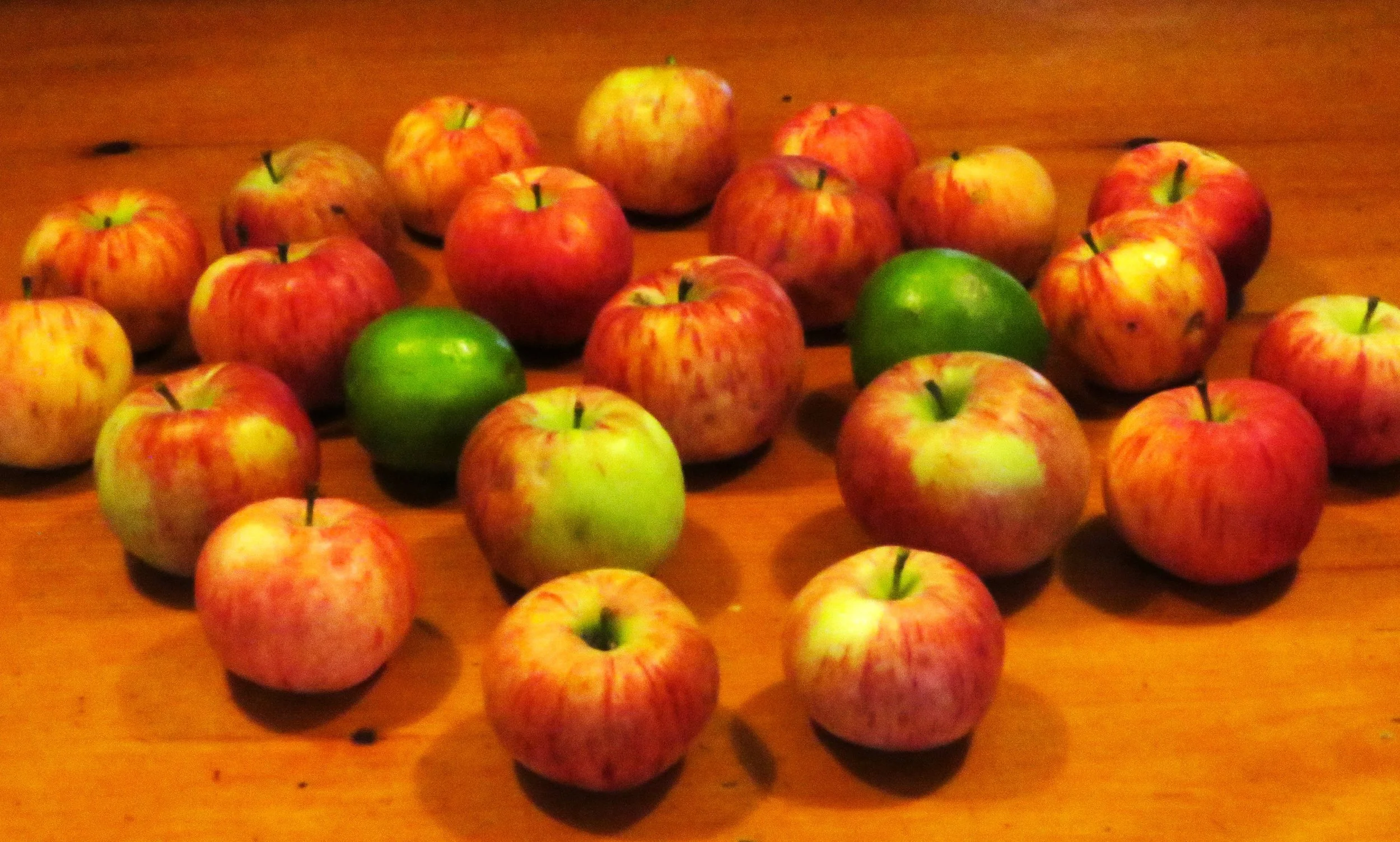
September 14, 2022
The first batch of apples from the wild tree in the Lower Meadow. Should I begin with apple pie or applesauce?
October – Big Birds
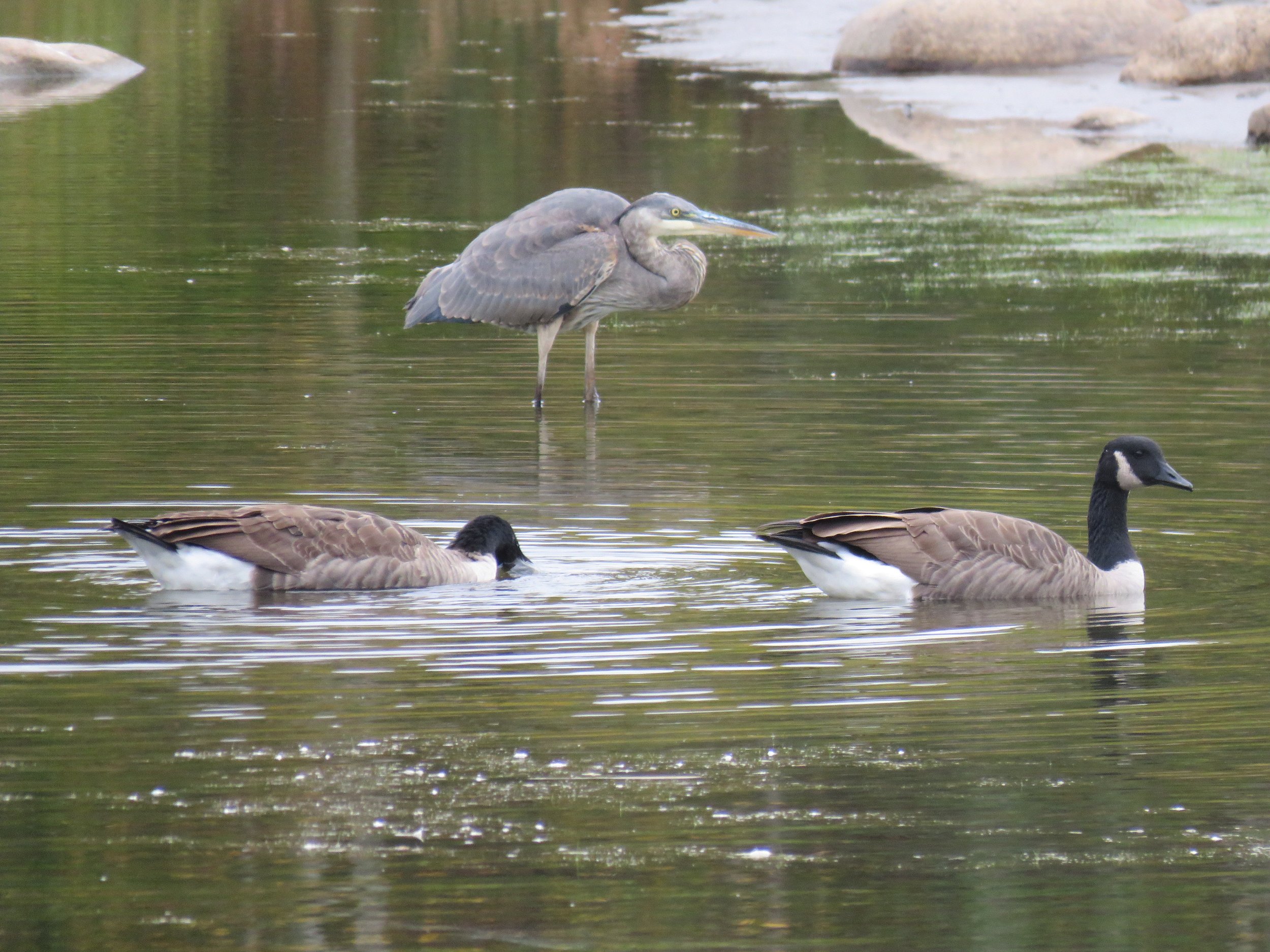
I think that the Great Blue Heron is the most spectacular large bird in the North Country. In the fall, I always anticipate their arrival to hunt for young frogs. Sometimes, they stand still at the shoreline, patiently waiting for a frog to come to them. Other times they stalk along the shoreline, neck down and extended, ready to dart to either side if they see a frog. If I get too close, they will fly off, probably headed for better hunting at Pearl Lake or Coffin Pond, but a couple of times I’ve seen them land at the other end of the pond, and once I saw one land near the top of one of the tall pines on the other side of the road.
October 4, 2016
A Great Blue Heron stood by a group of Canada Geese at Coffin Pond
November – Fliers Fishing
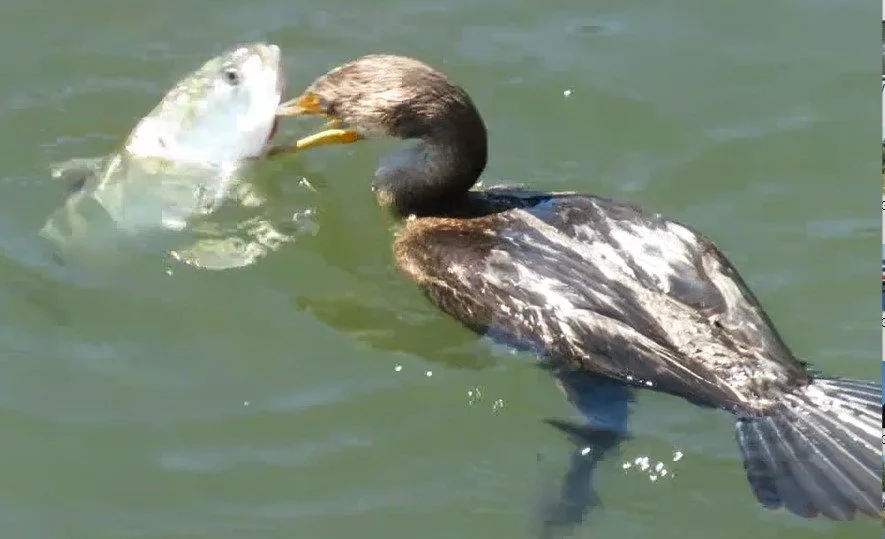
Ospreys and eagles catch fish with their feet. Loons and cormorants use different tactics, operating more like the navy than the air force. In Wickford, RI, we once watched a bunch of cormorants feasting upon a school of fish that was heading from the bay, going under a bridge, and ending up in a little pond. I don’t know whether the fish were seeking something to eat in the pond or intending to swim further upstream to breed. The cormorants probably didn’t know either, nor did they care. What they did know is that there were so many fish, they could certainly catch a meal. We were amazed at the size of the fish compared to the size of the cormorant’s beak and throat.
September 15, 2016.
A cormorant struggles to figure out how to devour the fish that it has caught at the edge of Narragansett Bay in Wickford, RI.
December 2025 – Dreaming of Warmer Climes
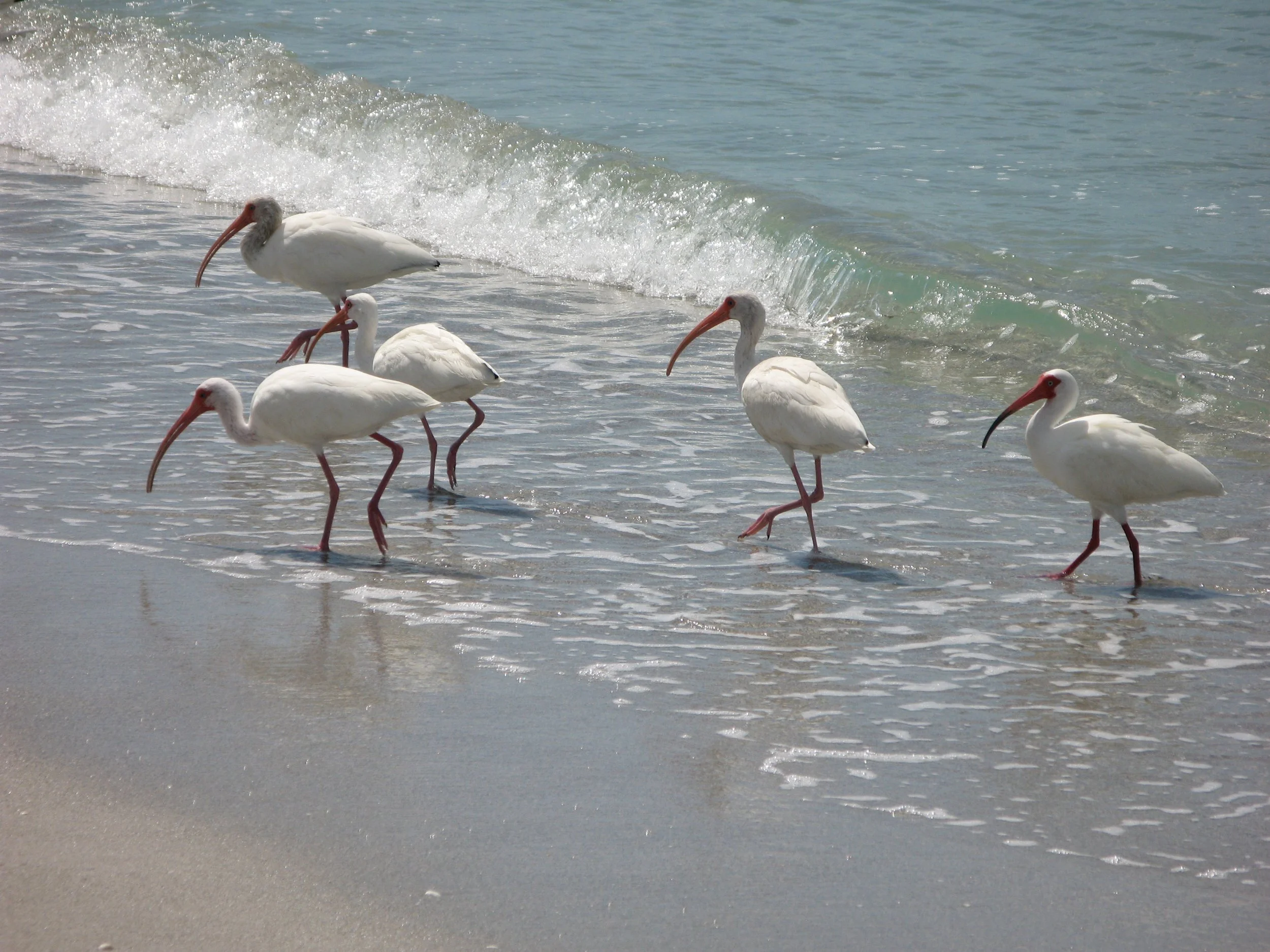
And now it’s winter. The snow and ice have covered the landscape. So, back in your favorite chair by the wood stove, you can think about where you’ve been and pretend you’re back there, enjoying the sunshine. I’m thinking back to 2012, when we followed a little flock of white ibis strolling along a beach near Tampa Bay.
Final Exam
1. True or false: In the 1990s, Cardinals were commonly seen at bird feeders in the North Country.
2. A Jabberwock is:
a. A mythical beast
b. A mixed drink offered to tourists in pubs in England’s Lake District
c. A terrapin
d. None of the above
3. Spell the flower whose name sounds like ACK–IN-NA–SHA.
4. Essay (choose one topic)
a. Explain why you prefer to use your wild apples to make pies or apple sauce.
b. If you were a frog, would you be more scared by the arrival of a snapping turtle, a great blue heron, or
a phenologist pointing a camera at you?
Assignment for the Winter Break
Explain how a cormorant manages to eat a fish that is nearly a foot long.
(No more than five pages; use proper footnotes; identify all on-line sources.)
Participate in the Audubon Society’s Christmas Bird Count by documenting the Birds that you see between December 14 and January 5. For details click here.
Photos and text by Carl D. Martland, founding member of ACT, long-time resident of Sugar Hill, and author of Sugar Hill Days: What’s Happening in the Fields, Wetlands, and Forests of a Small New Hampshire Town on the Western Edge of the White Mountain. Quotations from his book and his journals indicate the dates of and the situations depicted in the photos.