
Phenological Phacts and Photos with Carl Martland / February 2026
Birdseye Views
Phenology – “a branch of science concerned with the relationship between climate and periodic biological phenomena (as the migration of birds or the flowering and fruiting of plants).”
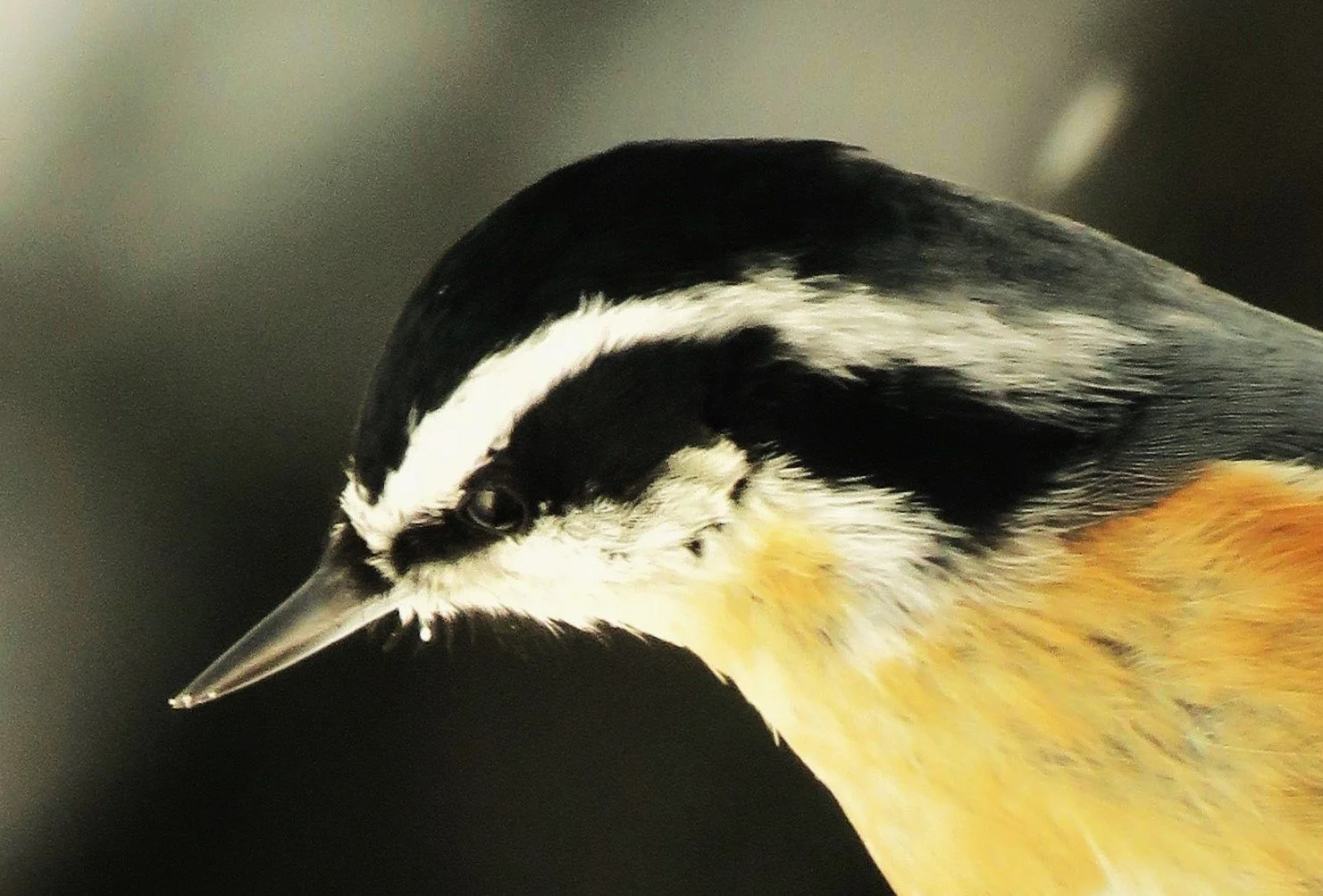
The Eyes Have It
My friend Tony, whom I have frequently mentioned in these essays, is a far more avid birdwatcher than I am. He travels to distant countries to add to his life list. I am happy to get a particularly nice close-up of a red breasted nuthatch. He saves at most one in ten of his 25-megabyte photos, while I save almost everything. His photos, on the average, will naturally be superior to mine, but my photos, well-named and well-organized, provide a more useful data base. However, we both agree that a good photo of a bird must show the eye. And that is why, in this essay, the eyes have it.
In February, the snow is deep, the nights are beyond cold, we stay close to the wood stove, and we’re careful to fill up the bird feeders. These feeders aren’t just for the birds, they’re for us. We have our feeder located about twenty feet from a large window in our kitchen. I sit at the counter, eating breakfast, watching the birds fly back and forth between the feeder and the nearby trees. I continue enjoying the avian activity as I do the dishes, and finally, I lay a fire in the wood stove. My chores completed, I reluctantly head to my office to do something useful, like paying the bills or working on my taxes. But every hour or so, throughout the daylight hours, I take another look at the feeder. Will the juncos finally show up? Will there be robins in the big maple trees? Will a flock of goldfinches be there? Will I have another view of birds’ eyes?
So, that is what this essay is about. The birdseye views that I get through our kitchen window. All of the photos in this essay were taken through that window. I have nothing against those who go on nature tours in Costa Rica, but I’m happy to stay at home, in our kitchen, binoculars and camera next to my cereal bowl, hoping for a surprise – a pair of cardinals, the first brilliant male purple finch of the year, or the first little flock of redpolls in several years. Or the surprise that took place just a half hour ago as I sat down to polish off this essay. What was that? You’ll see.
Chickadees
Chickadees apparently know every location where anyone has ever put out a feeder. When we first put out a feeder in the fall, the chickadees take only an hour or two to notice that the restaurant is open. When we put our feeder out after returning from a long absence, it is always the chickadees who show up first. They then alert their allies, little friendly birds with similar black and white garments, including titmice and nuthatches.
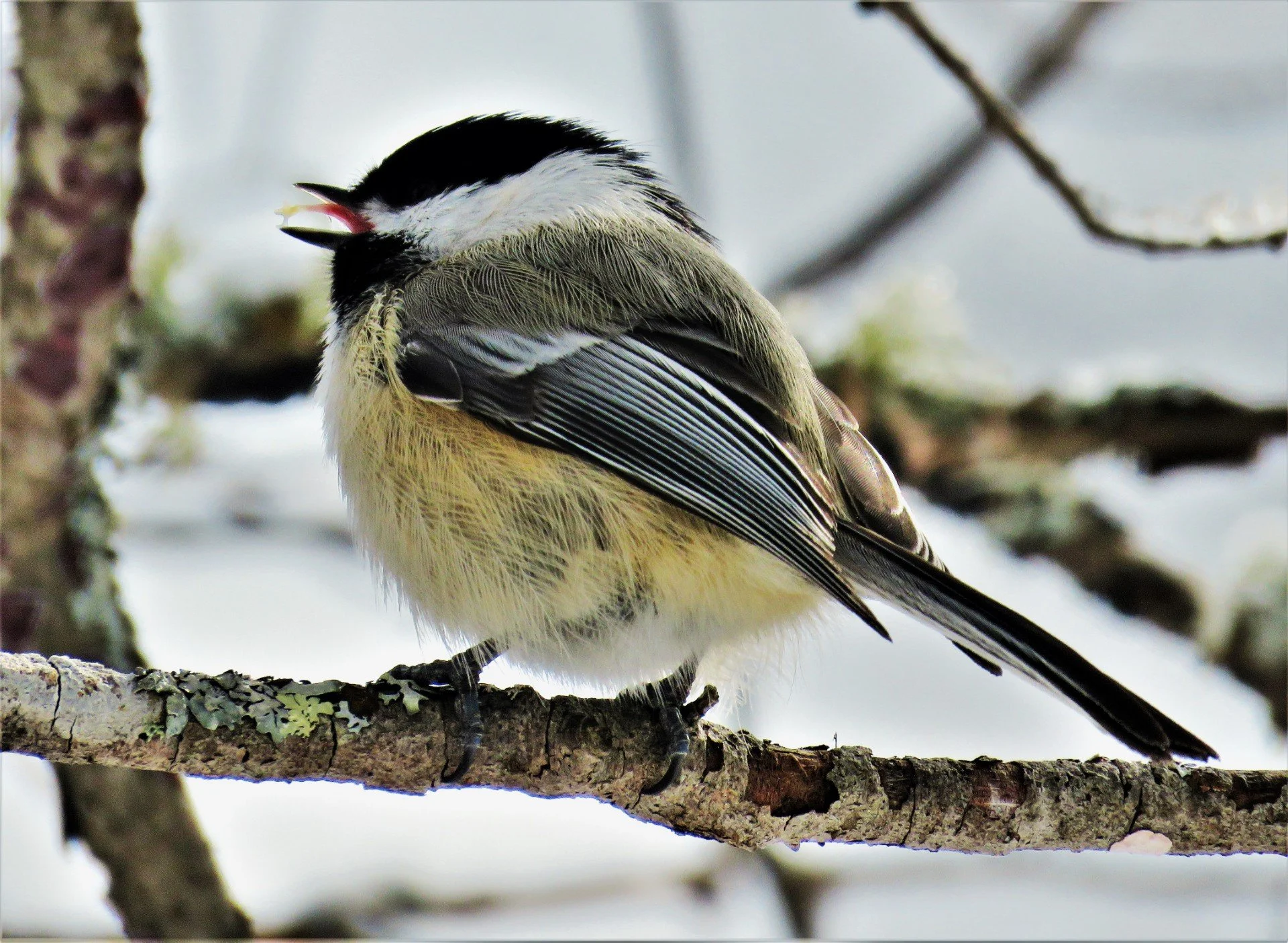
March 13, 2022
A chickadee has a seed in its beak. What’s next? Another seed, or perhaps a bite of suet?
Each bird has its own characteristic approach to the birdfeeder. Redpolls come in flocks, sometimes a dozen or more at a time, and they will all try to crowd onto the feeder, but, since there is too little room, some will forage below. These birds, along with finches, will remain on or below the feeder for a minute or more at a time. Chickadees, like Zorro, get in, make their Z, and get out to the comfort and safety of a nearby tree.
February 5, 2015, 16 degrees, partly cloudy……. Chickadees, whose flocks number only a half dozen, spend only a second or two at the feeder, just enough time to grab a sunflower seed. They then fly away, bouncing, to the cedar by the back door, the big willow, the spruces, or the maples – usually in a different direction than they came from.
Finches
House finches and purple finches are welcome guests at the feeder, because the males in mating season are happy to show off their glorious colors. This year, a half dozen or so female purple finches have been regular visitors, but I have only seen a couple of the males. However, even one glimpse of a brilliant male is an adventure.
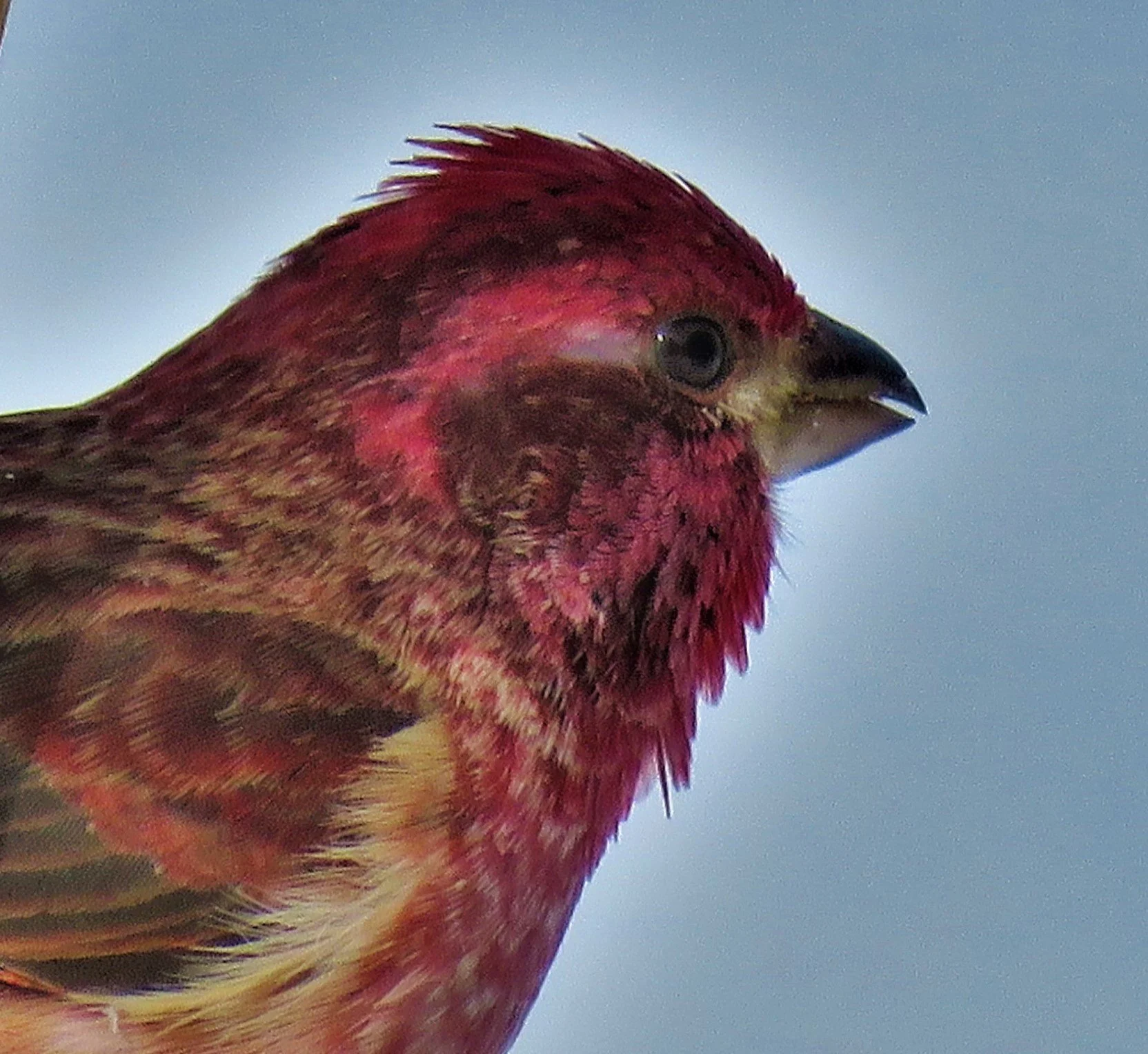
February 5, 2022
Sunny but cold, 15 degrees and windy after another foot of snow fell overnight. Was it a coincidence that the first-time visitors to the feeder included four purple finches, three goldfinches, a nuthatch and a dove!
Goldfinches come to the feeder as the males are just beginning to show the colors that inspired their common name. In February and march, we can see the yellows first becoming visible, then becoming plentiful, and finally becoming triumphant. Even their subtle colors of mid-February are beautiful.
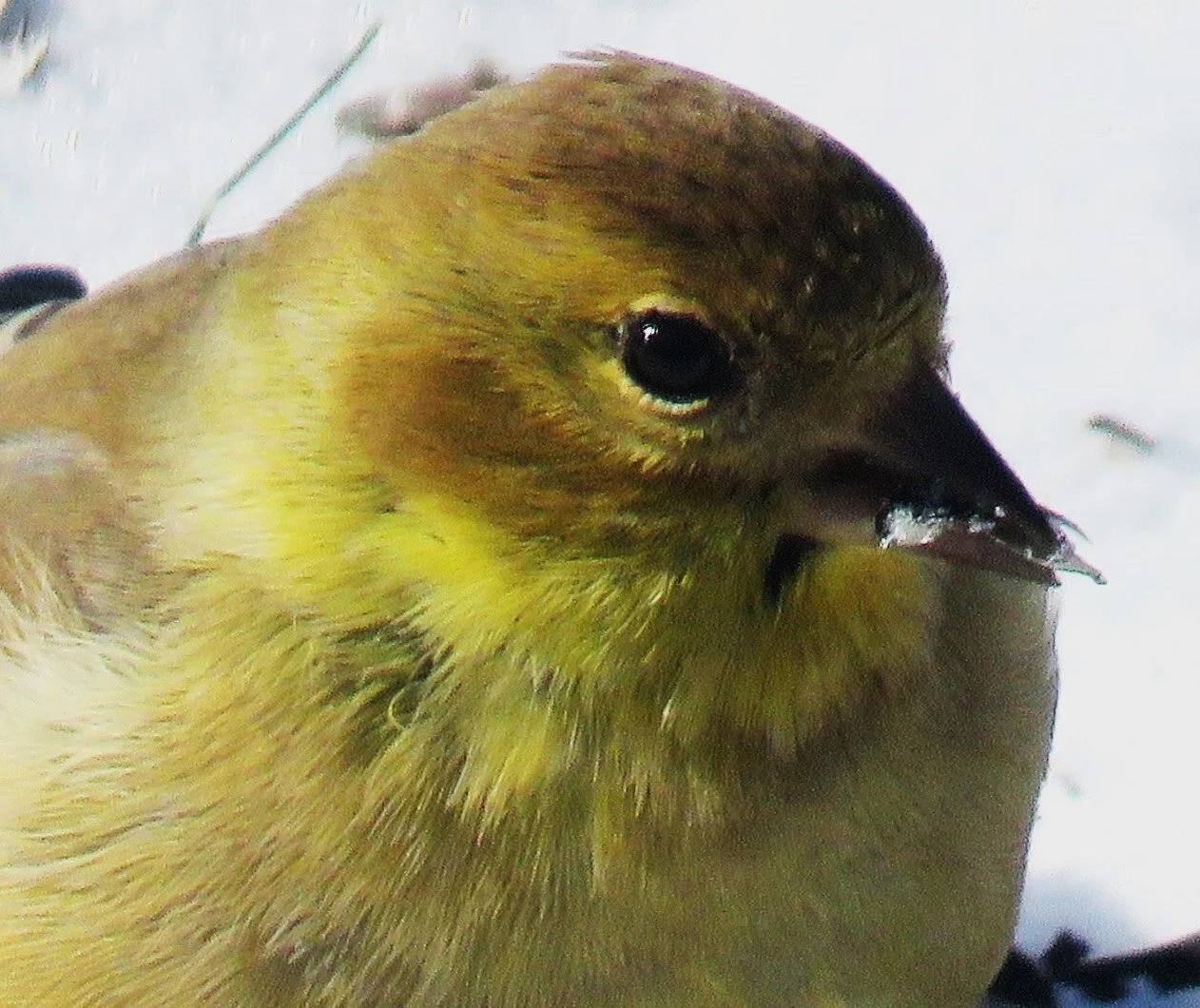
February 14, 2016
A goldfinch is just starting to show its colors.
The day after taking the above photo turned out to be one of the coldest of the past 25 years. The cold did not deter the finches:
February 15, 2016, minus 14 at 9am. The best group of finches we have yet seen gathered today at the feeder. A dozen goldfinches, a dozen purple finches, plus a couple of chickadees and a white-breasted nuthatch. I managed a photo showing 26 birds on and around the feeder. Yesterday was the coldest day of the winter (minus 21 in the morning; high of minus 4), so I wondered if the large assemblage of small birds was related to the cold. But maybe they came here because some of the usual, nearby feeders were empty.
Blue Jays
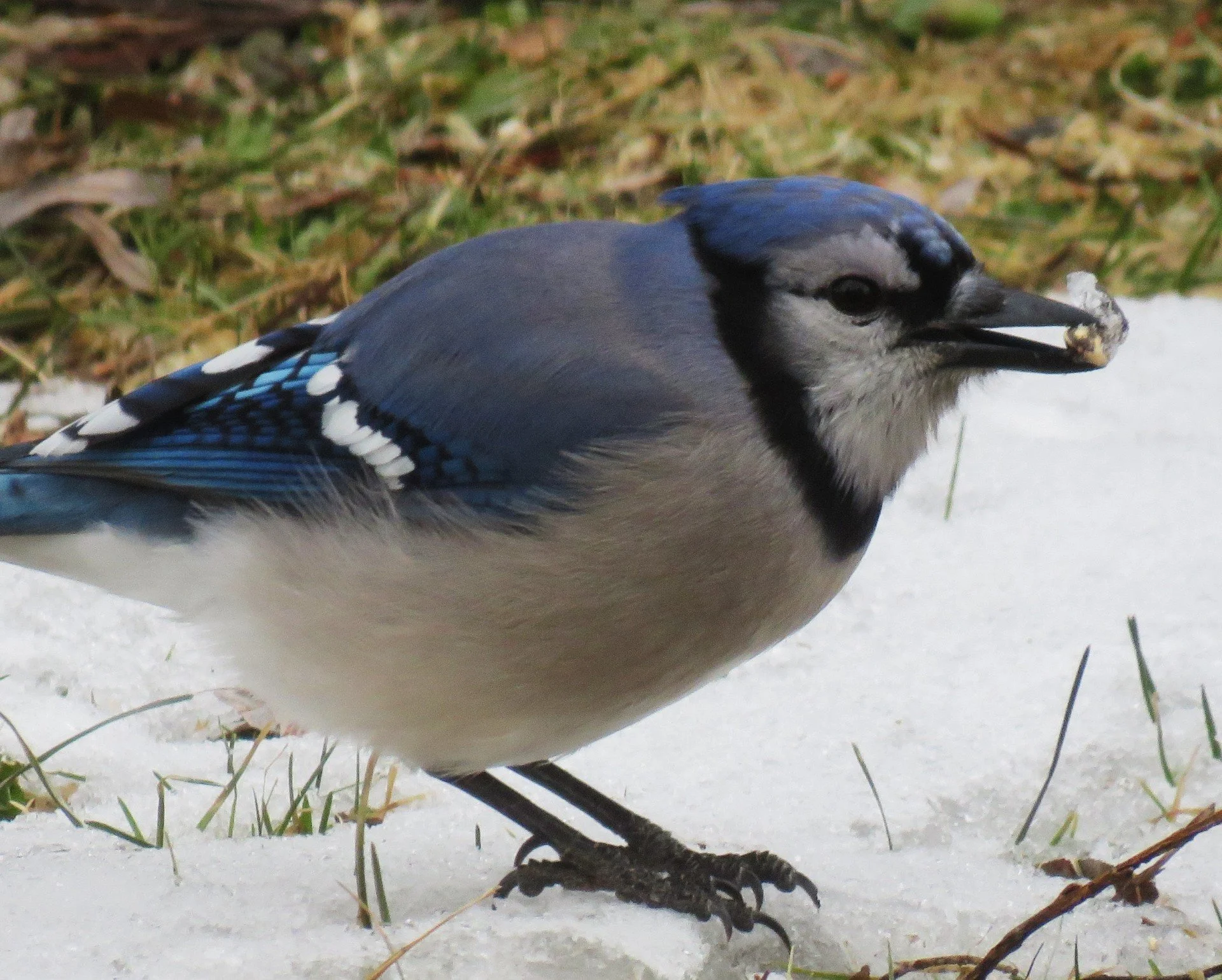
Blue Jays arrive at the feeder early in the morning, and they drop by now and then throughout the day, perhaps alone or with one or two of their pals. Their size tends to scare off the small birds, and they hold their ground when the red squirrels pop up out of their tunnels through the snow.
March 7, 2018
A blue jay has picked up one of the small, spherical seeds that has fallen off the feeder. Blue jays forage under the feeder, because they’re too big to get the food from the feeder without undue contortions.
Nuthatches
White-breasted and red-breasted nuthatches are small woodpeckers that frequent the feeder throughout the winter.
March 30, 2022, 26 degrees, 915am
A pair of red-breasted nuthatches spent about ten minutes of surveying the feeder, flying back and forth between the willow and the spruce, never spending more than a few seconds on each perch. Finally, they dared to land on the feeder – but immediately flew off. By their third or fourth try, they finally accepted the safety or simply couldn’t resist the sunflower seeds.
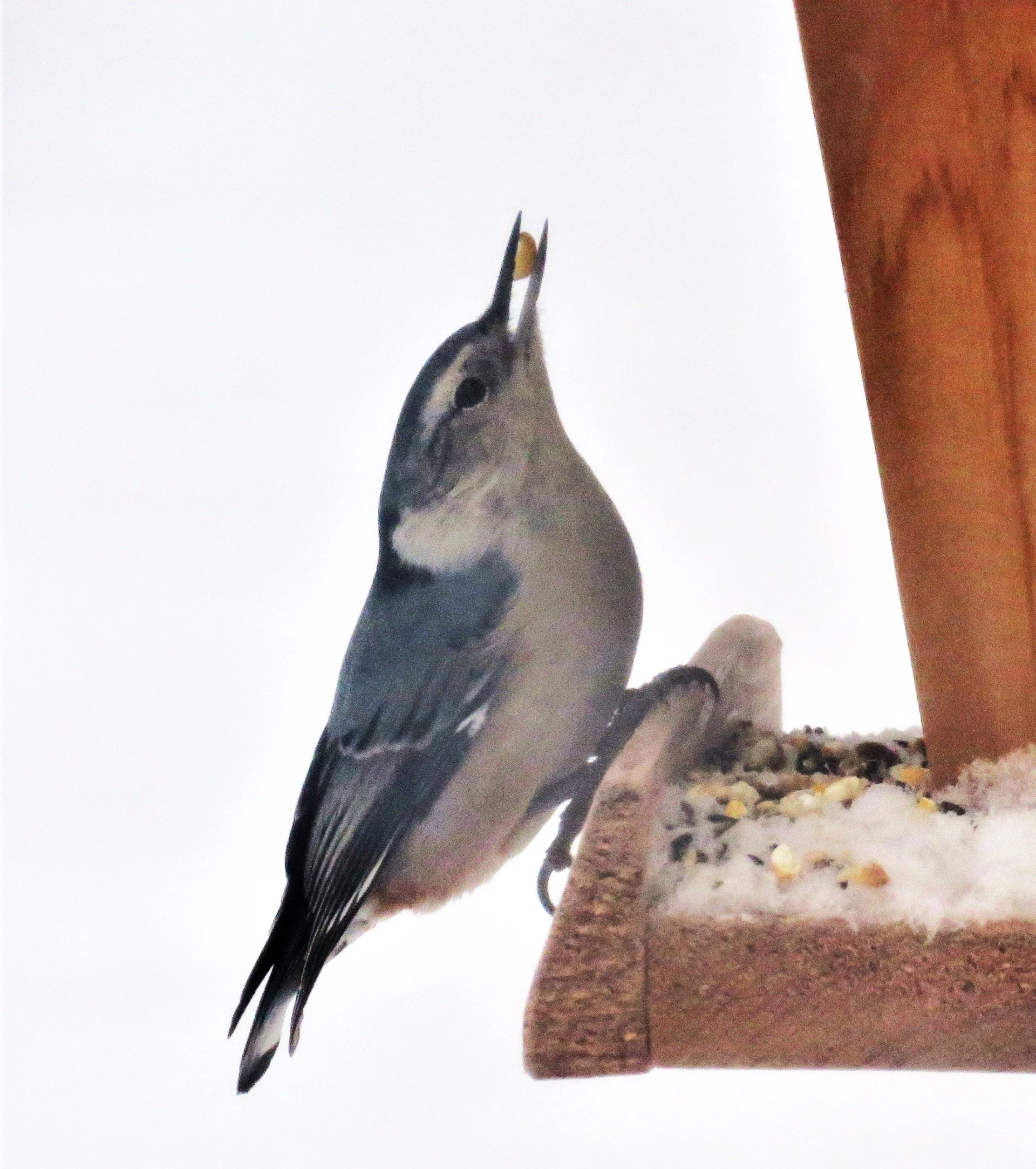
Nuthatches often strike a pose, sometimes with their beak straight up as they take a bite and sometimes seeming to stand on their head as they peck at the suet.
December 8, 2020
A white-breasted nuthatch strikes a typical pose as it eyes its next bite.
Scowling Grosbeak
Three species of grosbeaks can be found in the North Country, albeit not easily. All three have the striking beak that gives them their name. If Jimmy Durante had a favorite songbird, it would likely have been one of the grosbeaks. The rose-breasted grosbeak is aptly named, as I would demonstrate if I had a photo of one at the feeder. However, when I searched my journals, dating back over a quarter century, I found only four references to these colorful birds, all of them in the summer.
June 25, 2000 (hot, hazy and humid, 86 degrees, rain in late afternoon)
I spent an hour and a half birdwatching. The best sighting was a very vocal rose-breasted grosbeak. He warbled from the top of a larch, then was flying around tree tops in the inner meadow. Extremely melodious singer.
The pine grosbeak is even rarer. A half-dozen that visited our feeder in early March back in 2023 are the only ones I have seen. Mr. Sibley’s guidebook indicates that small flocks are often seen in more northern fir and spruce forests. Perhaps the bird was named long ago by someone unsure about the different kinds of evergreens.
That leaves the Evening Grosbeak as the one we are most likely to encounter. Don’t be misled by their name, as they are most apt to be at the feeder before noon. My PPP for February 2022, which was all about grosbeaks, noted that I had seen these birds once or twice a year in the early 2000s, but had only had a few views in the subsequent ten years. I had recently seen a small flock at our feeder, so I held out hope for the future. However, over the next three years, only two small flocks stopped by for short visits, one for a week in early April in 2023 and another for a few days last winter.
This year, we were happy to see a few evening grosbeaks soon after we put out feeders in mid-January. Since then, they have been here every day since, often in groups of a dozen or more.
February 14, 2026. Backyard Winter Bird Watch begins! And the grosbeaks were the first birds at the feeder. Last night, in the draft of my PPP, I wrote that I had seen “as many as 21 at a time.” Today, to my great surprise and pleasure, forty of them gathered in the top of the big maple at the corner of Post Road and Pearl Lake Road.
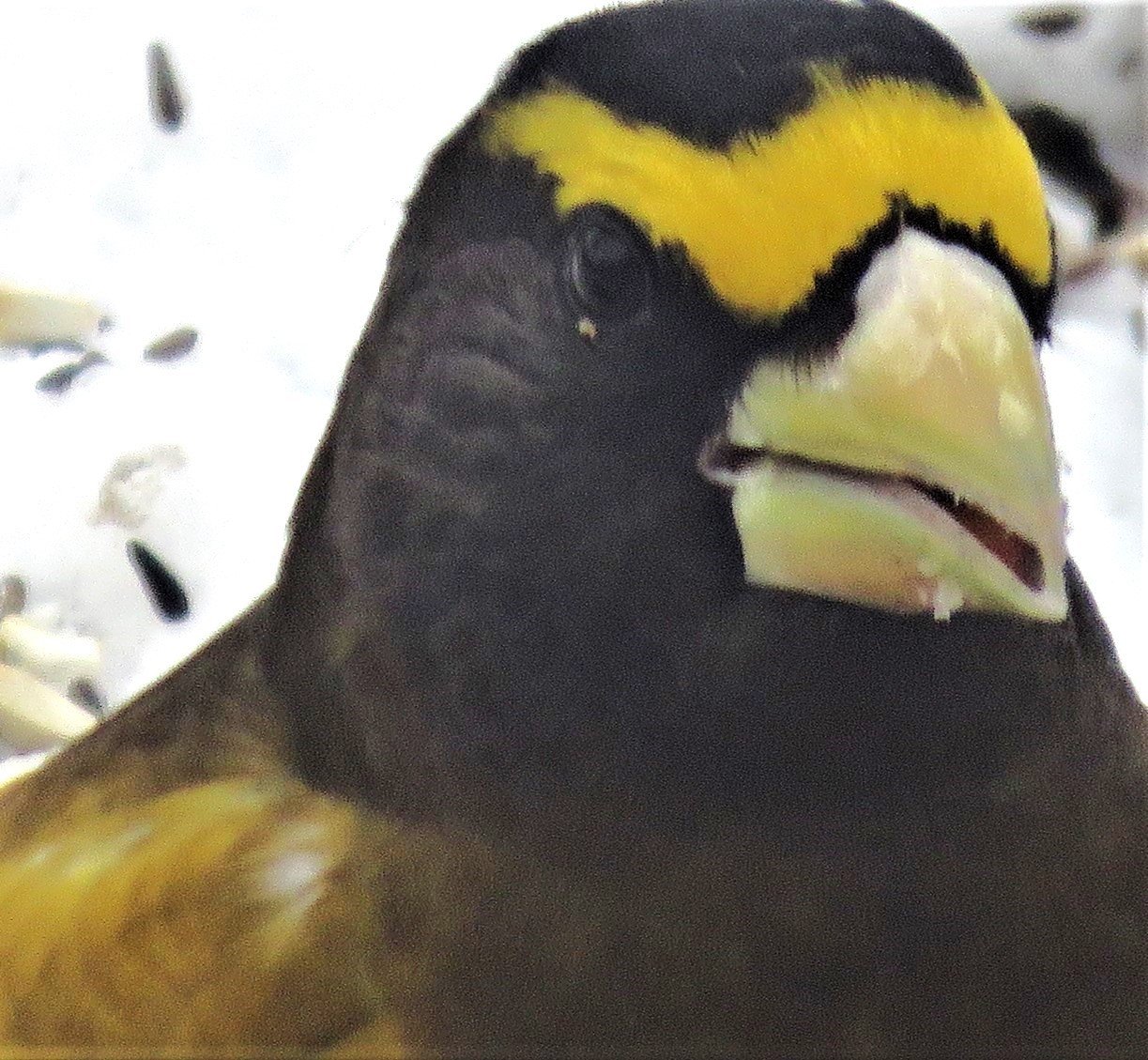
So now I have many photos and videos of these large, colorful birds. However, I have chosen a photo from 2020 for this essay. Admittedly, grosbeaks are dominated by their beak, but, as is evident in this photo, this bird has an attitude equally worthy of notice. One could say that this character has a wry smile, but I think its expression suggests a better handle for a mis-named bird that I have only seen in the morning or early afternoon. I think this could be the defining photo of what could be called the “Scowling Grosbeak.”
December 16, 2020
“Who you looking at?”
Eyes on the Ground
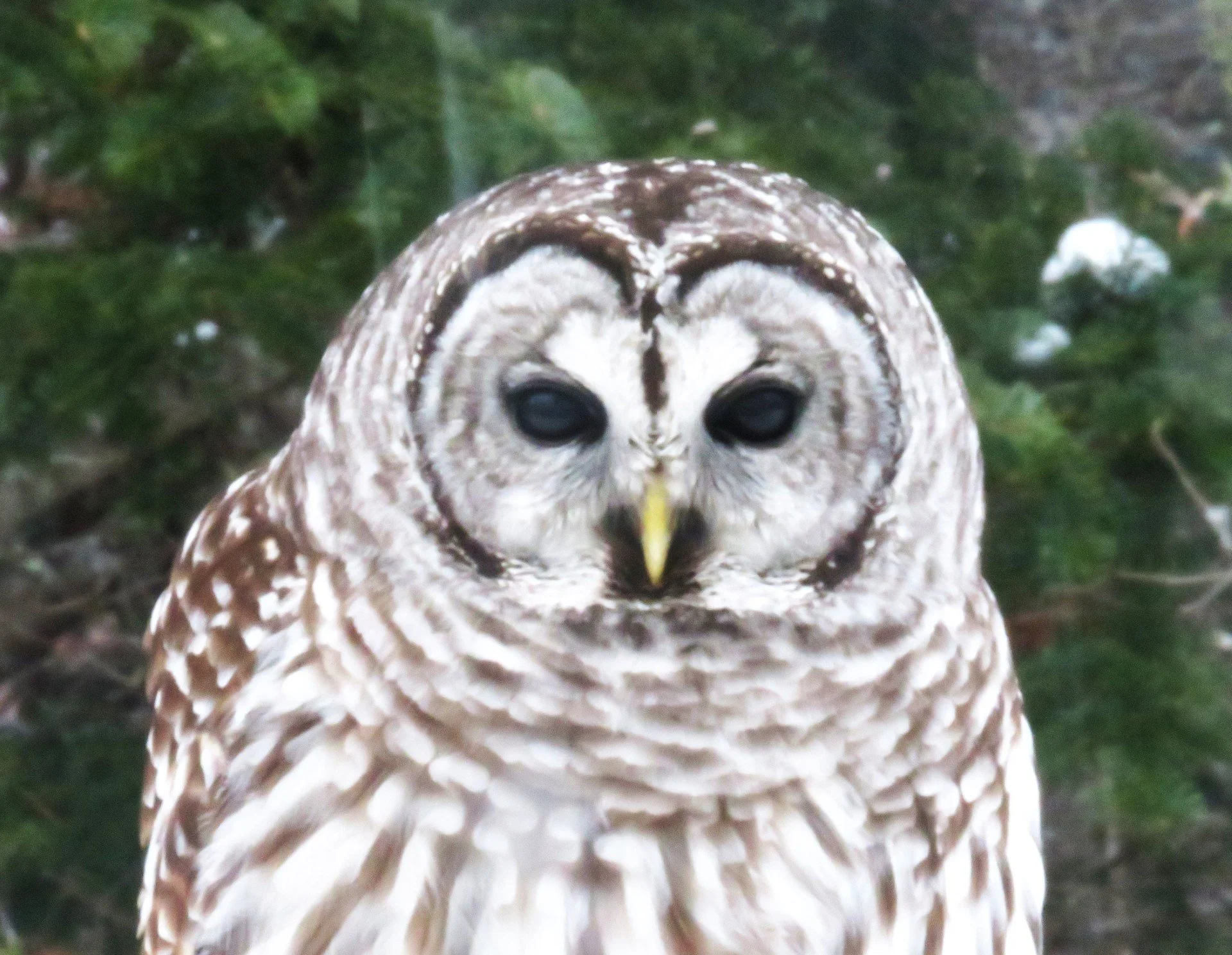
I try to end each essay with a memorable photo and a clever remark. With my new name of Scowling Grosbeak backed up by what is certainly a memorable photo, I figured my work was done. All that remained was to get a cup of hot tea, enjoy a mid-afternoon snack, and head to my office for a final review of my draft. I took a quick look out the window when I walked into the kitchen, but as usual in late afternoon, no birds were at the feeder. I filled the kettle, waited for the water to boil, prepared a snack, and, when I turned back toward the window, was astonished to see a huge barred owl sitting atop the pole holding up the feeder! I shouted the news to Nancy, grabbed my camera, and rushed to get a photo.
It turns out that I needn’t have rushed. The owl just sat there, slowly turning its head far to the right, then far to the left, sometimes with its eyes on me and sometimes with its eyes on the ground hoping to see the red squirrel emerge from one of its tunnels. After taking plenty of photos and videos and drinking my tea, I went to my office to work on this essay. I took a peek out the window every few minutes to find that the owl, like Poe’s raven, was still there. To paraphrase Poe’s famous finish to The Raven:
And the owl never flitting, still is sitting, still is sitting,
on the blackened steel pole, just beyond our kitchen door.
And his eyes have all the seeming of a demon’s that is dreaming,
And the sunlight o’er him streaming, throws his shadow ever more.
Photos and text by Carl D. Martland, founding member of ACT, long-time resident of Sugar Hill, and author of Sugar Hill Days: What’s Happening in the Fields, Wetlands, and Forests of a Small New Hampshire Town on the Western Edge of the White Mountain. Quotations from his book and his journals indicate the dates of and the situations depicted in the photos.