
Phenological Phacts and Photos: Mosaic Darters by Carl D. Martland
Phenology – “a branch of science concerned with the relationship between climate and periodic biological phenomena (such as the migration of birds or the flowering and fruiting of plants)”
Mosaic Darners
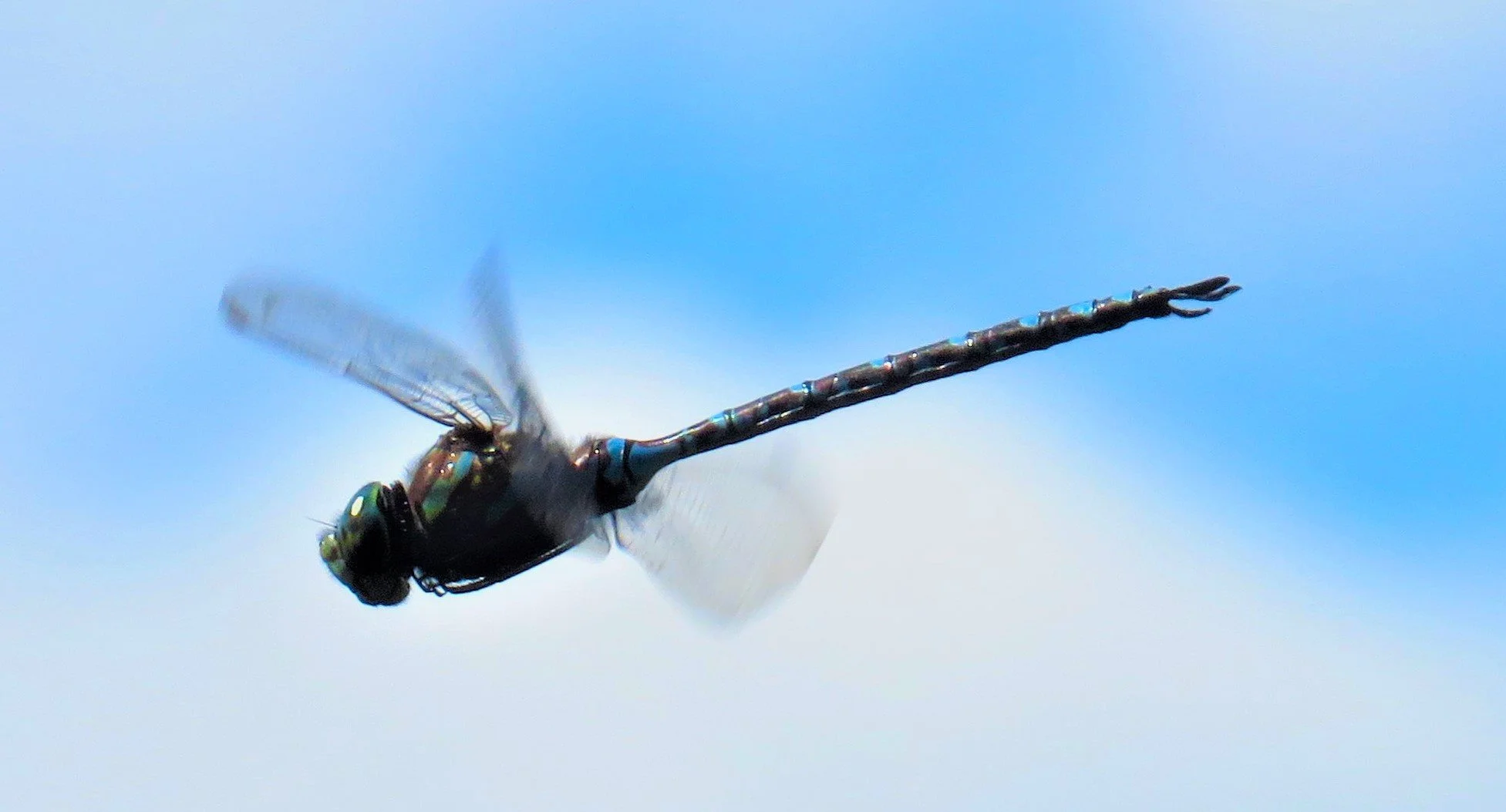
If you spend a few minutes by a pond on a sunny day in late summer or early fall, you are very likely to see some large, blueish dragonflies. Some will be patrolling back and forth along what they view as their personal portion of the shoreline. Others may be seen hovering above an opening in the cattails, such as the one in the above photo. Still others may be seen hanging from vegetation a little inland from the pond. If one of them stays still for long enough, you will see an intricate pattern of blue patches along its dark abdomen, which is the defining feature of the family of dragonflies commonly known as mosaic darners. These darners, which are nearly three inches long, fly not only during the afternoon, but often right up until dusk. From time to time, dozens gather in swarms as they hunt small insects over the shore or nearby meadows.
Identifying Mosaic Darners
Of the 17 species of mosaic darners in North America, eight can be found in the North Country. While it is easy to identify any of these large dragonflies as mosaic darners, it is difficult to determine the species. The key diagnostic characteristics concern the shape of the thoracic stripes, which are nearly impossible to see the when the darner is flying and difficult to capture in a photo even when they are at rest. And the males seldom rest.
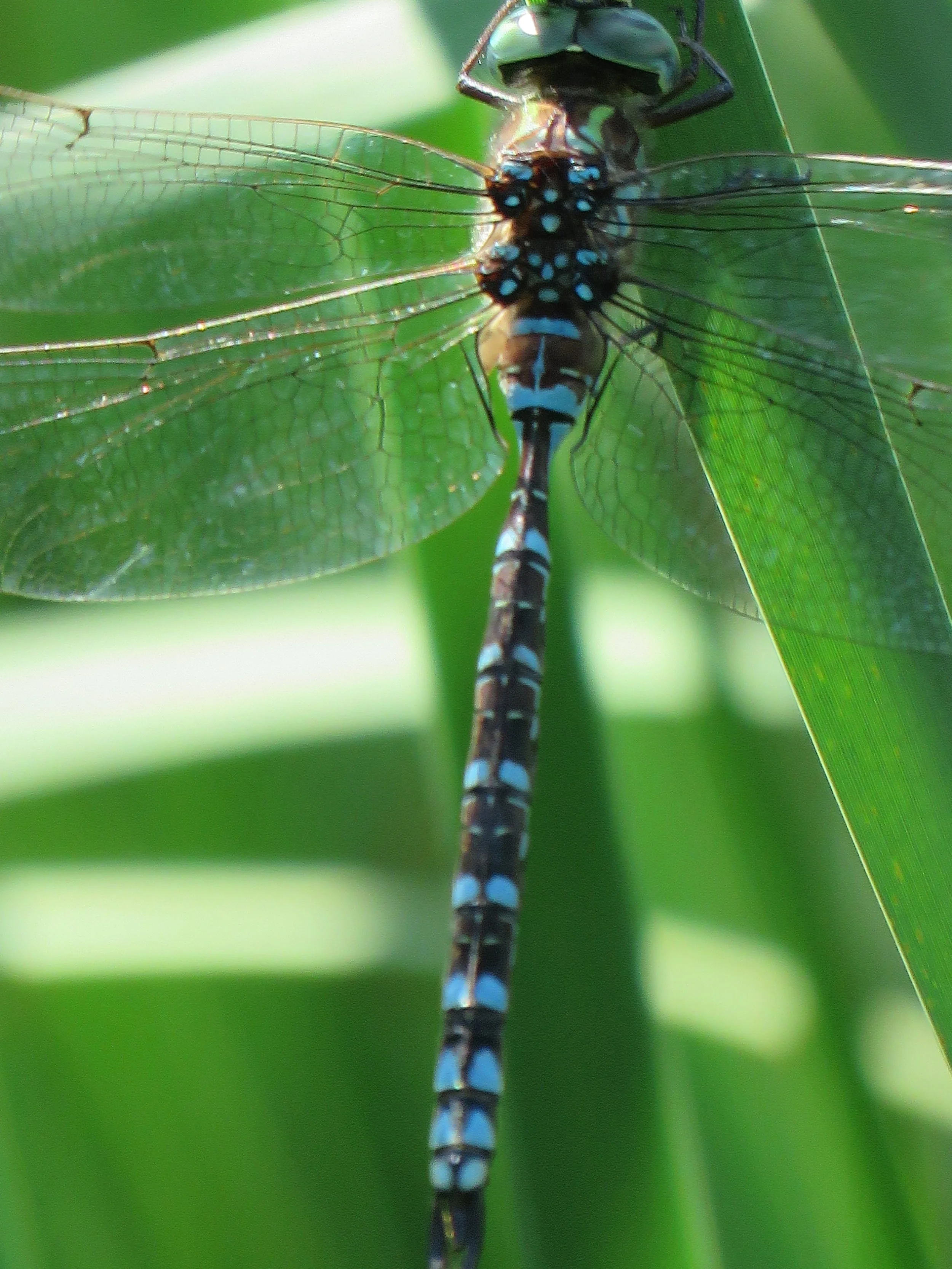
July 7, 2019. A mosaic darner hanging from a cattail at the edge of our pond. This photo, which clearly shows the characteristic mosaic pattern that distinguishes this group of dragonflies, is not enough to determine the species. The shape of the stripes or dots along the side of its thorax must also be seen.
Four species of mosaic darners can be seen on a regular basis around our pond and the nearby meadows. The largest and most aggressive of these regulars are the black-tipped darners, who fly in and out of the cattails at the edge of the pond. Females commonly land on stalks of the cattail leaves, scratch for a while, and then descend slowly into the water to lay their eggs. Variable darners fly around the pond, but are less apt to penetrate much beyond the perimeter of the cattail patches. They may sometimes be seen hanging from trees or high-bush blueberries in wheels. Canada darners are willing to pose on the large rocks at the Point, on birch trees at the pond edge, and especially on the sunny side of the nearby screen house. Lake Darners prefer larger bodies of water, but a few show up by our pond every now and then.
To distinguish among these species, it is necessary to have a good photo that shows the diagnostic features of their thoracic markings. Black-tipped darners have wide, straight stripes. Variable darners usually have very thin stripes, but there is a spotted variety whose stripes have each split into two dots. The Canada darner has both a sharp indentation and a wing on its anterior stripe. The Lake darner has a circular indentation on its anterior stripe.
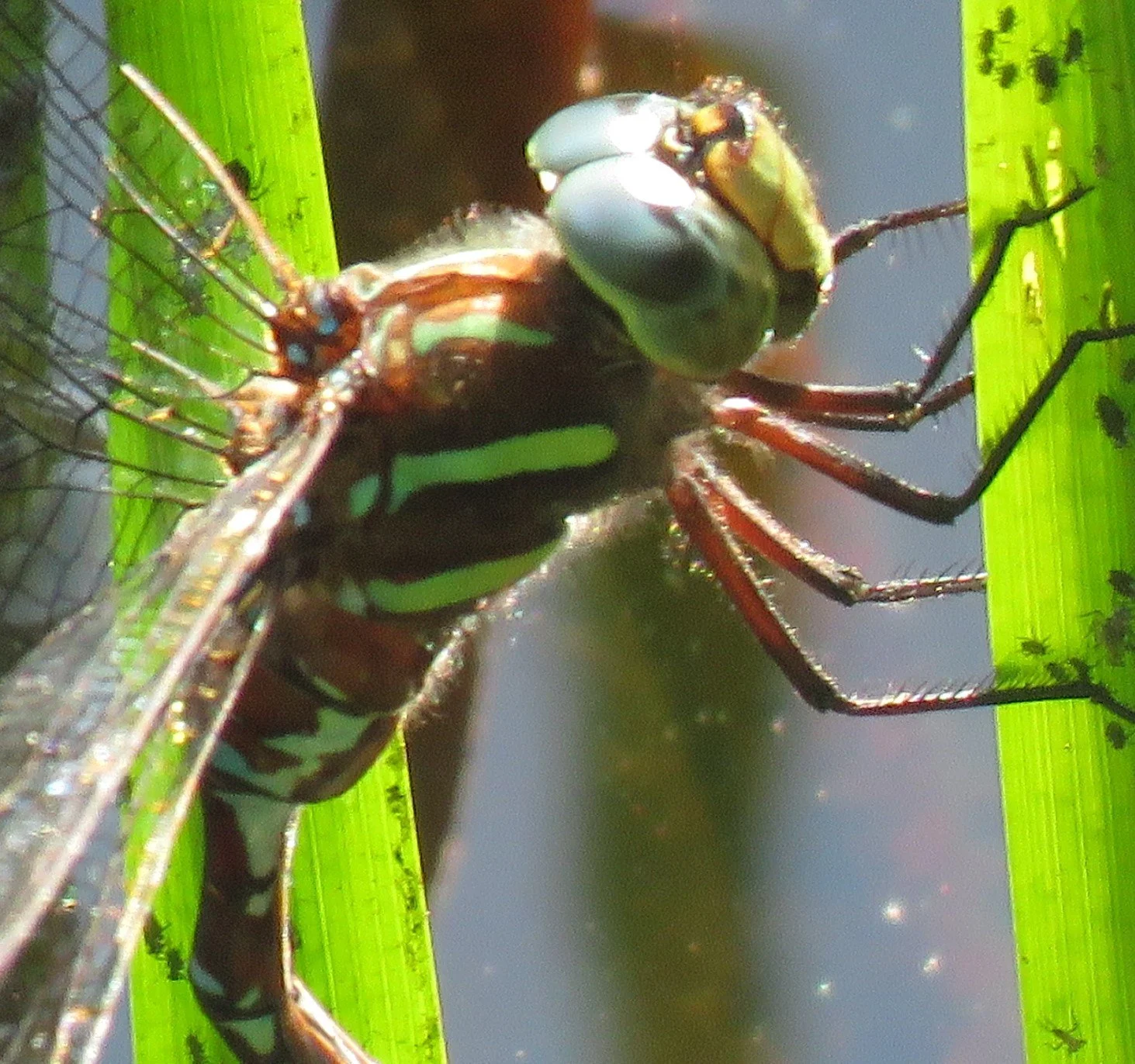
Black tipped female, Aeshna tuberculifora.Wide straight thoracic stripes.(August 30, 2017).
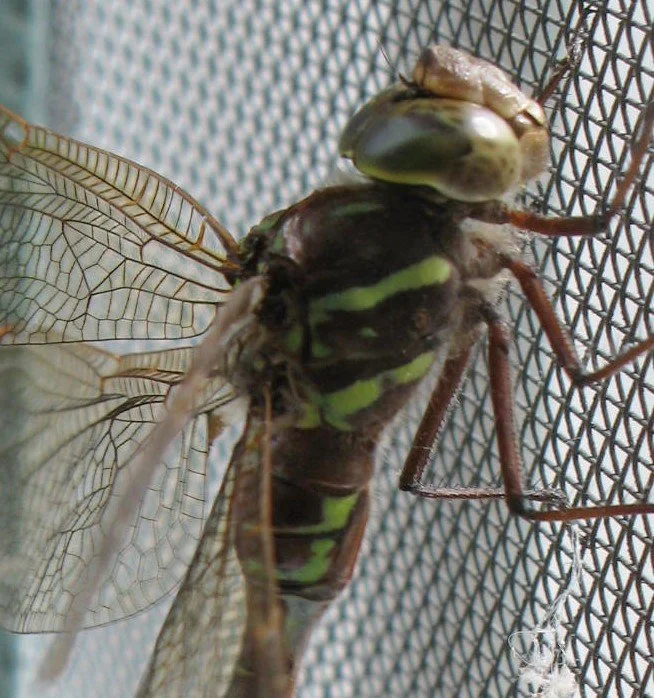
Variable Darner, female, Aeshna interrupta. Thin, straight thoracic stripes. (August 30, 2008).
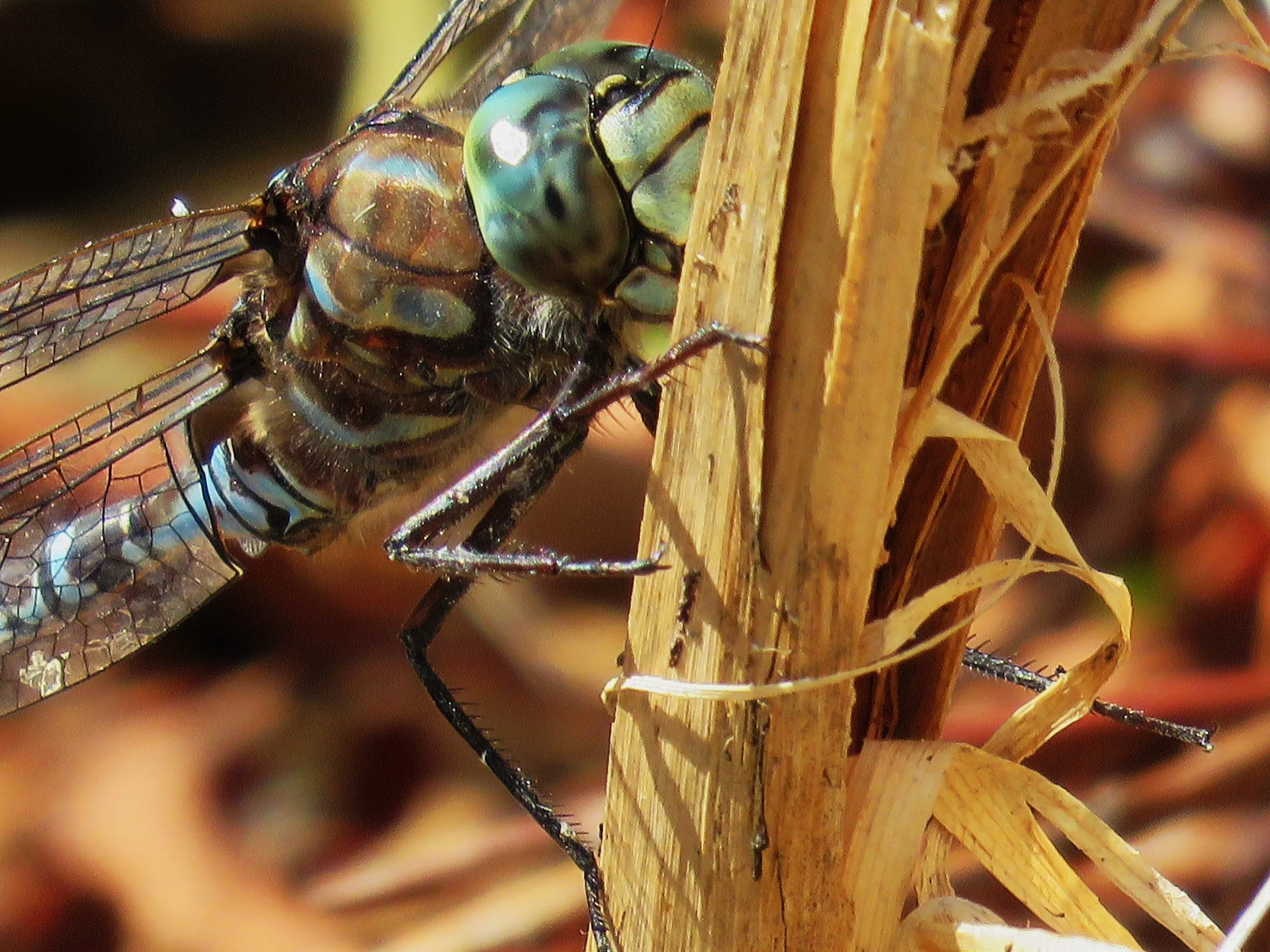
Lake Darner, Aeshna eremita. Circular notched anterior stripe, no “wing”. (October 4, 2017).
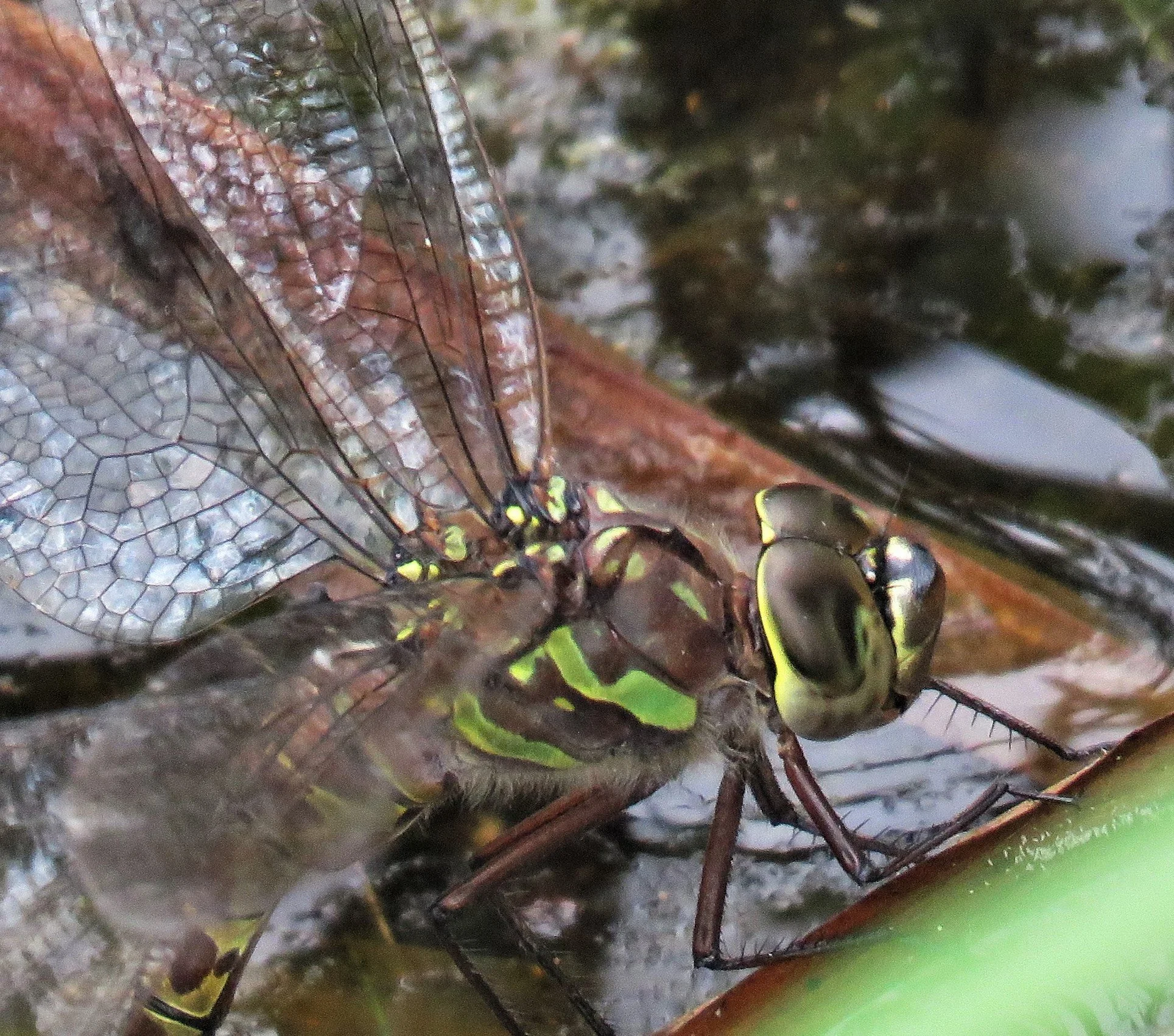
Canada Darner, Aeshna Canadensis. Notched anterior stripe with “wing” on top. (September 19, 2005).
Variable Darners
Prior to 2015, variable darners were one of the most common dragonflies by the pond. They were large, colorful, active, and willing to pose for a photo.
August 23-24, 2011. A couple of young variable darner would perch the railing of the screen house for a minute or more, fly out over the Upper Meadow, return and perch for another minute before flying off again. … The next day, a half dozen were active by the pond, fighting for territory by the shore amidst the reeds, sometimes searching low among the reeds, squabbling whenever encountering another male.
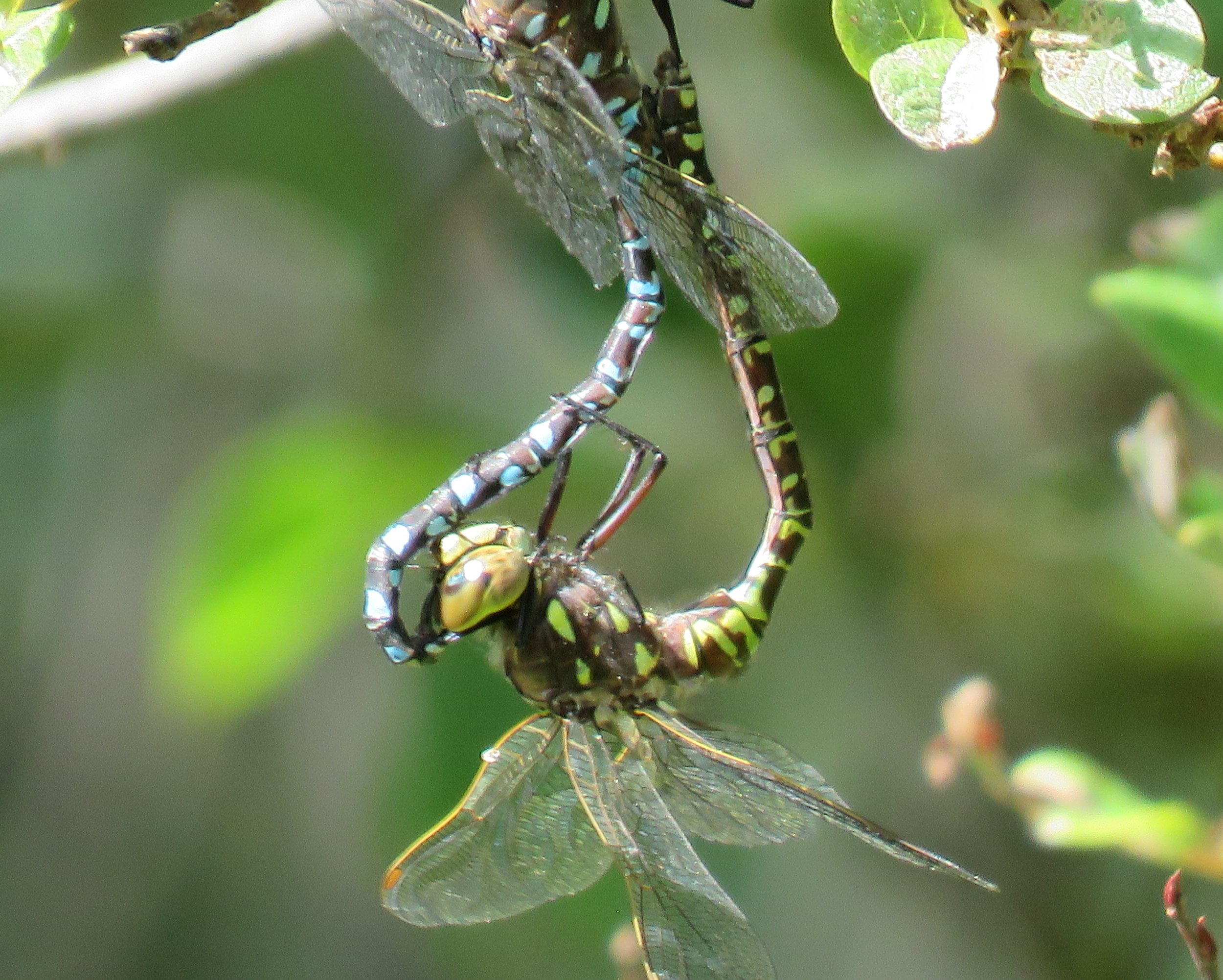
September 11, 2019. A pair of the spotted variety of variable darners formed a wheel, suspending themselves from an apple tree.. These dragonflies have four lateral spots rather than the two straight stripes of the other variety of variable darners.
Black-Tipped Darners
For a long time, I thought that all of the large darners with distinctive blue abdominal markings were variable darners. However, after noticing subtle differences in both size and behavior, I realized that variable darners were not the only mosaic darners in town.
August 19, 2015. Based upon recent observations, I suspect that there may actually be two kinds of similar darners, the variable darner that has been active at the pond for years and one that I have just realized is not quite the same. The new one has the same general appearance, but it is slightly larger and sports a brighter blue coloring that, from the side, looks blacker. This is the dragonfly that “scratches” the side of the reed leaves, leaving little tufts. I don’t know if it is creating a space to lay eggs, fixing a meal, or something more exotic. This darner flies low in and out of the reeds, then will fly very fast across the coves. The variable darner patrols an area close to the reeds, but is less apt to fly in and among them.
When I checked my guidebook (Dragonflies by Binoculars by Sidney W. Dunkle), I found that the new darner was the black-tipped darner, which is slightly larger than the variable darner and likes ponds with cattails. The female not only looks like the male, but behaves like the male, flying low in and out of the cattails. The clincher was that the female lays its eggs in green vegetation below and above the waterline, “even on cattails” – and the picture of the female laying eggs on a cattail is exactly what I had seen and photographed a year or two earlier. Over the years, as the number and size of cattails have increased around our pond, the black-tipped darners have become much more numerous than the variable darners.
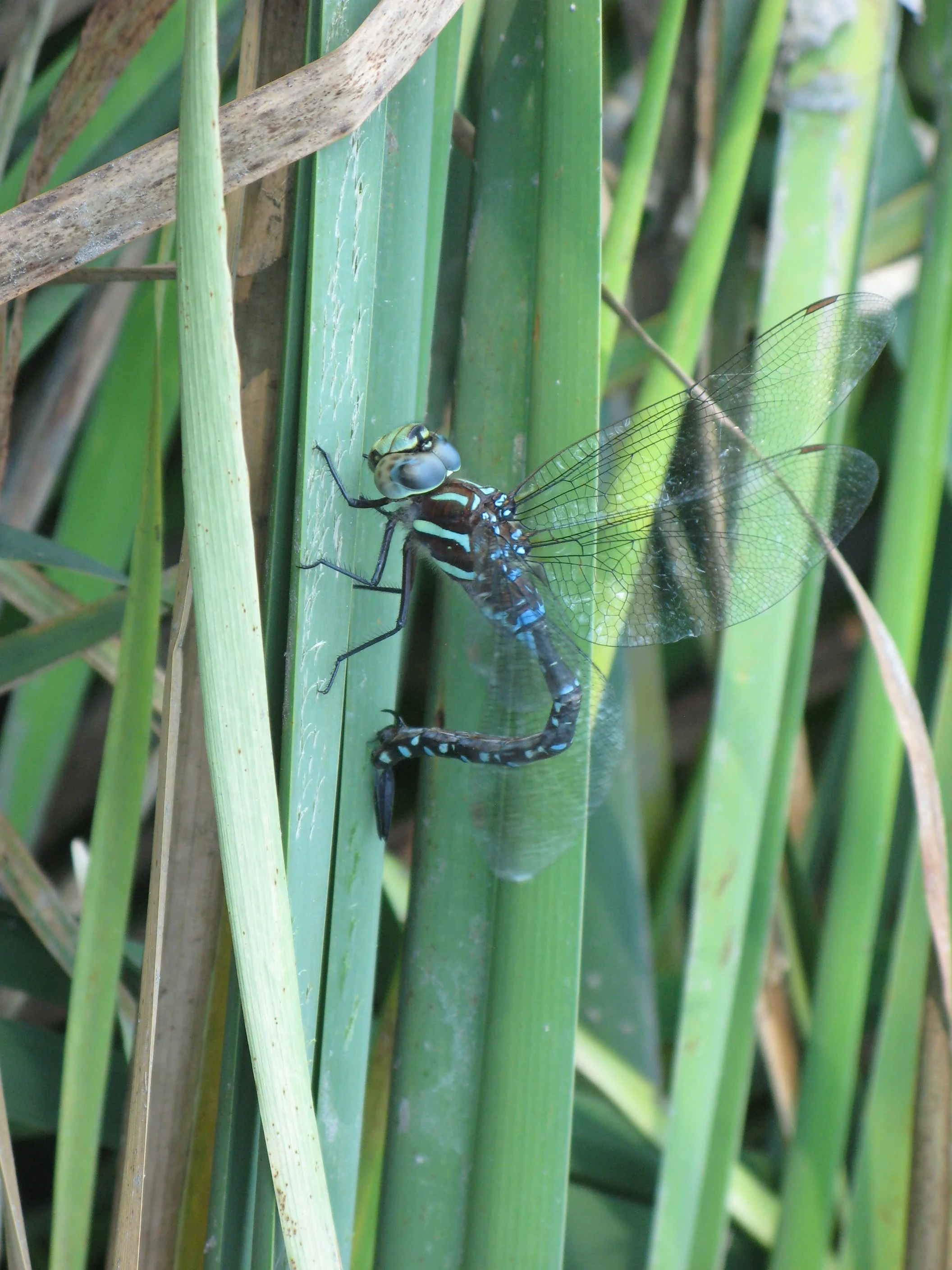
August 23, 2012. This was my first photo of a what I thought was a variable darner scratching on cattails at our end of the pond. It wasn’t until three years later that I realized that this is the characteristic behavior of female black-tipped darners.
Once I had recognized the large size and behavior of black-tipped darners, they were easy to identify. Since the females are neither attacked by other dragonflies nor bothered by their mates, they can take their time scratching on cattail leaves before dropping down to lay their eggs an inch or so below the surface of the pond. The only difficulty in getting a photo was finding an angle with a clear shot through the cattails.
Canada Darners
Once I realized that variable and black-tipped darners are members of the large family of dragonflies commonly called mosaic darners, I begin to wonder if the mosaic darner that commonly lands on our screen house might be something other than a weary variable darner. To find out, I needed to peek around the corner of the screen house to get a view where the dragonfly’s wings didn’t block my view of its thorax. Eventually I was rewarded with photos such as that shown below. Sure enough, the crooked thoracic stripes indicated that this was a Canada Darner. When I examined my earlier photographs of dragonflies, I discovered that the Canada darner is the one that hovers in openings amidst the cattails.
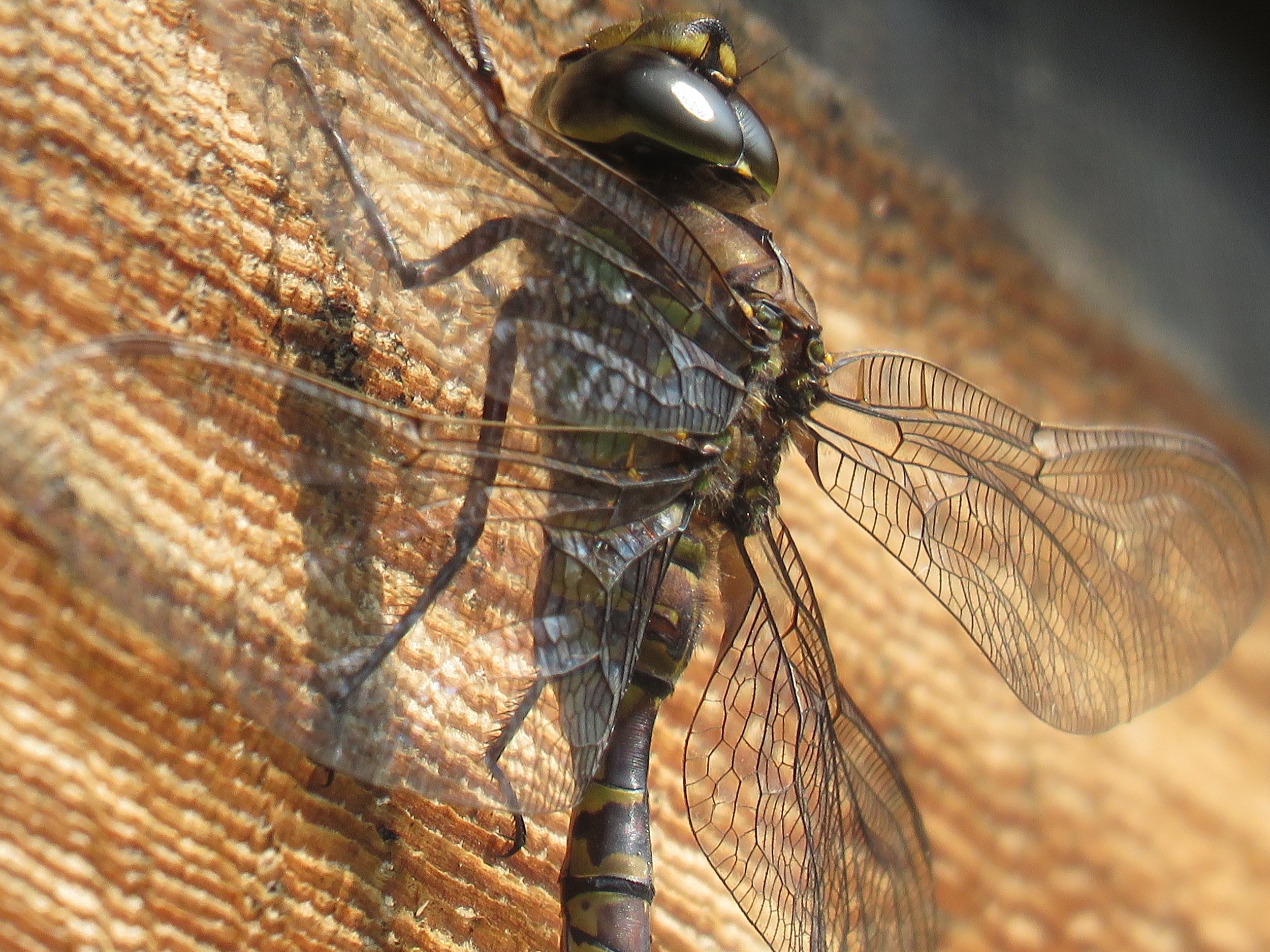
September 10, 2017. The winged thoracic stripe that is barely visible through this dragonflies wings proves that this is a Canada Darner.
When mosaic darners show up by the pond in mid-July, they have to fight for territory with the larger green darners that have been around for months as well as the smaller, but more aggressive newly-arrived slaty skimmers.
July 9, 2010 88 degrees, not humid, white clouds on deep blue sky. The first variable darner of the year was faster and more purposeful than the green darners.
August 5, 2016. A 12-spotted skimmer and two slaty skimmers defended their territories from perches on dead cattail stalks, frequently going out and driving off any variable or black-tipped darners that attempted to trespass.
Although male mosaic darners may be active until dusk, they seldom land, so it is noteworthy when a photo op does arise.
August 2, 2018, 88 degrees, HHH, windy. … finally, at 415pm, a mosaic darner landed; only the second time this year that I’ve had a photo op. … From the photo, I was able to identify it as a black-tipped darner.
By mid-August, the females are hanging out by the pond, often landing on the cattails.
August 12, 2016, 88 degrees; hot, hazy, and humid; partly cloudy. A black-tipped darner twice landed on a cattail leaf near our end of the pond and began scratching the leaf, once for 50 seconds and the second time for 100 seconds. During this time, none of the other darners – which may all have been variable darners – bothered her.
Meanwhile, the males continue their patrolling, back and forth across the pond, in and out of the reeds. Once in a while one will run into trouble, sometimes managing to escape, and sometimes failing.
August 19, 2018, 2-330pm. A mosaic darner struggled fiercely to escape the surface tension. It would beat its wings, raise and then slap down its abdomen, and then rest for up to minute. Then try again, and again, and again. It finally escaped after struggling more than 15 minutes, during which time only one other darner bothered to investigate, and none tried to help.
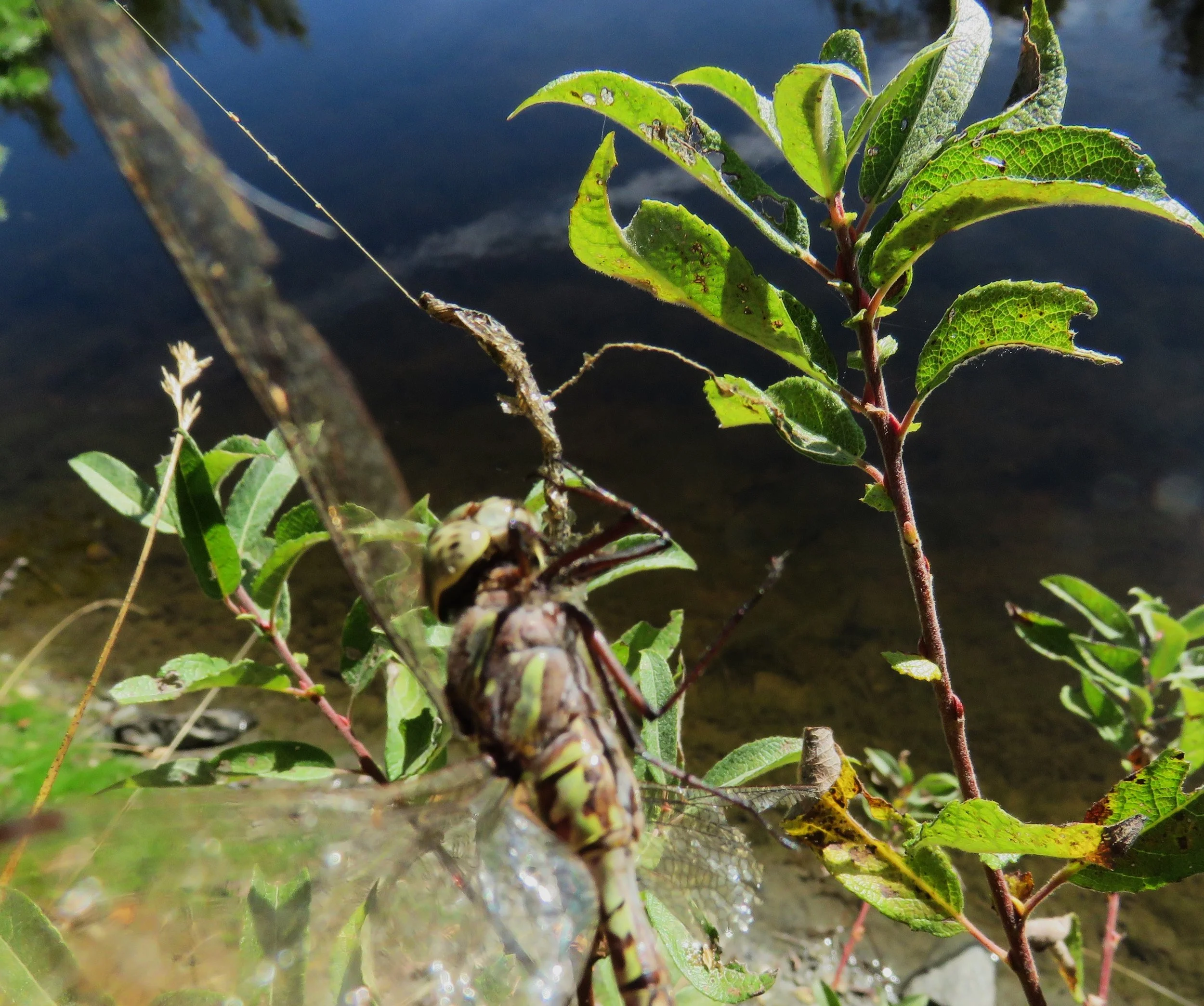
September 12, 2020. Spiders spin their webs across spaces left in the brush next to the pond, hoping to catch one of the flies and small dragonflies that cruise along the shore. This spider captured bigger game – a three-inch mosaic darner.
Late in August, females will often be seen pairing up with mates or laying eggs. Variable darner females have a tough time getting a few seconds alone to lay some eggs:
August 31, 2011, 10am, 75 degrees, mostly cloudy. The variable darners were very active at our end of the pond. Two pairs flew by, flying united in a wheel. Two single females sped through the openings and tried to lay a few eggs. They flew at high speed, in a straight line low over the water, splashing down to lay an egg every 10 to 20 feet.
Female black-tipped darners generally have no such trouble. Instead of rushing across the pond with males ever ready to pounce, the black-tipped female takes her own sweet time in going about her business. She looks for a suitable cattail near the shore, grabs ahold, and then drops slowly down until her abdomen dips into the water:
August 22, 2017, 72 degrees, breezy, beautiful. … Three black-tipped darner females on cattails, descending into the water in three locations, just in from the edge of the pond; they don’t stay long.
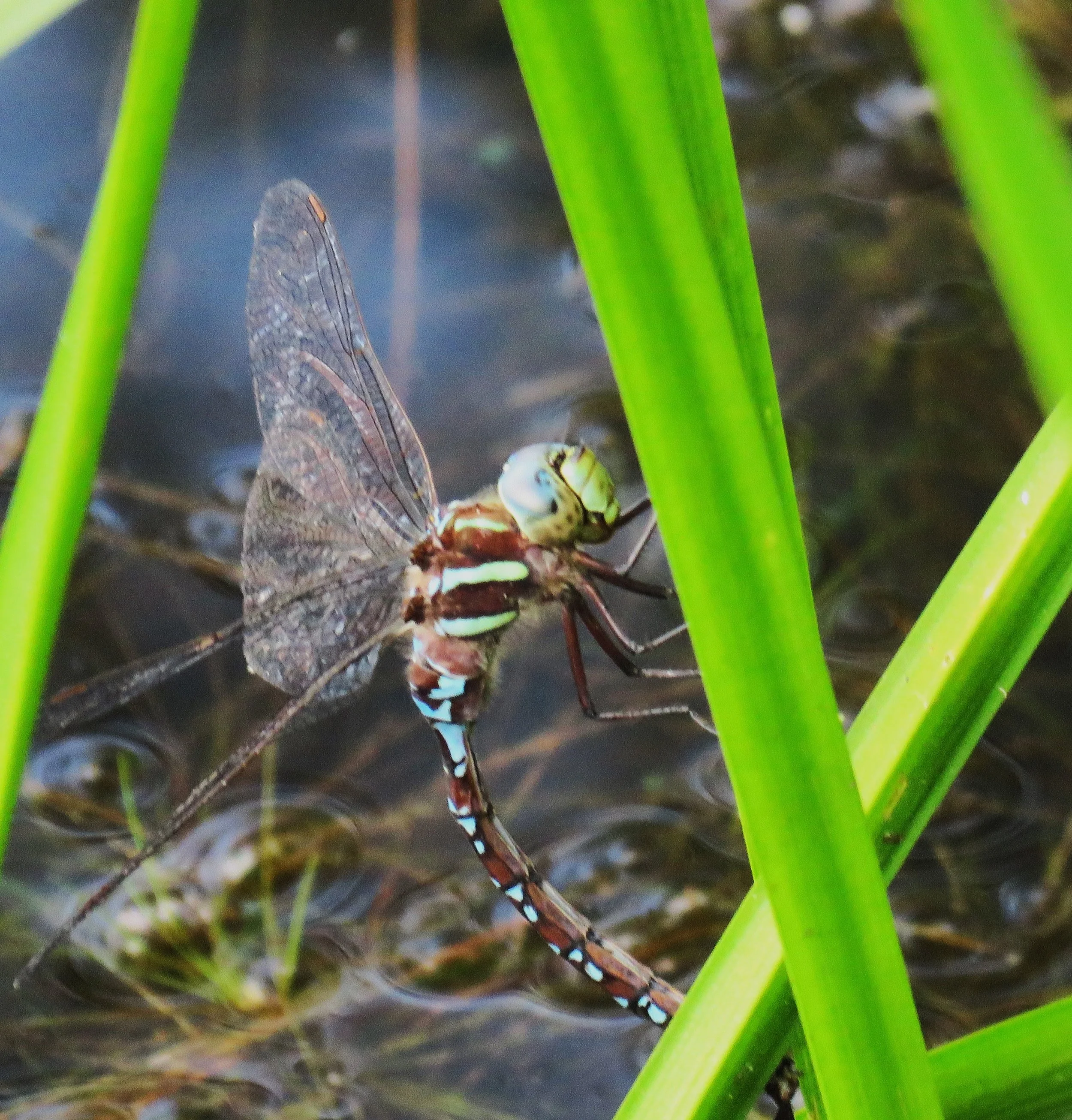
September 5, 2015, 4:15pm. A black-tipped darner laying eggs.
But even the black-tipped females sometimes have to deal with rogue males.
August 25, 2017, 65 degrees, mostly cloudy, seems like early autumn. … a lady black-tipped darner was just minding her own business laying her eggs when a scurrilous male grabbed her by the neck and was tried to coerce her into a wheel. No dice. After a struggling for about a minute, they both departed, separately.
By Labor Day, darners and meadowhawks are the only dragonflies to be found at the pond. Male mosaic darners sometimes gather in swarms by the shore or in the nearby meadows, apparently more interested in finding food than in finding a mate. The females, meanwhile, steadily go about their business of laying eggs.
September 4, 2018, 78 degrees, partly cloudy. A dozen mosaic darners were over the pond, and another dozen were over or below the dam. This was the most I’ve seen this year. Meanwhile, several black-tipped females continued laying eggs.
While all this adult activity is going on, nymphs may still be coming out of the pond, looking for a place to climb up a stalk of a wildflower so they can break out of their shells, stretch their wings, dry out, and fly away as juvenile dragonflies. The young dragonflies are always at their greatest risk when they are hanging onto a branch or a cattail leaf waiting for its wings to dry. I believe the following entry describes a young darner that may never have managed to make it into the air:
September 12, 2016, 5pm. I noticed a dragonfly case on a dead branch hanging over the north side of the pond. When I reached the dock, I found a dead black-tipped darner floating in the pond. When I picked it up, I could see that a third of its head had been bitten off.
I once had an unusually close, prolonged view of a darner having a meal. Unfortunately, the geography of the situation prevented my taking a photo:
September 11, 2016, 67 degrees, partly cloudy, lovely. A black-tipped darner paused right in front of me as I stood on the dam. It then landed on my shirt, so I was able to look down at its head from distance of only ten inches. It had a bug in its mouth! Over a period of about ten seconds, it pulled it in, like someone pulling in a bit of spaghetti. At first, only the bug’s head was in the dragonfly’s mouth, but soon, only a couple of legs were still visible.
It was three years later when I next came across a mosaic darner enjoying a similar meal. Although this darner chose a more traditional perch, it too ignored me as it proceeded with its meal:

September 2, 2019, 3:55pm.. I came across a Lake darner that had landed on a lupine seed pod to enjoy its lunch. It kept at it while I took photos and videos for the next five minutes!
Mosaic darners will be seen regularly on warm, sunny days through the end of September, and a few will be pairing off even into the first week of October.
October 6, 2017, 60 degrees, cloudy, still, 330pm. Only one dragonfly and no damsel flies. Just a lonely darner searching along the reeds, hoping – for what? A final fling with a mate? A juicy bug? Or maybe like me, out here with no expectations, but enjoying the chance to recall summer’s plenty. (20 minutes later I saw two of them, so perhaps not so lonely after all.)
The latest mention of darners in my journals was for October 22, 2017. My latest photo was taken just two days earlier, quite possibly of the same insect.
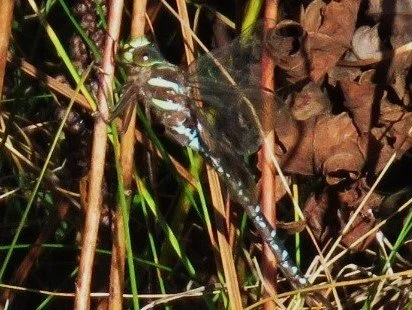
October 20, 2017, 60 degrees, sunny at noon. A single black-tipped darner basked in the sun on a stalk of dead goldenrod at the far end of the dam. It didn’t move until I put my hand within a foot, and it stayed put for more than ten minutes.
By this late in the year, the few surviving darners seem barely alive, and for sure they are doomed.
Photos and text by Carl D. Martland, founding member of ACT, long-time resident of Sugar Hill, and author of Sugar Hill Days: What’s Happening in the Fields, Wetlands, and Forests of a Small New Hampshire Town on the Western Edge of the White Mountain. Quotations from his book and his journals indicate the dates of and the situations depicted in the photos.