
Phenological Phacts and Photos: Great Blue Heron by Carl D. Martland
Phenology – “a branch of science concerned with the relationship between climate and periodic biological phenomena (such as the migration of birds or the flowering and fruiting of plants)
Why Do They Come to the Pond?
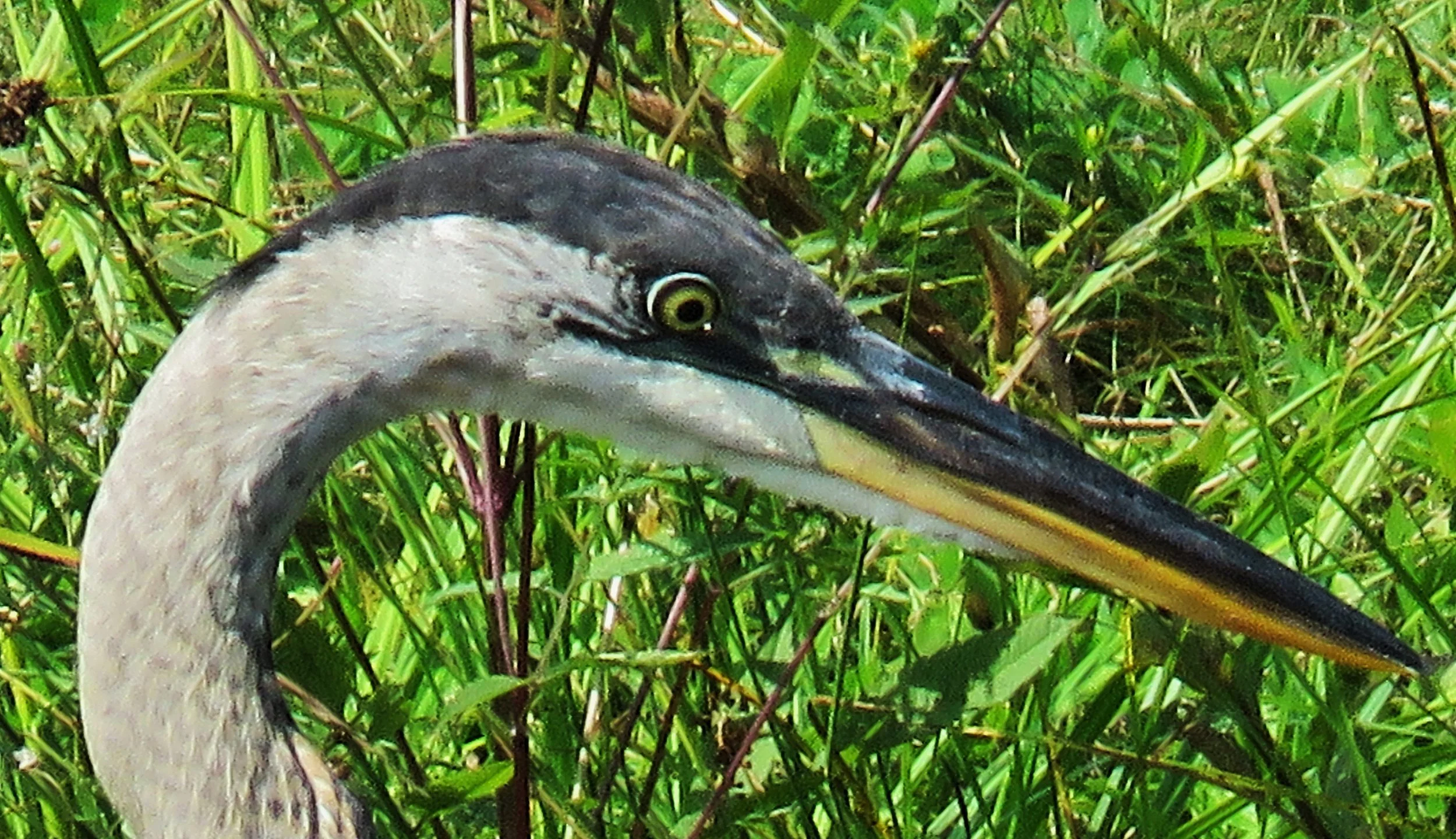
Great Blue Herons are magnificent birds, easily the largest bird that ever comes to the pond. They stand nearly four feet tall and have a wing span of six feet, nearly twice the dimensions of bitterns, the next largest bird that visits the pond. While you may not be impressed by their typical weight of 5.3 pounds, that is more than three times the weight of a bittern and double the weight of a mallard, one of our largest ducks. So what is this over-sized bird doing at our little pond? Well, the answer is hardly surprising – it comes looking for lunch. And, if you look at the above photo, you would certainly agree that this bird has not stopped by for a peaceful hour or two. It is definitely looking for something to eat! And exactly what is it looking for? It’s looking for a frog.
Early in the Spring
Great Blue Herons show up when frogs are abundant. A couple of times, I have seen them early in the spring when the wood frogs are partying in the ponds.
April 17, 2004, cloudy, 60 degrees. A great blue heron flew up from the swamp at the back of Jayne’s Pond. I counted 100 wood frogs and estimated there were more than 200 in that small pond. In the Lower 40, a pair of American mergansers and a kingfisher were at the beaver pond. Listening to the latter, I wondered if it was trying to imitate the quacking sound of the wood frogs? Perhaps he was inviting them to (be) dinner. … On the way back, the blue heron was sitting on top of the snag at the back of Jayne’s Pond. Must have been good feeding!
April 18-22, 2003. Cloudy, about 50 degrees, with almost all of the snow gone. There was a lot of activity at the pond: two pairs of beautiful common mergansers, a pair and another male hooded merganser, a pair of mallards and an extra male, plus a magnificent great blue heron. The heron was hunting right at our end, but flew up and away when I approached. Another one, or perhaps the same one, stood at the point on the 20th; we looked at each other, motionless, for a minute; when I started to take a step toward the pond, it immediately flew away.
Male wood frogs are small, only a couple of inches long, and when they are waiting and hoping for the females to arrive, they are only thinking about one thing – and that isn’t watching out for a heron!
Wood frogs come to small ponds for their mating rituals for just a few days after the ice breaks up in the spring. So there is just a small window at the end of winter when these frogs are easily available for predators. Perhaps they gather at the pond so soon after the ice melts in order to through with their business before the big birds return.
Nesting
Great Blue Herons spend the spring making nests, sitting on eggs, and feeding their newborns. A couple of years, they have nested close to Pearl Lake Road.
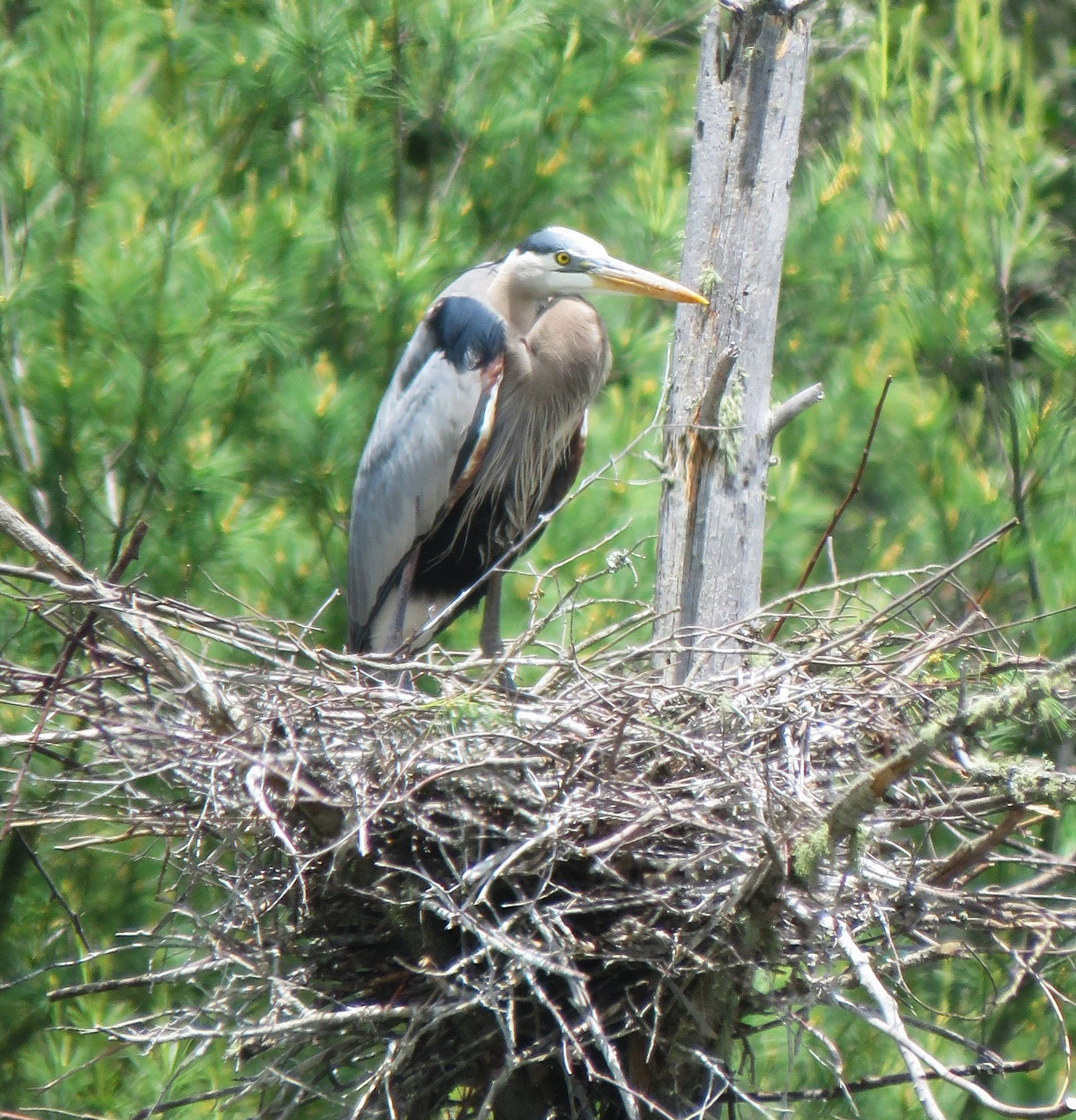
June 11, 2022. A Great Blue Heron sits on a giant nest built high up on a dead pine tree at the edge of a swamp next to Pearl Lake Road. Since the bird stands nearly four feet tall, the nest is more than six feet wide.
In 2022, the nest was built by June 11th, and tiny chicks could be seen bobbing their heads by the 19th. Two weeks later, four of them could be seen standing up on the edge of their nest, at least two feet tall, but still with their downy feathers. By July 14th, they were getting ready to fledge.
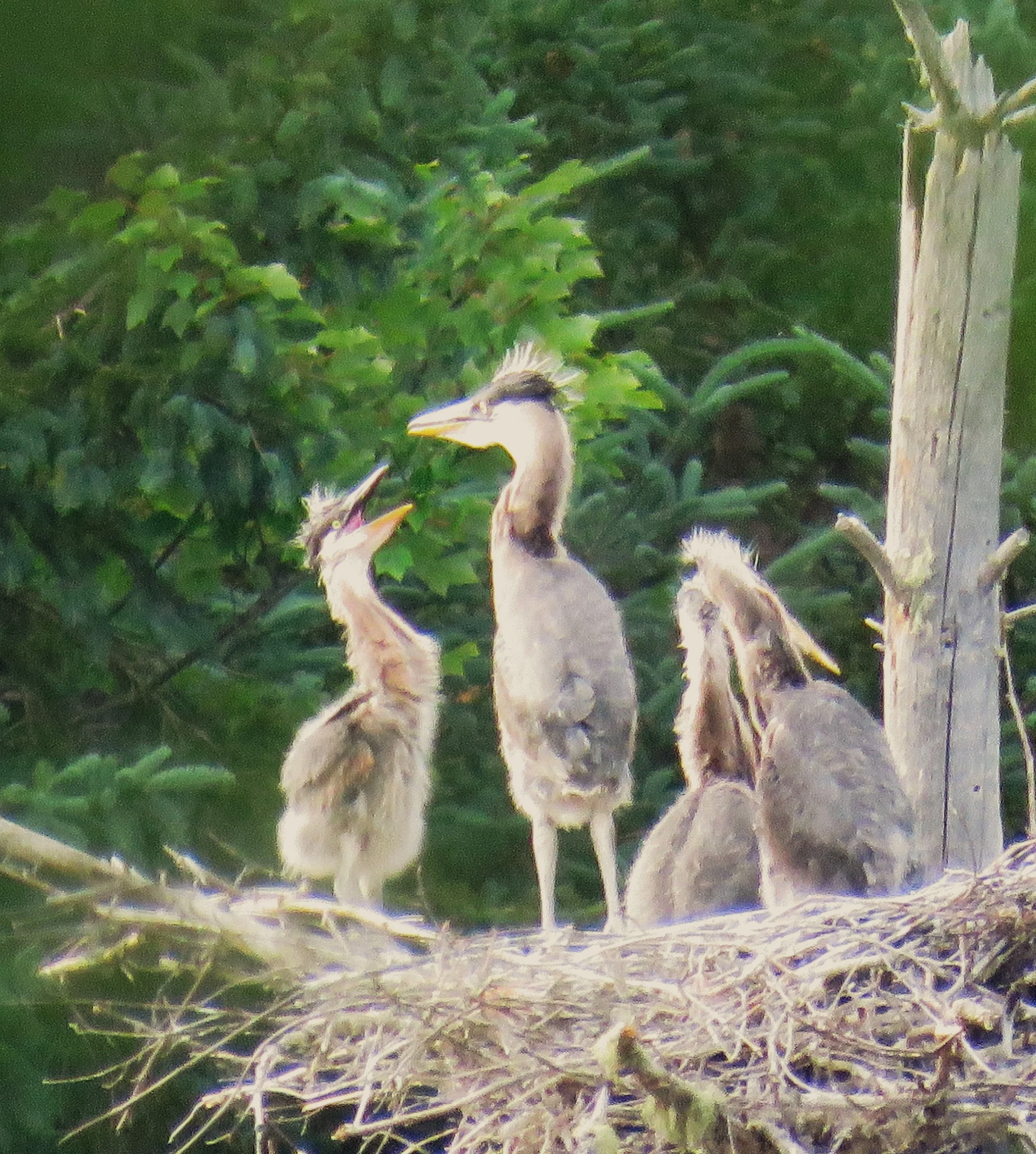
July 1, 2022. Four young Great Blue Herons are quite active in their nest.
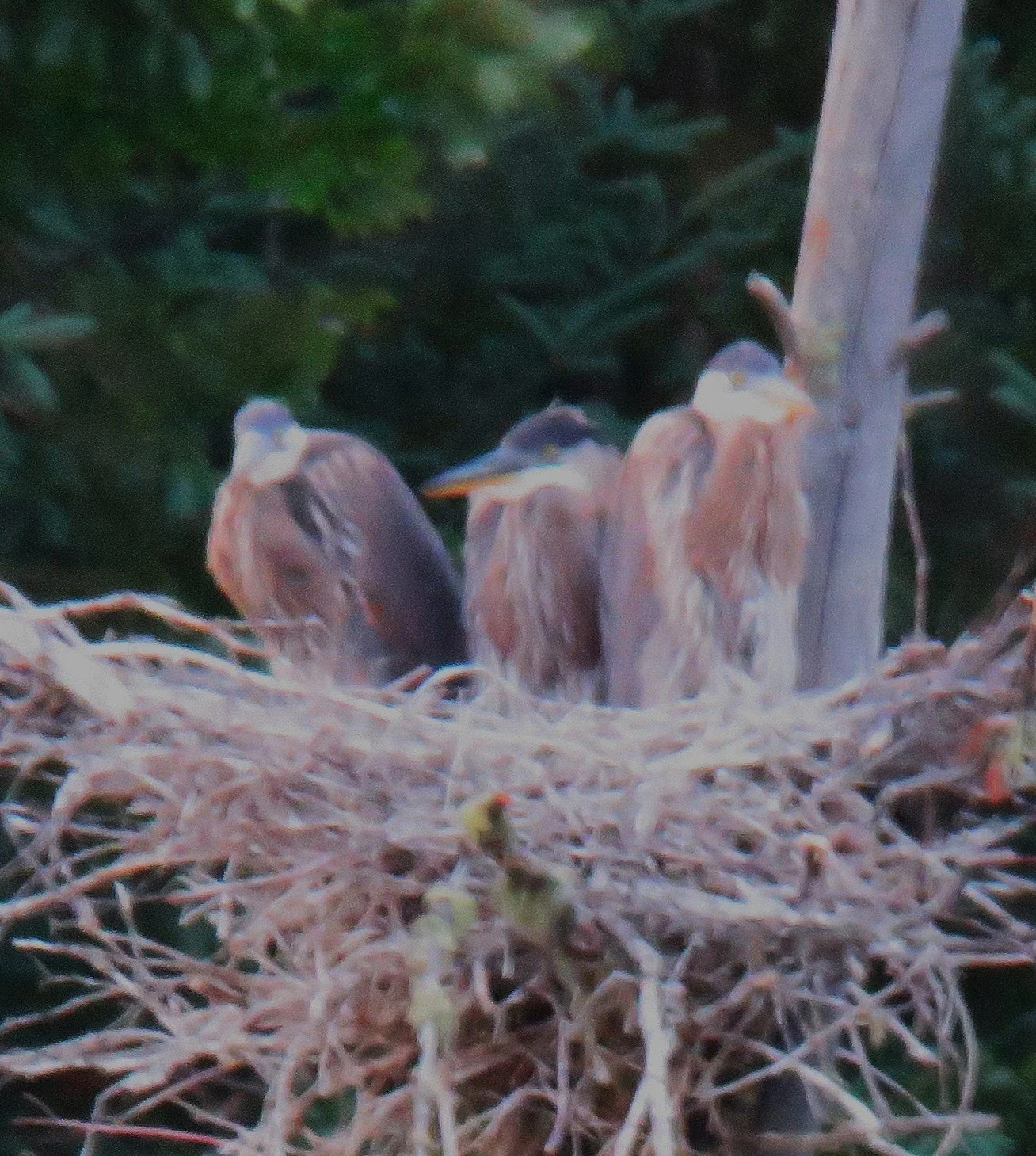
July 14, 2022. Two weeks later, they have lost their down, gained some color, and are about ready to fledge.
By the end of July, the young are ready to go out on their own, and that is when one or, rarely, two will show up at our pond.
July 21, 2024. Two great blue herons at the far end – the first of 2024 and the first time I’ve ever seen two here.
July 27, 2017, 70 degrees at noon. A great blue heron flew in as I was starting my usual walk along the dam, and I managed to get a movie of it.
August 7, 2020, 80 degrees, light breeze, partly cloudy, lovely! … A great blue heron landed on Kennerson’s dock for a while, then moved first to the shore and then to the Point.
Dinner Time
When a Great Blue Heron lands at the edge of the pond, it will spend a minute or two pretty much stationary, perhaps looking around just a little. It will then slowly lean forward, lift up a foot with its toes spread wide, plant it down slowly, bend its knee, and continue on, lowering its neck, and moving up within striking distance of a few unsuspecting young green frogs sitting with their heads out of the water no more than an inch or two from the shore.
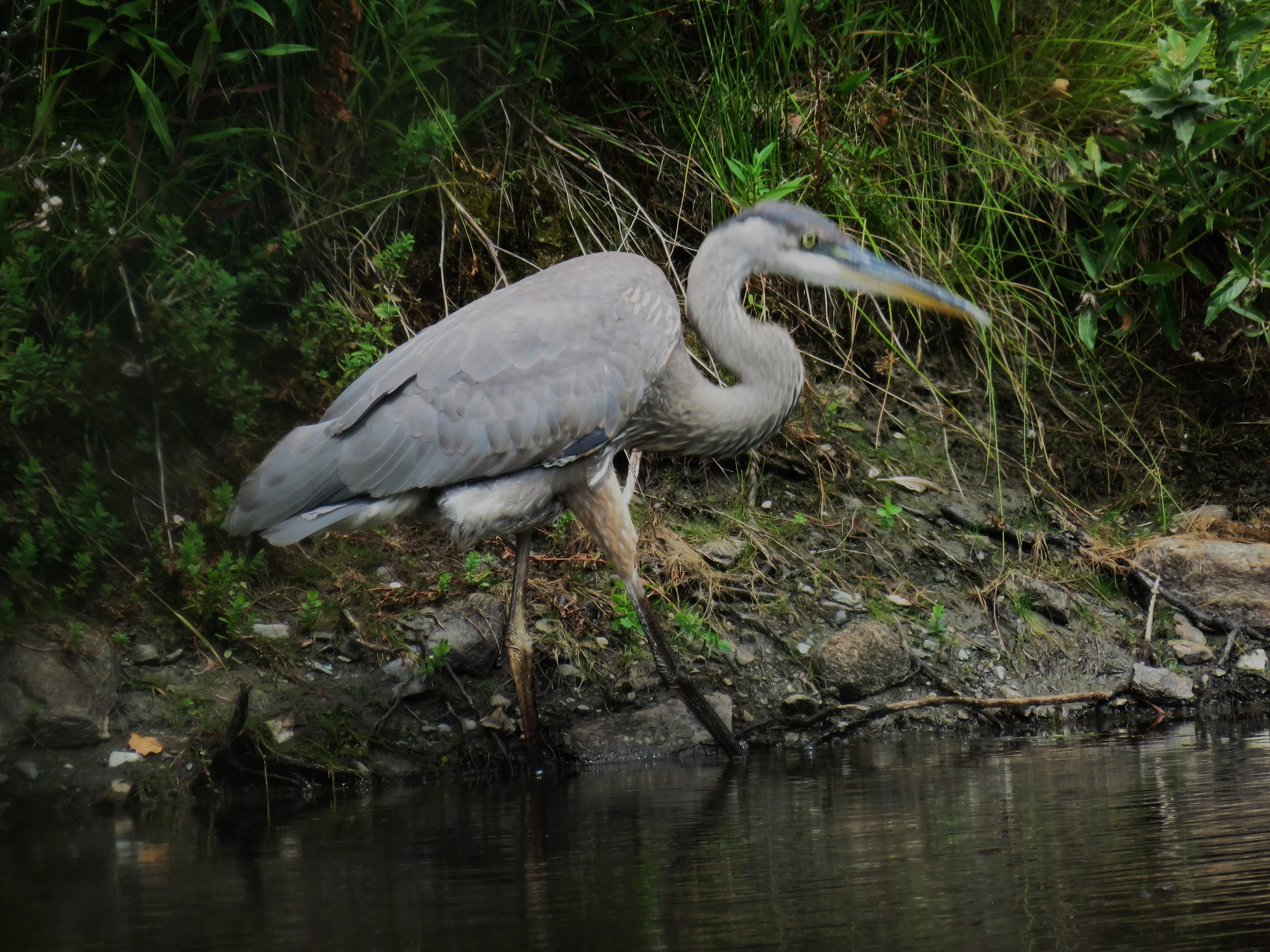
August 7, 2020. A Great Blue Heron moves along the shoreline, focused on a frog a few feet away. His neck is arched, ready to strike.
The little frogs, meanwhile, are oblivious to the danger. It’s only been a week or so since they consumed their tails and ceased their months-long existence as tadpoles. A half dozen or more are likely sitting along a few feet of the shoreline, heads just out of water, motionless for many minutes at a time.
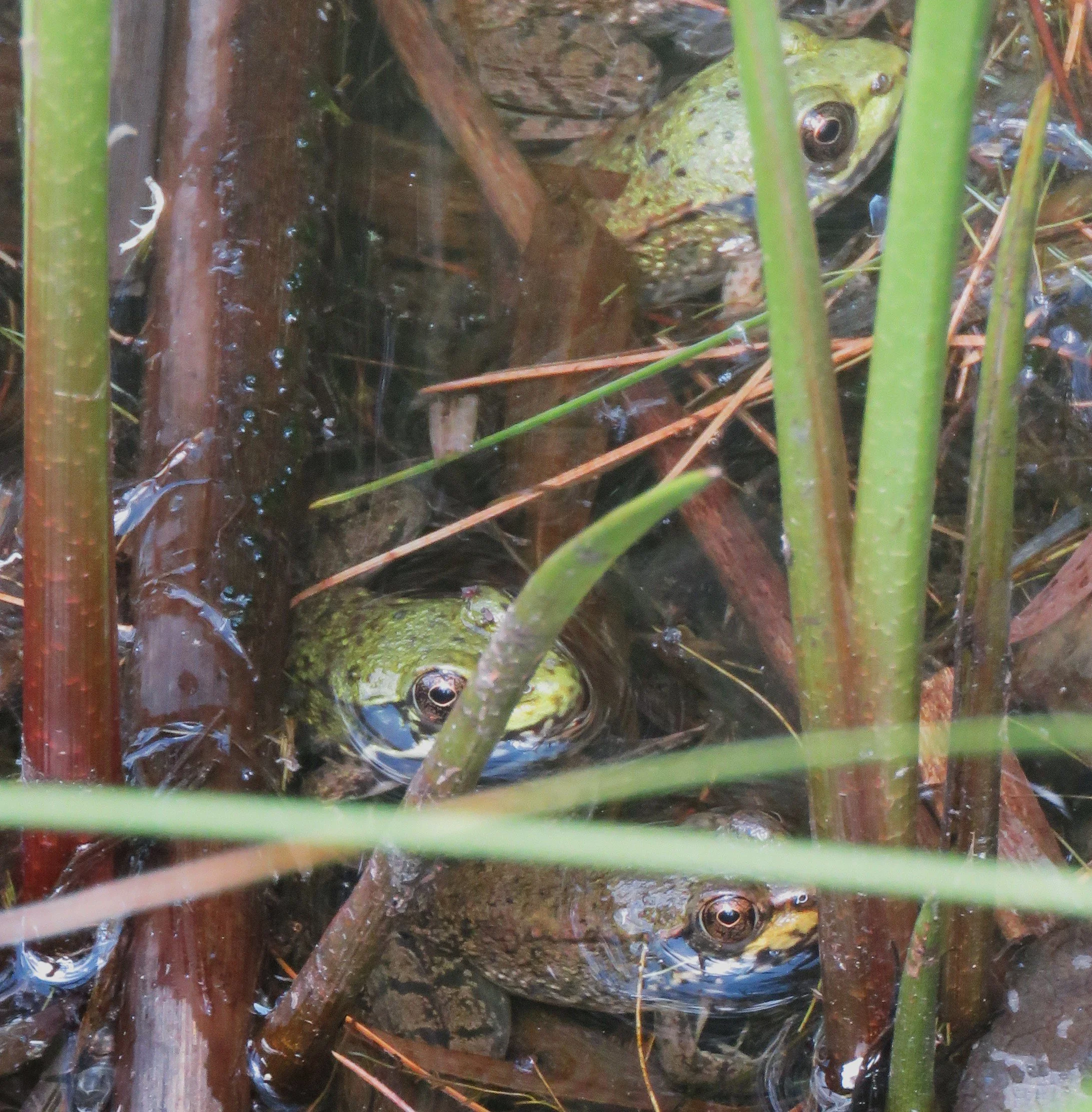
August 1, 2017. Three juvenile green frogs sit motionlessly amidst some cattails at the edge of our pond.
The bird, with it ferocious stare focused on a single doomed frog, moves ever so slowly and silently, and – suddenly! It throws its next out and strikes at the frog.

July 27, 2017. This is a frame from a video that shows the heron carefully approaching, crouching down, zapping its neck forward to catch the frog. The heron caught the frog in its beak, and excitedly stood up, flapping its wings. The frog is just visible in the heron’s beak.
If successful, the heron flaps up, twists its neck around several times, straightens it, and then keeps adding a few more twists until it has swallowed the frog. The heron then may preen itself and take a couple of drinks of water for the pond before starting to stalk another frog. It might also choose to hide in the cattails, contemplating its next move.
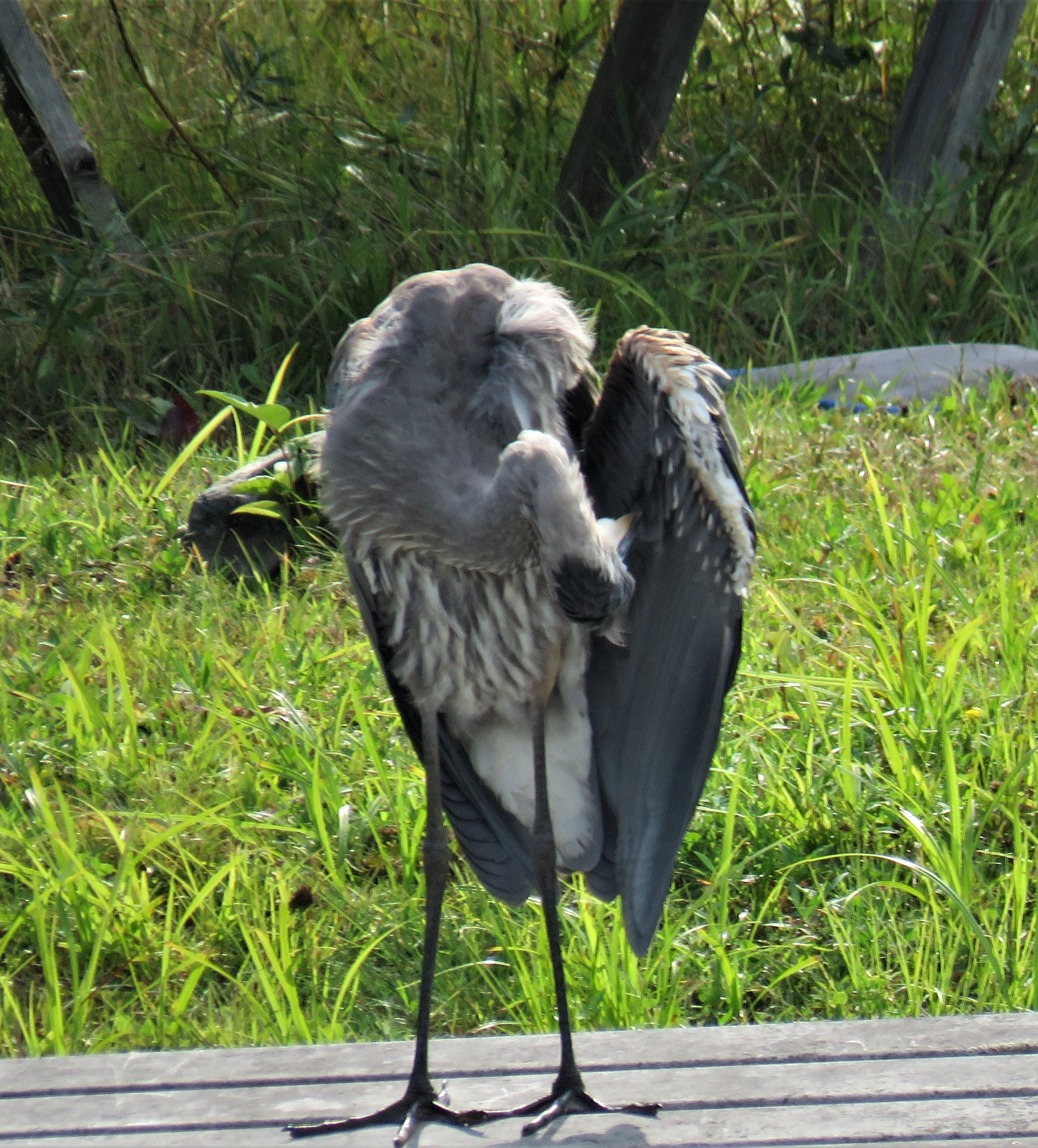
August 24, 2020. Preening after a successful hunt.
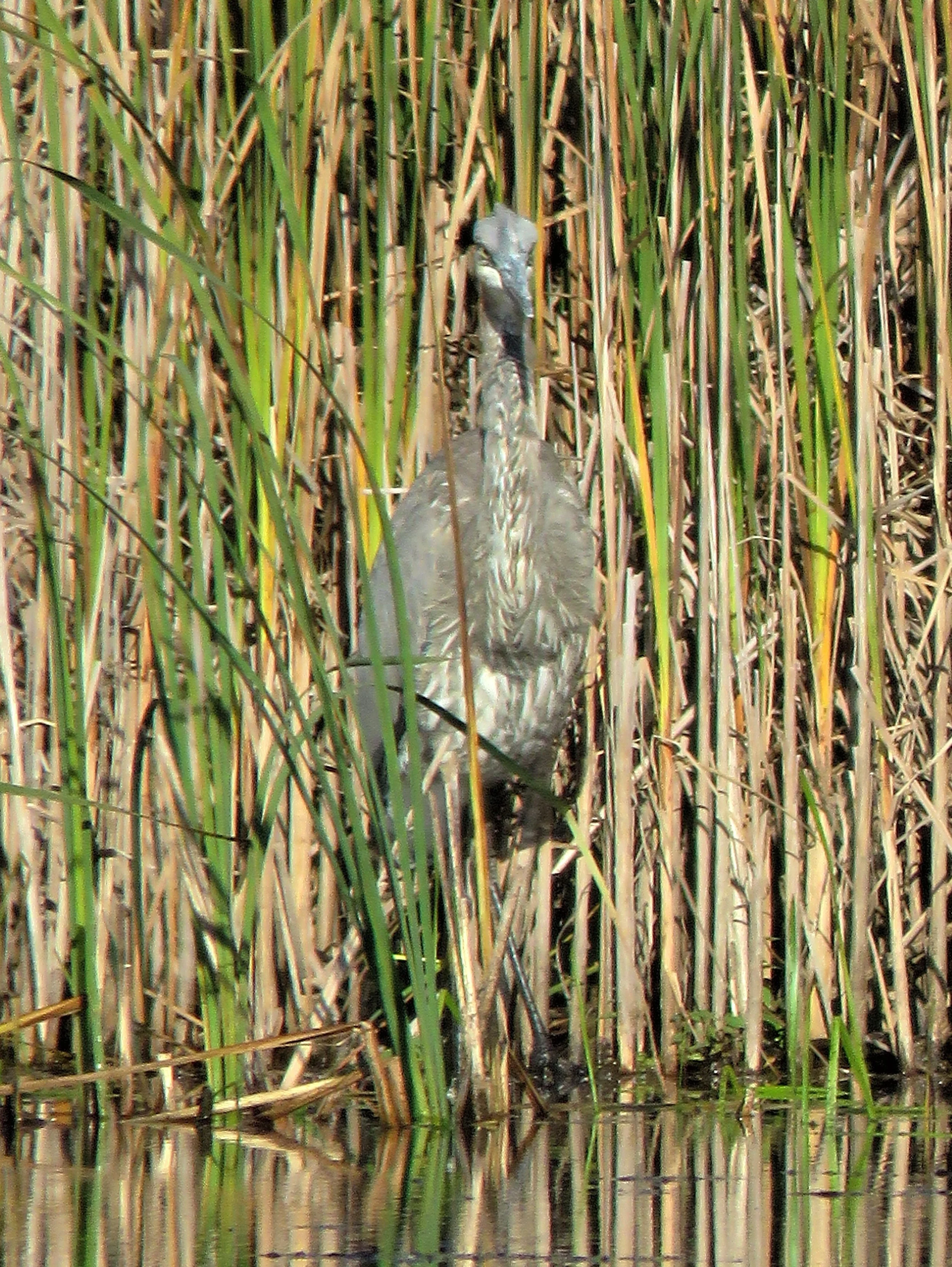
September 6, 2020. Standing still in the cattails, pondering its next move.
Great Blue Herons can be found in every state, southern Canada, and Mexico. In the winter, I have come across them on beaches in Florida, ignoring me and the sunbathers, just enjoying the view and contemplating the seafood options for dinner. Which is just what I was doing when I took this final photo.
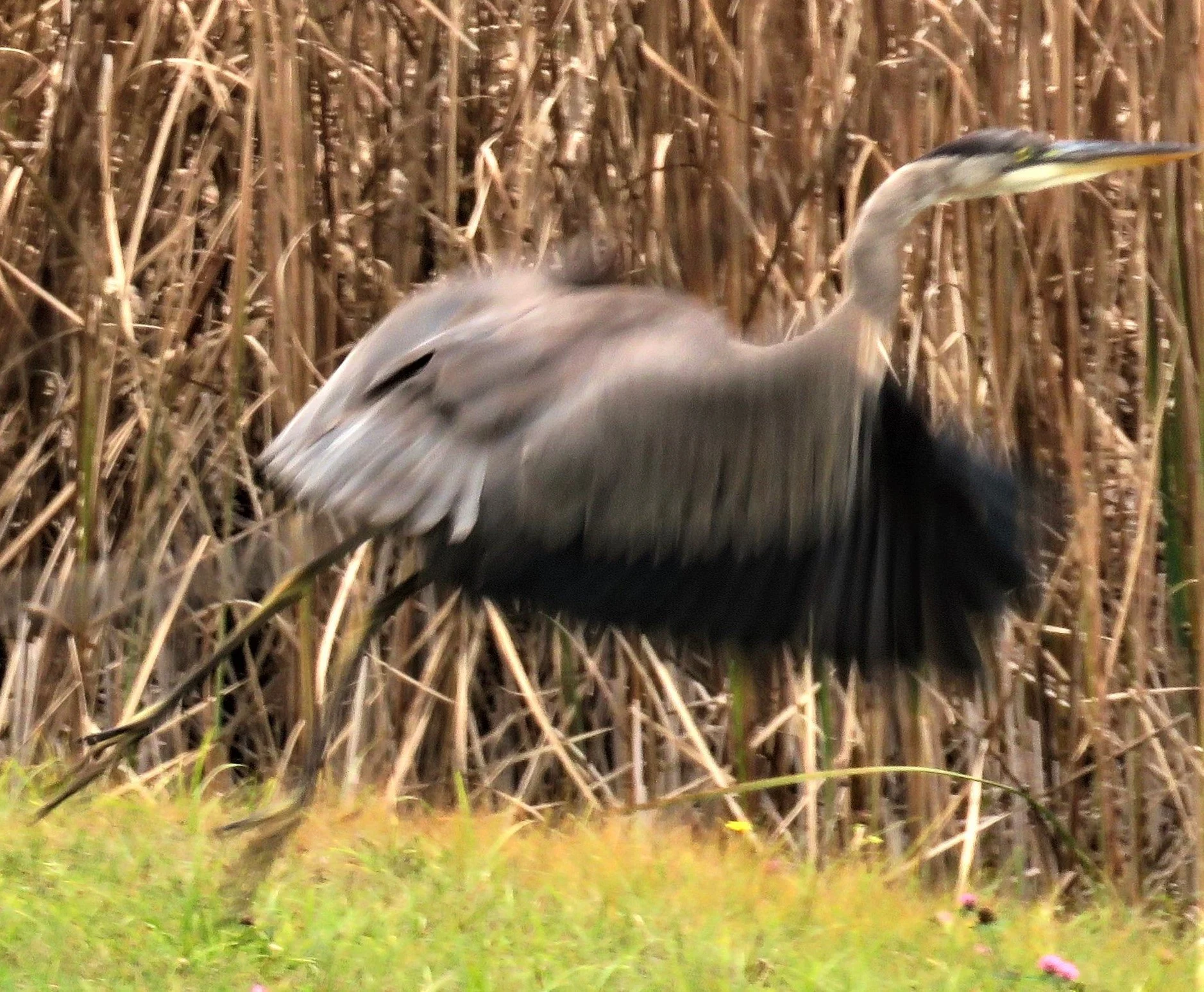
October 23, 2021. This heron showed up at our pond yesterday, stayed overnight, and was gone for good by late afternoon.
Great Blue Herons can be found in every state, southern Canada, and Mexico. In the winter, I have come across them on beaches in Florida, ignoring me and the sunbathers, just enjoying the view and contemplating the seafood options for dinner. Which is just what I was doing when I took this final photo.
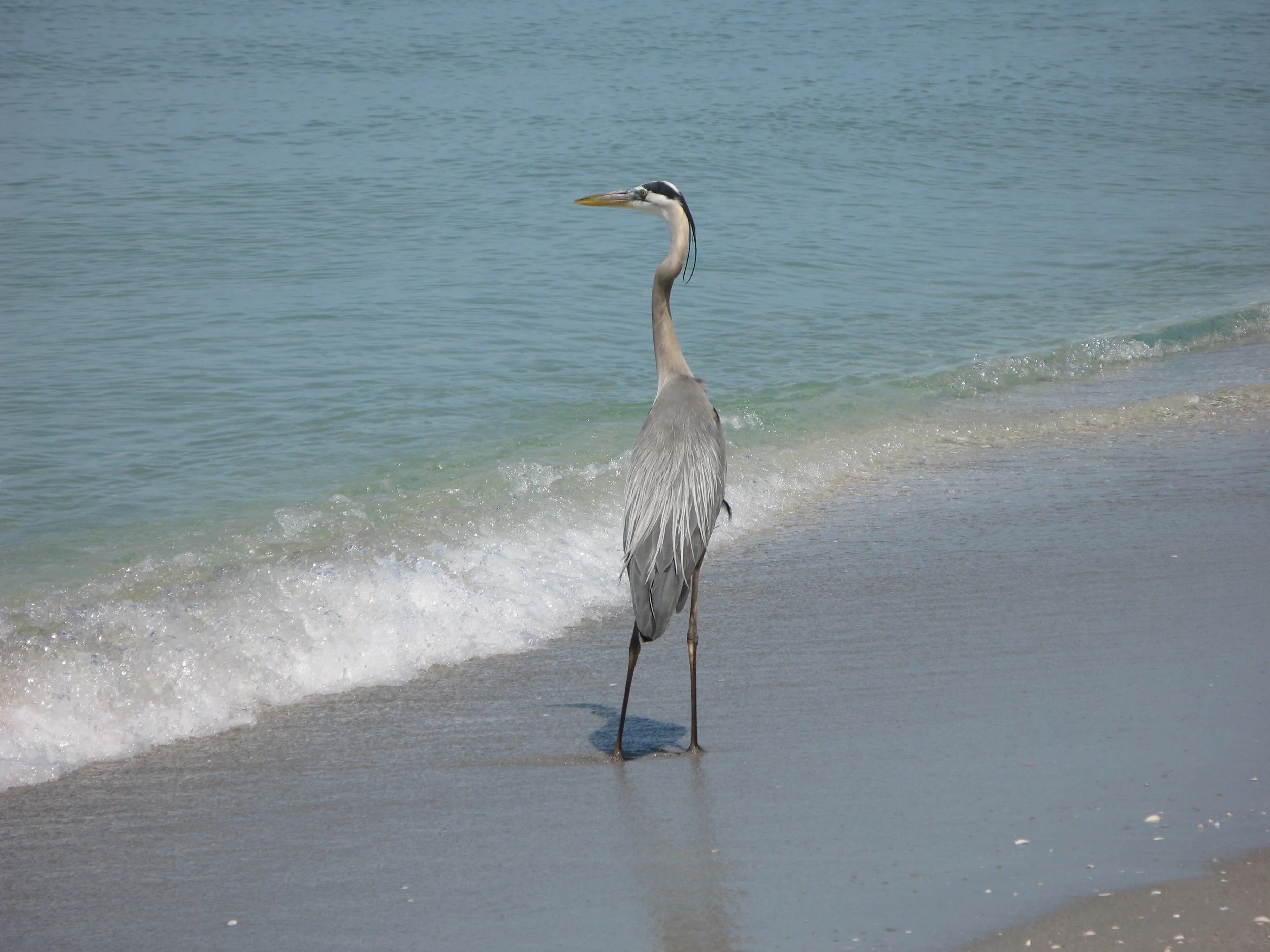
March 18, 2012. On a beach in Florida. Where? Who cares! The sun is shining, the breeze is delightful, and food is plentiful!