
Phenological Phacts and Photos: Coffin Pond – Down the Drain!?! by Carl D. Martland
Phenology – “a branch of science concerned with the relationship between climate and periodic biological phenomena (such as the migration of birds or the flowering and fruiting of plants)
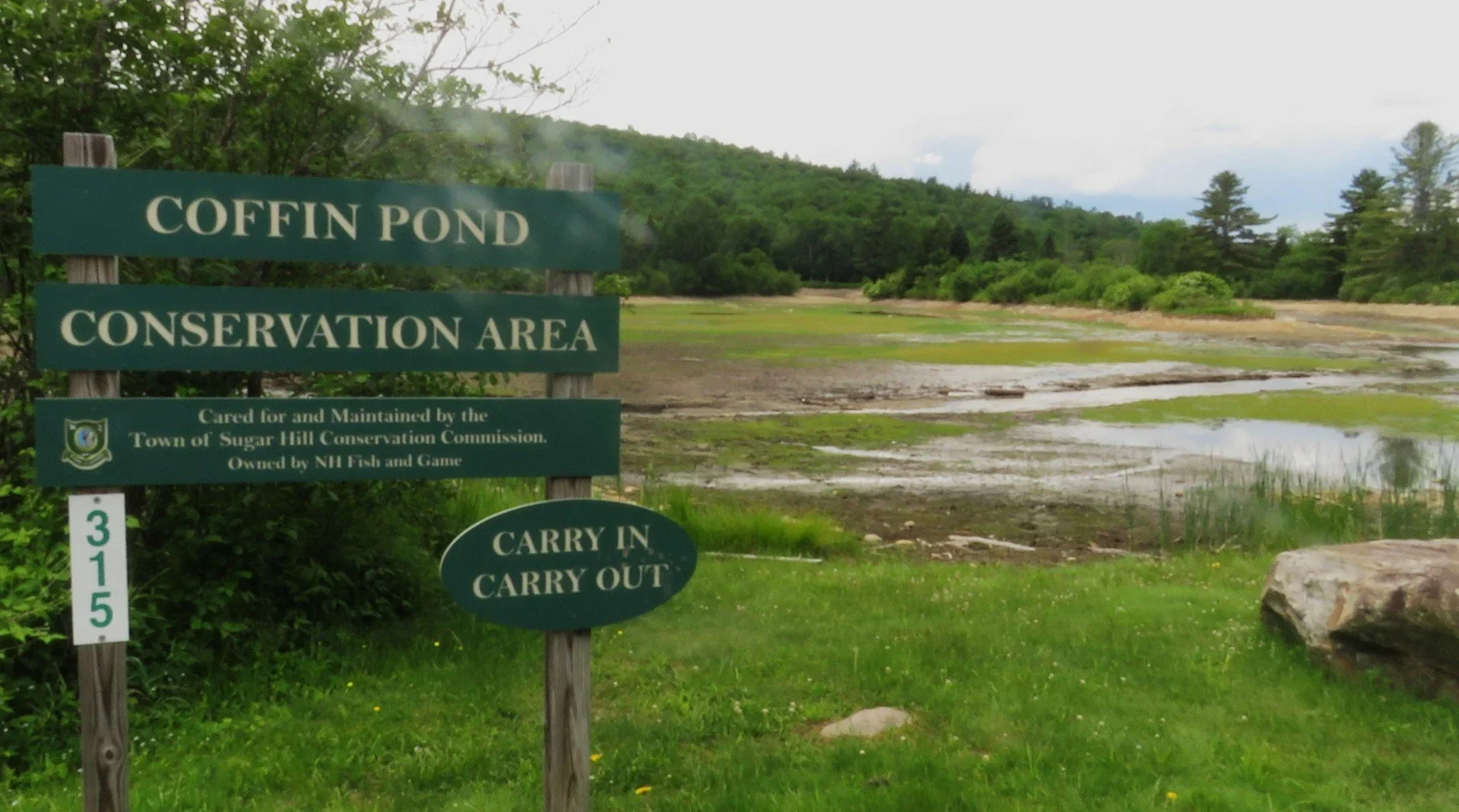
Coffin Pond Conservation Area
The Coffin Pond Conservation Area, which is owned by NH Fish & Game, is maintained by the Conservation Commission of Sugar Hill. A pull-off from NH 18 provides access to the pond and a mile-long trail that goes between the pond and the Gale River. Because of its location on NH 18 near downtown Franconia, it is easily accessible and has been widely used by locals, visitors, and people out for a ride on the North Country’s byways. In 2021, the Sugar Hill Conservation Commission won the North Country Scenic Byway Council’s first “By the Byway Award” for the work they had done to improve the site. The award citation reads as follows:
“The Town of Sugar Hill, the Sugar Hill Conservation Commission, and community volunteers have vastly improved parking and landscaping, provided access for fishing or boating, added flat stones as places to sit or have lunch, and upgraded a trail from the road to the far side of the pond.This site is clearly an outstanding example of a byway pull-off where there are many things to do and byway travelers should know that this is a place worth visiting.”
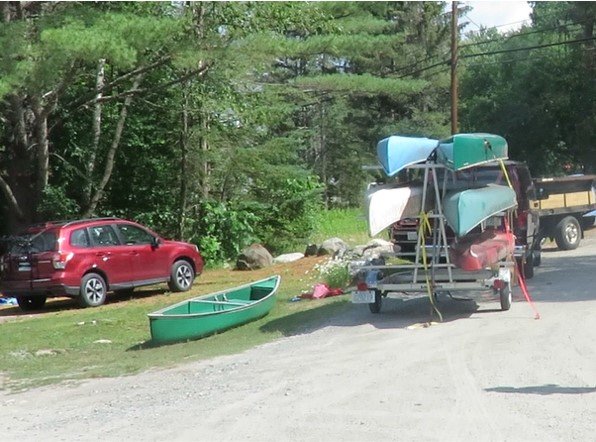
June 30, 2021
A few minutes after I snapped this photo, a group of school kids came down to the pond with their teachers and a few parents. Some kids jumped in the water, while others made good use of these canoes
Whatever Happened to Coffin Pond?
You shouldn’t be surprised to find me focusing on Coffin Pond for this month’s PPP. Coffin Pond had long been a wonderful place to visit, as it was a great place for a picnic, bird-watching, or getting close to the shore to see if there are any frogs, butterflies or dragon flies. I have plenty of photos and journal entries to draw upon for this essay. What’s surprising is not my focus on Coffin Pond, but my having to write about its demise. I won’t encourage you to visit Coffin Pond, for there’s a problem. The pond isn’t there. To build upon the famous Monty Python sketch, I must protest that Coffin Pond is not a living pond - it is a dead pond - it is a swamp - it is a mudflat - it is a series of puddles – it is gone - it is extinct!! And that is a disgrace.
What happened? Who did it? How did it happen? Well, the State of New Hampshire did it. Why did the State do this? The so-called justification seems to be that there was a risk that the dam would fail. Yes, that was indeed a risk, but what was the way to deal with this risk? Perhaps the dam could have been reinforced; perhaps the drain could have been replaced; perhaps a sluiceway could have been added to send water from the pond to the Gale River when the pond is full. Did the State consider these options or weigh the extent of the risks? No. To avoid the unquantified risk, someone abruptly decided, “To hell with any risk analysis, let’s just drain it!” What? The risk was associated with the dam failing, so the response was to make the dam fail? I don’t get it, and neither should you.
So, instead of urging you to enjoy the natural wonders of the Coffin Pond Conservation Area, I can only pretend that I’m preparing to speak at a memorial service to celebrate the life of the Pond. I knew and loved Coffin Pond, and I hope that my memories and photos will be helpful in ensuring that the State figures out how to bring the pond back to life. So, let’s think back to what you might have seen over the course of the year if you too had frequently visited Coffin Pond.
Springtime
By the end of March, when the hillsides were still covered with fresh snow, a trip to Coffin Pond provided an initial taste of spring.
Hooded mergansers stay at Coffin Pond only until the ice melts off the smaller lakes where they prefer to raise their families. However, common mergansers like the broad waters of Coffin Pond, and they can be seen there throughout the spring.
April 14, 2022. A dozen common mergansers at Coffin Pond.
The broad open area above the pond is a good place to look for hawks and eagles. I always kept an eye out (an eye up?) for them, and once in a while I was rewarded:
May 4, 2017, 55 degrees, sunny, high clouds. Bald eagle flew high over
Coffin Pond
May is also when the geese have their goslings, toads have their parties, colorful insects show up, wildflowers bloom, and songbirds sing their hearts out. Last year, Nancy and I saw or heard all of this on one fine spring afternoon.
May 15, 2025, 78 degrees, partly cloudy, warm, humid. We went to Coffin
Pond in mid-afternoon. A pair of geese had four goslings, just like the
geese at our pond. Many male toads were calling loudly, but I only saw
two or three couples. I took photos of a blue butterfly, violets, wild
strawberries, and a bird singing high from a tree.
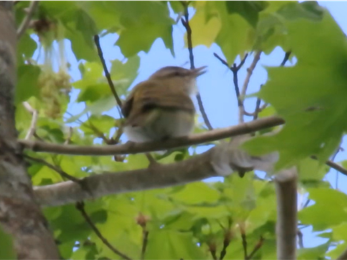
May 15, 2025 (continued)
The bird’s repetitive song, along with the white and black stripes on its head, helped identify it as a red-eyed video, a very common bird in forests, but one that usually is unseen as it stays well up in the canopy.
Summertime
By mid-June, the geese would put on quite a show for anyone stopping at the Coffin Pond pull-off:
June 12, 2025. I watched the activities of geese at Coffin Pond, notably
a family with four goslings that was leaving the pond to graze on the
grass at the edge of the parking lot. The adults were amazingly active, presumably cleaning their feathers or getting rid of mites. One turned completely over, with its belly facing up. Two others scratched, twisted,
and flapped their wings – making a great video.
Even if there were no ducks or geese, there would have still been a lot to see at the pull-off, especially for those who seldom spent time by a pond and those who liked dragonflies:
June 19, 2019, partly cloudy, calm, 84 degrees. About 10am, I stopped
by Coffin Pond, hoping to see something new, but there were no
waterfowl, only one small frog and a few of the usual suspects: 3-4
chalk-fronted corporals, a half dozen swallowtails, and a few redwing
blackbirds flying across the pond.
June 29-30, 2021, noon to 1pm, 88 degrees, partly cloudy, hot! I saw two
widow skimmers and a 12-spotted skimmer at Coffin Pond about 1045am.
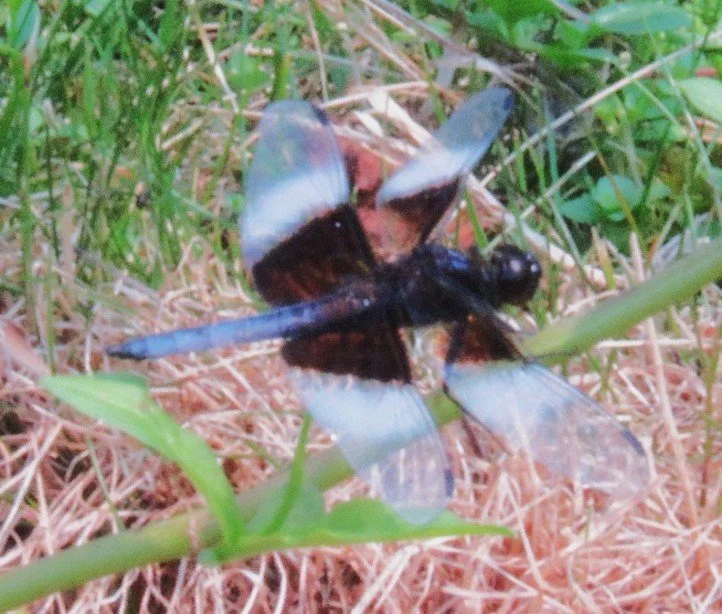
August 4, 2025
A widow skimmer posed for photographs right at the edge of the parking area at Coffin Pond.
And sometimes, there was something out of the ordinary in addition to the dragonflies, such as one of the big birds that, like the local contractors, sometimes stopped by the pond hoping for a nice bite to eat.
July 10, 2025. At the Coffin Pond Pull-off, I watched two widow skimmers
fighting for territory; a chalk-fronted corporal posed on the rocks; a slaty skimmer chased the corporal; and a green darner patrolled the
shoreline. A bittern flew up as I was watching the dragonfly activity.
August 3, 2022, 81 degrees, partly cloudy, wonderful! We then stopped
by Coffin Pond, where we saw many 12-spotted skimmers, a few widow skimmers, a slaty skimmer and many bluets. We were also happy to
see a northern harrier flying overhead.
Last summer, I was lucky enough one day to see a loon out in the middle of the pond and, on another day, to see a cormorant even further toward the opposite shore. Although they were both too far away for me to get close-ups, I managed at least to document their presence.
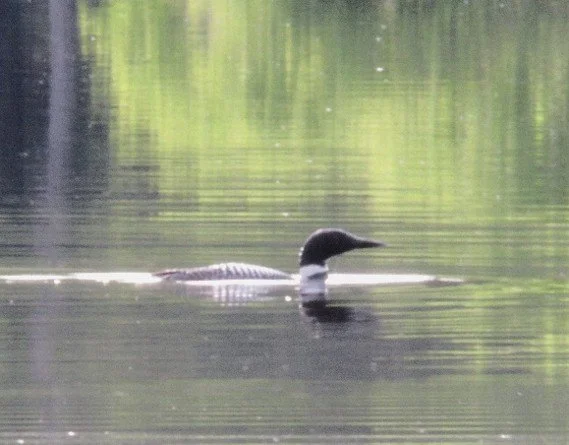
June 3, 2025
A loon swam along out in the middle of Coffin Pond.
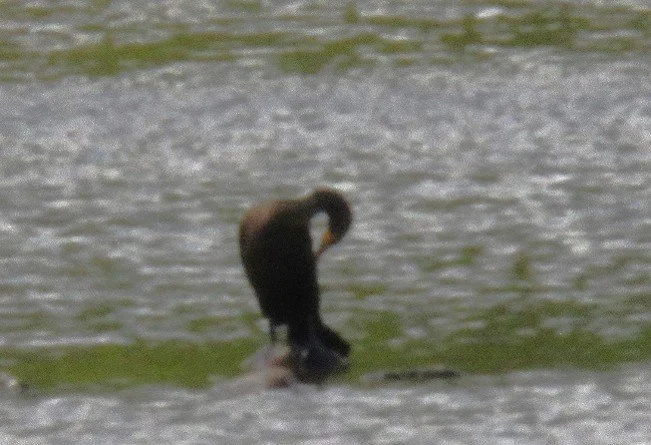
September 4, 2025
A cormorant scratched itself while sitting on a rock near the other side of Coffin Pond.
Fall
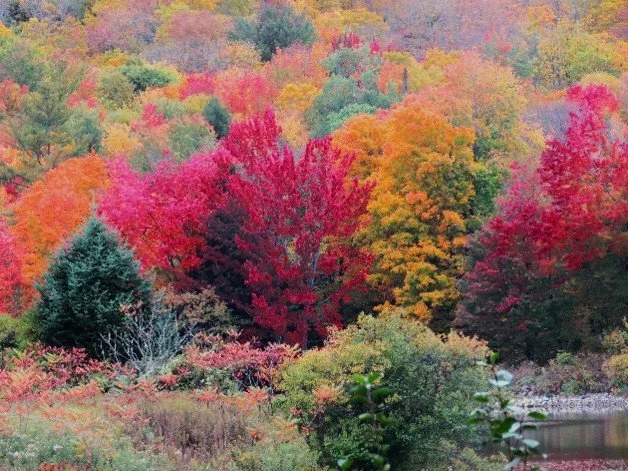
The foliage around Coffin Pond was usually breathtakingly beautiful in the fall. From the pull-off on NH 18, you could enjoy the views across the pond toward forested hillsides. From the pull-off on Streeter Pond Road, you could get the view toward Lafayette, Cannon, and the Kinsmans. Or you could enjoy the falling and fallen leaves as you walked along the trail by the river.
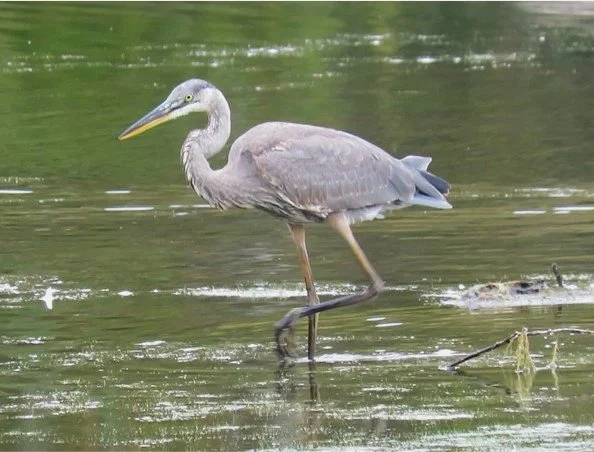
October 4, 2016
What did we enjoy the most as we walked along the trail by Coffin Pond? The colors or the great blue heron that was hunting not too far from the shore?
Winter
Eventually the leaves drop, the summer birds head south, the pond freezes over, and snow covers everything. After a fresh snowfall, it’s best to wait a few days for someone younger to break the trail that goes between the river and the pond. Who knows what you would have seen? I certainly was surprised when I visited the conservation area last January:
January 22, 2026, 32 degrees, partly cloudy, 110-140pm. At Coffin Pond, I
walked along a trail prepped by a couple of snowshoers from the parking
lot to the second bridge, i.e. almost to the end. The river was mostly frozen,
but was rushing along in a couple of open spots. Halfway out, as I stood
for a moment by a very large pair of grown-together trees, a fat beaver emerged from behind them and lumbered across the trail, less than ten
feet in front of me! It continued about twenty yards off the trail before disappearing into a hole, presumably its den, although the hole was at
least fifteen yards from the pond.
I knew that beavers lived near Coffin Pond, but that was the only one that I ever saw there. Back at the very start of Covid, we found a clear sign that beavers – presumably very large and overly ambitious beavers – were winter residents at the Pond. Who says that beavers won’t attack pine trees?
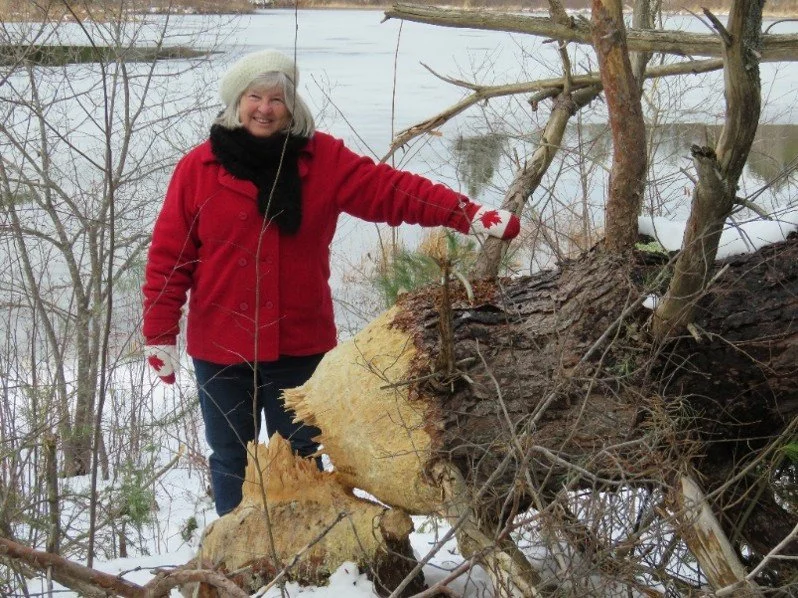
March 25, 2020. Who says that beaver avoid pine trees? What was the beaver thinking when it attacked this 80-foot pine near the shore of Coffin Pond?
So long as the snow was cleared from the parking area, I liked to spend a few quiet minutes looking out over the pond, thinking about the many sights and sounds I’ve enjoyed at this wonderful conservation area.
Hope for a New Pond
The good news is that the Town of Sugar Hill is working with the State of NH to have ownership of the entire conservation area shifted from Fish & Wildlife to the Town. The Town can then take charge of restoring the dam and installing a new drain or sluiceway to handle the overflow into the river. Until then, I can only repeat what Bob Hope would have said:
“Thanks for the Memories!”