
Phenological Phacts and Photos with Carl Martland / May 2026
“Now That April’s There”
Phenology – “a branch of science concerned with the relationship between climate and periodic biological phenomena (as the migration of birds or the flowering and fruiting of plants).”
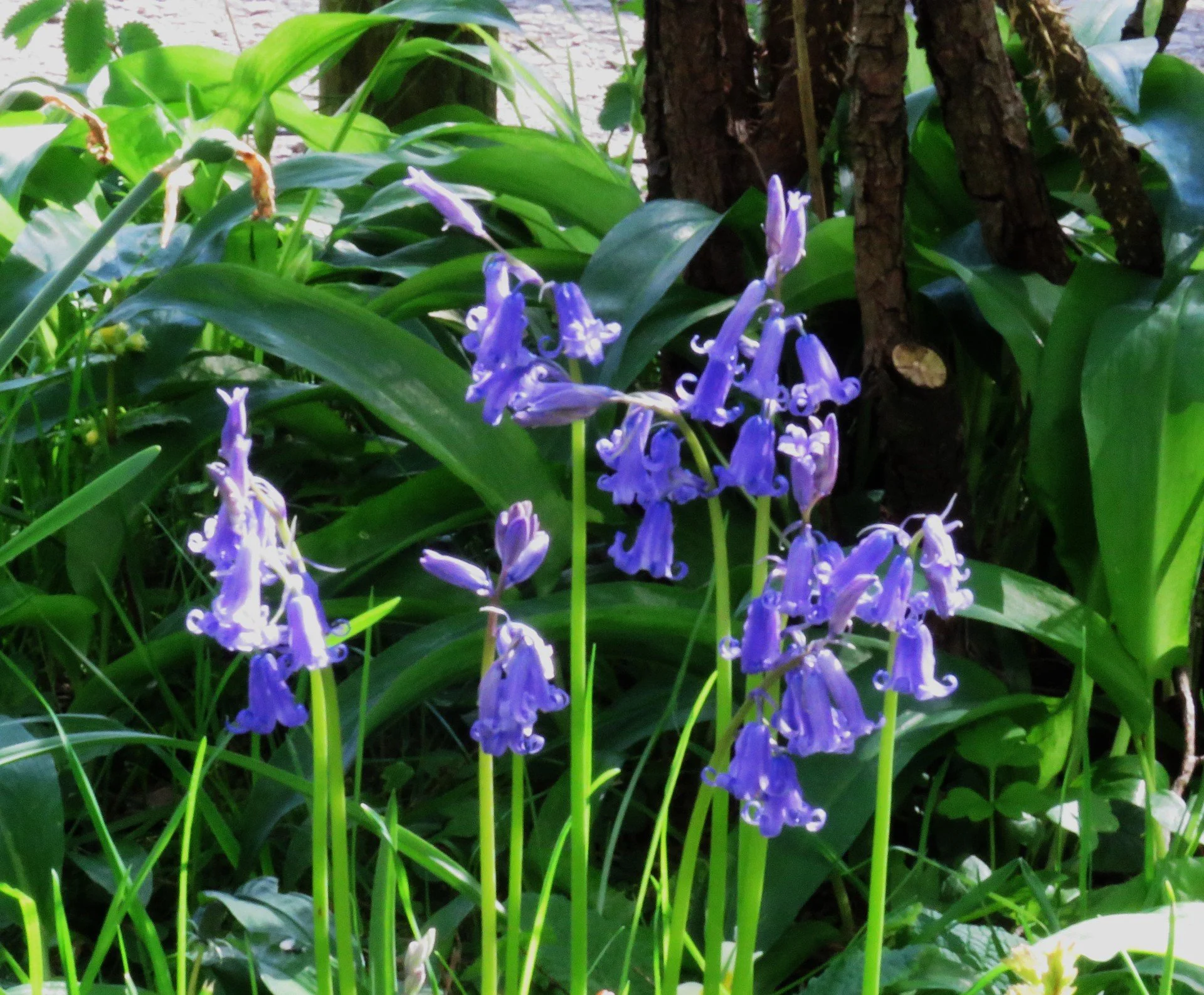
“O, to be in England”
Phenological phacts cannot be ignored in April. In the North Country, we think about ice out, the snow melting, and taking in the bird feeders before the bears awaken from their winter slumber. We may get some warm sunny days, but often they only help to melt the snow. Daffodils and tulips? No way. Even crocuses are unlikely until the end of the month. Leaves on the trees? None, although we do see some pussy willows by the pond. When April comes to the North Country, I can count on seeing more and more birds, but it will likely be May before we come across apple blossoms and spring green tints on the hillsides.
In Rhode Island, Robins Were the Harbinger of Spring
In southern New England, the robin announces the coming of spring. This is what Marjory Rawlings wrote in “The Yearling”, which is a book that I read in the 7th grade at Gorton Junior High School in Warwick, Rhode Island in 1958. “Harbinger” was one of the vocabulary words that we had to look up as we were reading this fine book, so we all learned what it meant when Rawlings wrote that “the robin is the harbinger of spring.” However, as of early 2012 when I wrote the book, the only time I ever heard the word “harbinger” was when someone quoted the phrase “the robin is the harbinger of spring” after seeing their first robin of the year.
Perhaps I was overly harsh on an innocent word, one that still merits inclusion in anyone’s vocabulary. I therefore googled “harbinger” to see what I would get. And I got a lot. Definitions from several dictionaries. Examples of usage including “harbinger of winter”. A set of photos of wildflowers that are “harbingers of spring.” Even a 10-minute You-Tube video from “Randy’s Natural World” entitled “The American Robin: Harbinger of Spring?” I have to admit that the word “harbinger” has much greater use, at least on the internet, than I gave it credit for.
The robin’s claim to be the “Harbinger of Spring” rests on several factors. First, robins are easily recognized, very common, and well known. Second, they do, at least in the northern part of the country, migrate south in the fall and return north right around the beginning of spring. That is why Randy had the question mark in the title of his video: he said that robins could be a harbinger of spring, but only in the north; in the rest of the country, robins are commonly seen year-round. Here in the North Country, few robins remain for the snow and ice. Until last year, I had only seen a single robin before March:
February 10, 2012
A lone robin fluttered to the top of an apple tree, the one by the path to the screen house that still has dozens of (quite frozen!) apples on it. The robin chirped a minute or two, then poked at an apple, then flew off as I approached. This was presumably one of the hard-core manly-man robins that toughs it out all winter in the north country, not one returning from points south.
Then last year, a little flock showed up for a couple of days even earlier than that:
February 3, 2025, 28 degrees, cloudy10-11am
A flock of eight to twelve robins were in the tall maple on Pearl Lake Road near the array, singing a nice “coo-coo-coo”.
Where they went, I don’t know, because it was weeks before any others showed up. In 2018, on a more sensible date in late March, we happened to disturb a huge flock of robins as we walked past a field with a bunch of apple trees:
March 20, 2018, 530pm
We walked down Pearl Lake Road as the sun set. As we walked along, we started to see birds skipping across the road, left to right, and soon we could see that it was a flock of about 50 robins.
That’s still the largest flock I’ve seen in the North Country. However, while it is nice to see newly arrived robins up in a tree or flying across the road, what I want to see are the first robins foraging on our still partially snow-covered lawn, which typically happens later in March. That is the sign of spring we had always looked forward to back in Rhode Island
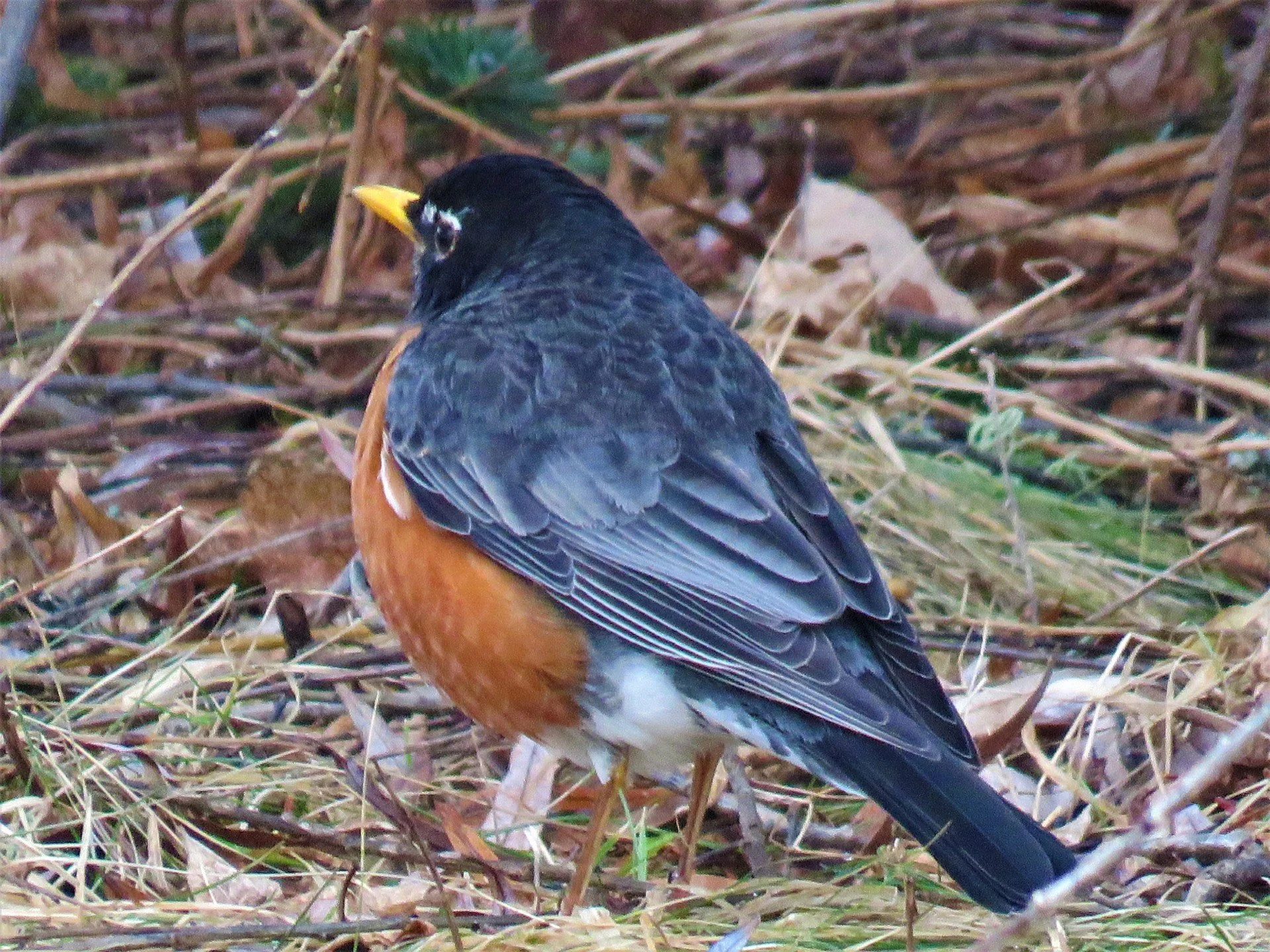
March 27, 2022
The first robin of the year foraged on the lawn in our back yard.
The Woodcock Mating Ritual
In Sugar Hill, the woodcock and more specifically the woodcock mating ritual is definitely a major event at the end of winter. The woodcock is not the first bird to return, an honor that usually belongs to the redwing blackbird. But being first to arrive is far from being first in the hearts and minds of our (north) countrymen. A woodcock’s arrival is not merely noted, but anticipated anxiously and eventually celebrated. When a woodcock comes to town, the townsmen gather round, for there is no one as excited by spring as a woodcock.
As soon as most of the snow has melted, a male woodcock will stake out his turf in a flattened field with nearby woods and water.
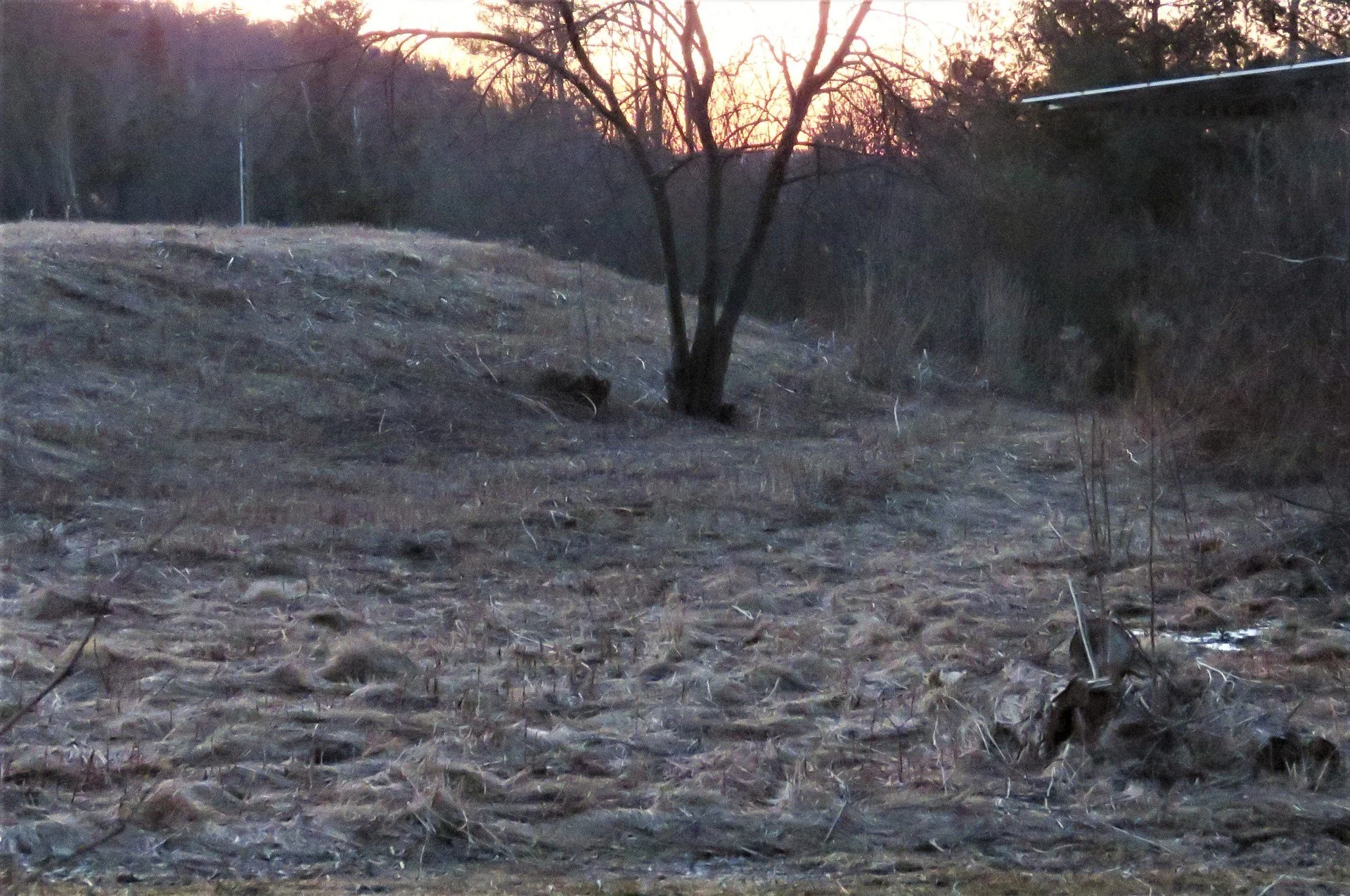
March 27, 2020, 7:37pm
Ideal conditions for the woodcock mating ritual. Woodcock start calling just after sunset, when it is nearly too dark for a photo. The bird was in the center of this picture, at the bottom of the dam, and it began calling at 7:35pm.
Once the woodcock has found his spot, he then begins his act. He utters the irresistible appeal to the female of that species: “peeent” – a sound that might be a wolf whistle through a kazoo and certainly a sound that would attract a seventh-grade boy – but not a sound recommended to men or boys seeking a relationship with a female of our species. He does this repeatedly, at intervals of several seconds, and if you get close enough you can hear a self-satisfied, but very soft “coo” after each call. He might do this five times or fifty times, but eventually the adrenaline is up to its peak and he takes off into the night, circling higher and higher, wider and wider, with the wind whistling through his wings emitting an eerie wail that will attract and entice any female (well, any female woodcock) within a half mile. Happy and excited, he flutters back to his mating grounds, looks hopefully for a mate, shrugs, and does it all over again. And again. For hours. For days. For weeks if necessary.
March 23, 2009
First woodcock in Upper Meadow, right in a spot where I’d been kneeling to cut an alder clump, thereby creating mud and a small pool of water amid the otherwise snow-covered field,
March 25, 2021, 66 degrees and sunny in the late afternoon
At 730, we went out for the third straight evening to listen for the first woodcock. This was in fact the day – as soon as I stepped out, I heard “peent.” A short while later, as I stood still by my ditch at the edge of the Upper Meadow, one flew within a yard of my head and landed not eight feet away!
March 23, 2000
It was 56 degrees when we arrived, and snow still covered about a third of the yard. It was immediately apparent that more birds were around. In addition to the usual chickadees, crows, blue jays, doves and woodpeckers, we had robins, bluebirds, and blackbirds. We heard the first woodcock even though it was not the usual cold, windy, dark, and disturbing night. It was a harbinger of spring in Sugar Hill, and we were indeed happy to hear it.
March 27, 2009
At 7:30pm, just as the sunset was fading, at least one male woodcock was calling in our backyard. He flew down so close to Nancy that she thought it was going to hit her. When he “peents”, he bobs his head up and down.
Redwinged Blackbirds
If you live by a pond, as we do, then you will certainly agree that redwinged blackbirds are also a harbinger of spring. These birds, commonly known as redwings stake their claim on generally arriving a week or two before the first robins. Yesterday, I wrote that the males arrive first, sometime in mid-March, and immediately start calling from the trees near the pond. Then they join the other birds scavenging under the feeder and contending with each other for territories near the pond.
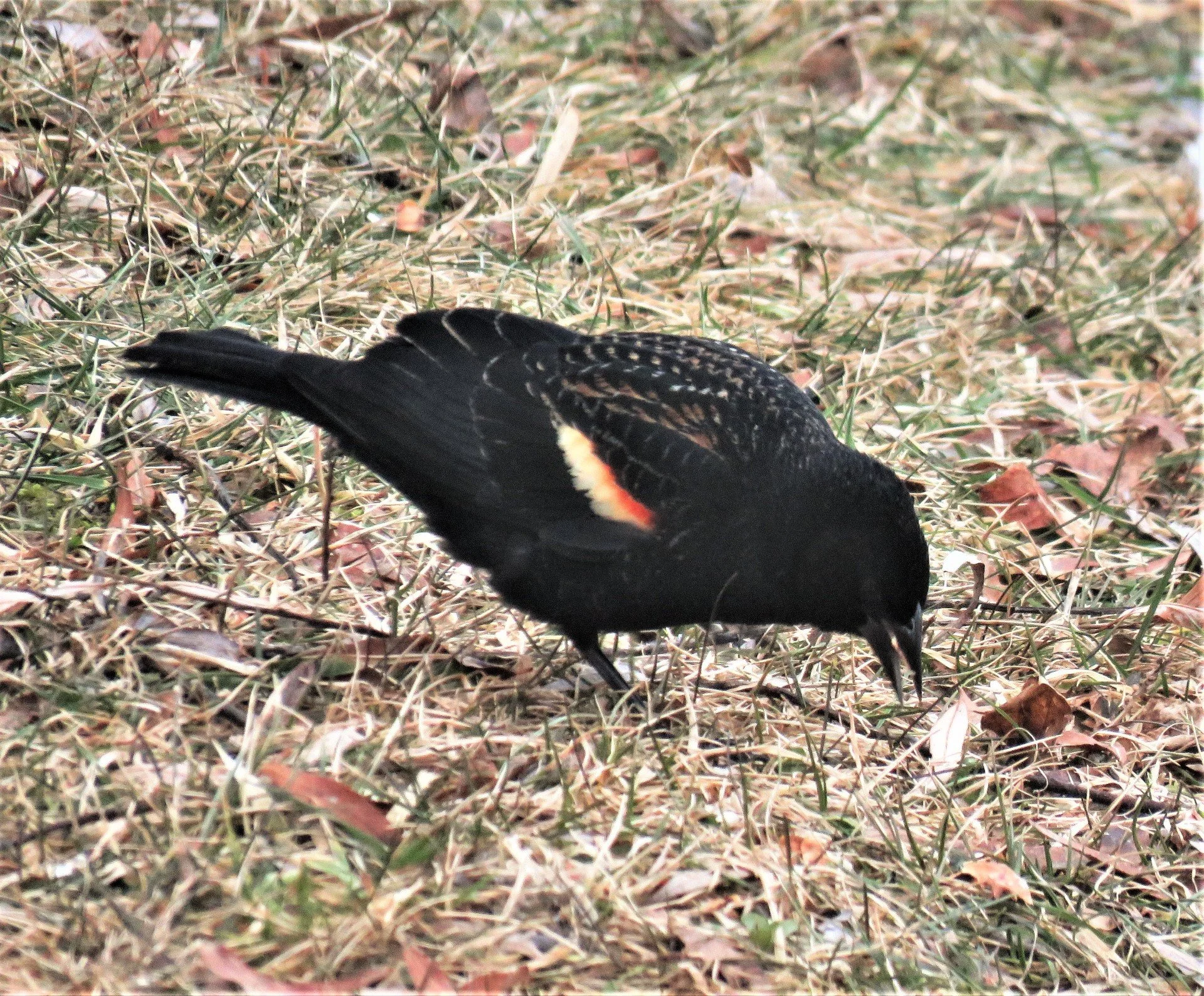
March 7, 2018
The first redwings were high in the trees by the pond on the 5th; today they were under the feeder.
Today, as I am working on this essay, is not only mid-March, but the Ides of March! And, true to what I had written yesterday, the first redwing of 2026 showed up just in time to get its photo published in this essay!
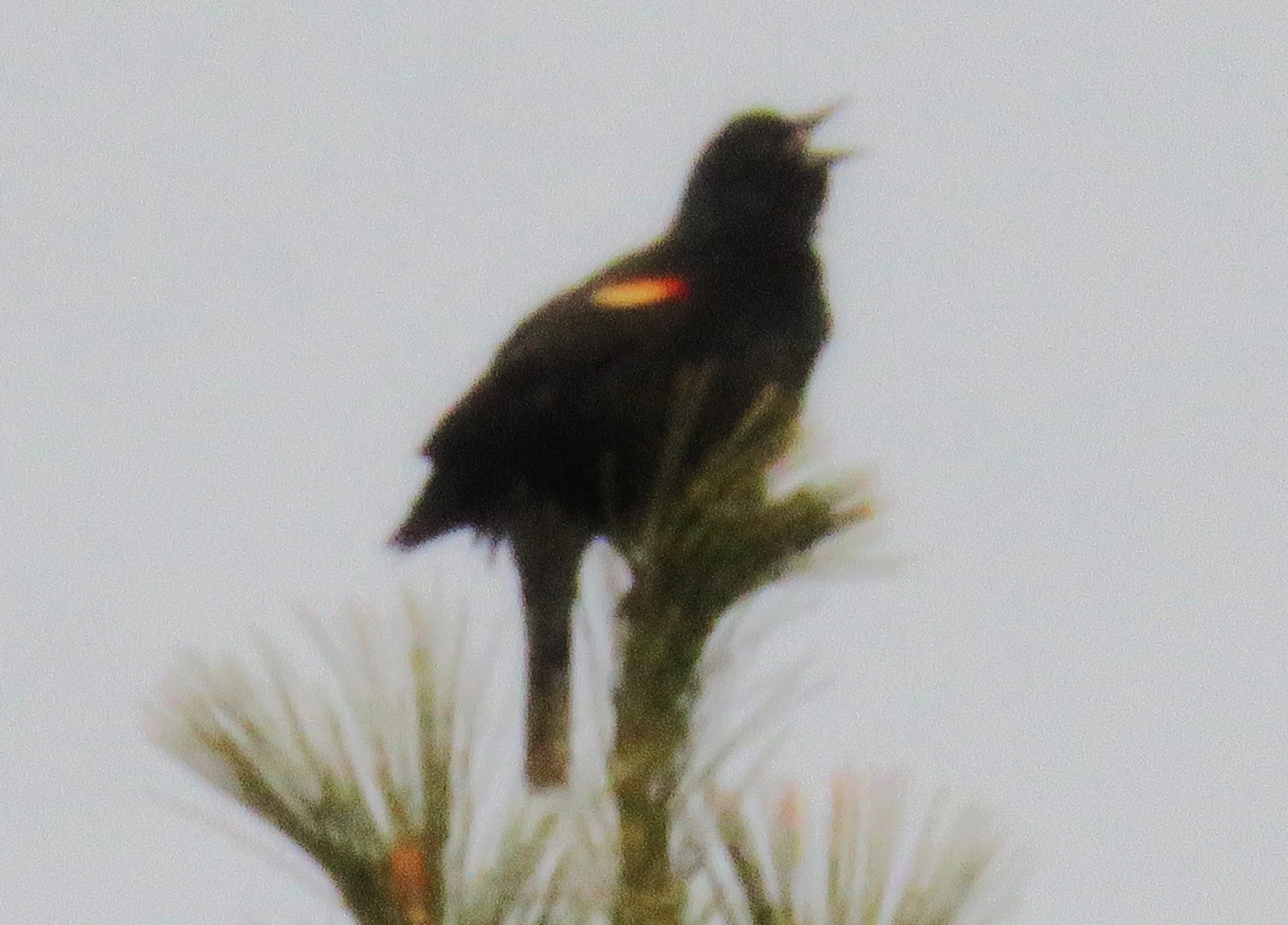
March 15, 2026, 30 degrees, mostly cloudy, 830am
The first redwing of the year was calling from the top of the big pine between the solar array and Pearl Lake Road. A poor photo, unfortunately, but it does document the time and location of the first redwing of 2026.
Redwing behaviors are more varied than the those of the early-bird robins. Redwings, like robins, are looking for food, but they are also busy establishing a pecking order before the females arrive. The males expose their wing patches in displays of dominance, and they shout at each other from the tree-tops, seeking to defend the best nesting areas for a week or more until the females show up.
March 22, 2023, 36 degrees, light clouds, 930am
The first redwing flew into the big spruce, its red patches brilliant in the morning sun!
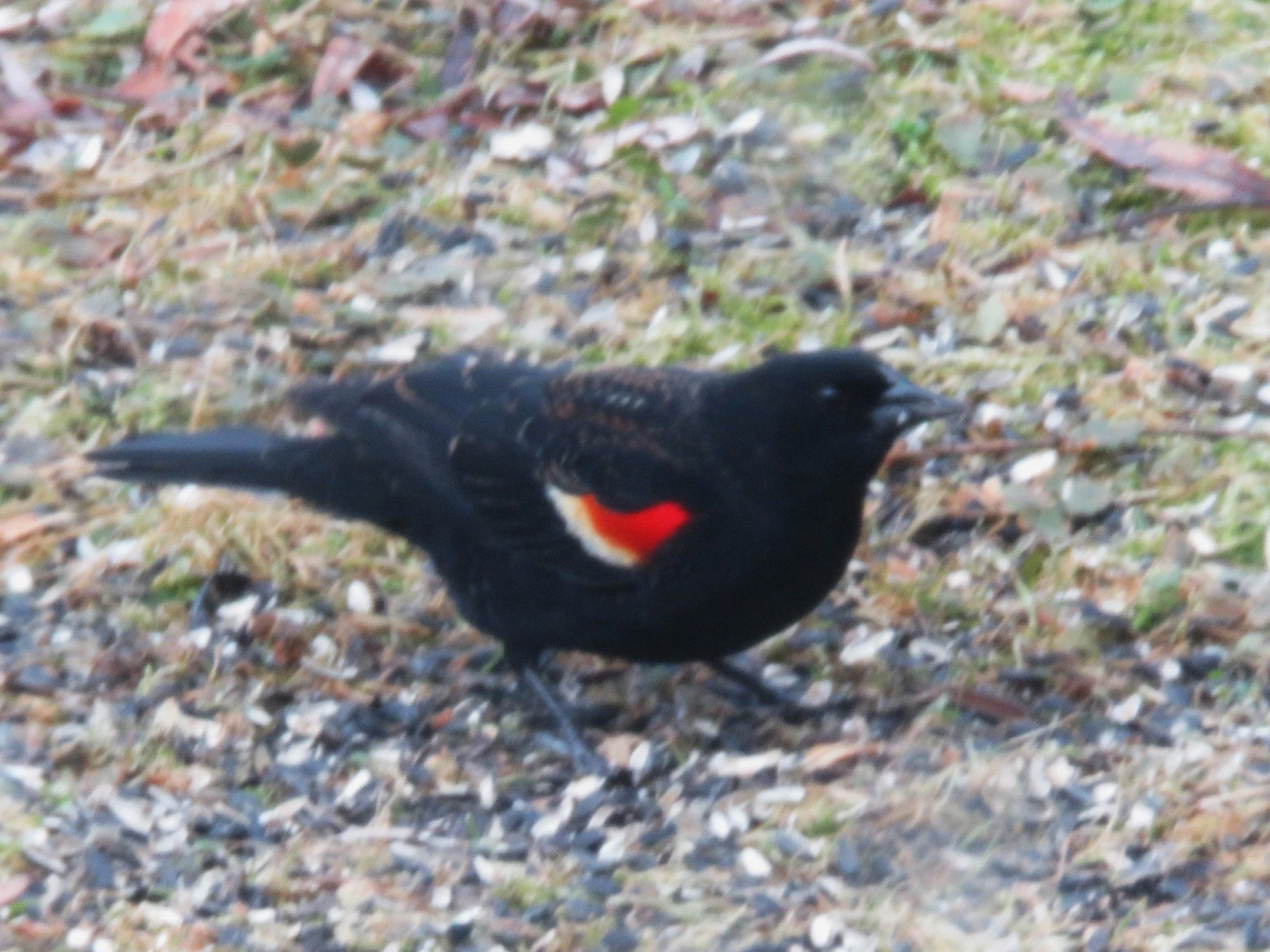
March 14, 2024, 45 degrees, mostly sunny,
10-11am
A half dozen redwings foraged beneath the feeder. A couple expressed their dominance by displaying their wondrous red patches to the others, who meekly displayed only a narrow yellow stripe as they kept out the way.
At least to the human observer, redwings are more in tune with the romance of spring than robins, possibly because, to us, male and female robins look pretty much the same. The female redwing leaves the flashy colors to the male. We, along with the restless males, eagerly await the arrival of the first female redwings.
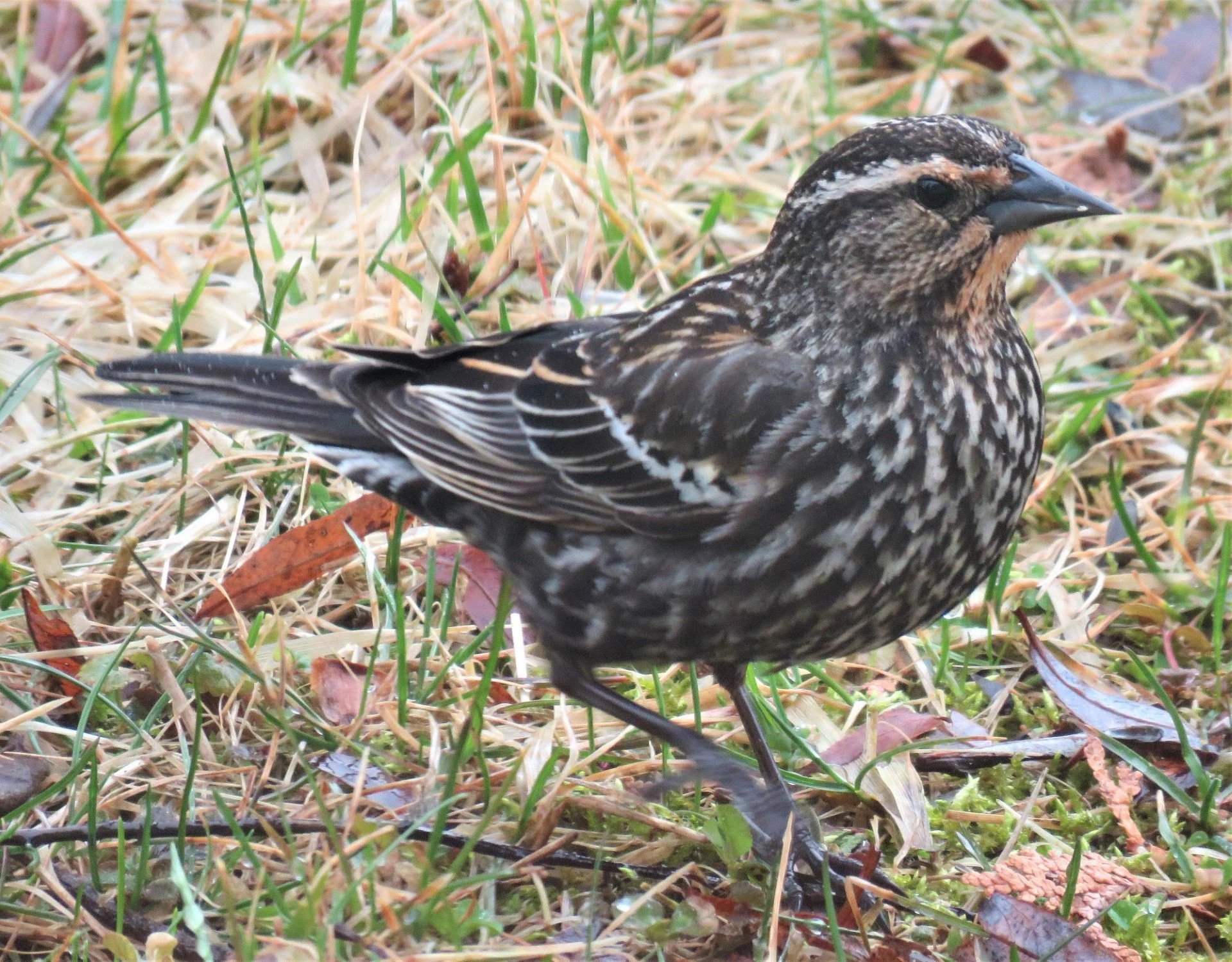
April 26, 2018
A female redwing has subtle colors on her throat and back, but lacks the bold wing stripes of the male.
Nominees for “Harbingers of Spring”
I am finishing this essay on Sunday, March 15, 2026 – and tonight millions will be watching the Academy Awards. If the Audubon Society were having a similar event, then the nominees for Best Harbinger of Spring would include robins, woodcock and redwings
If the award went to the earliest bird, then I would have to spend a lot of time documenting the average arrival times in Sugar Hill for these three nominees over the past 25 years. Generally, redwings are first, followed a week later by robins and a week after that by woodcock. However, they sometimes all arrive on the same day:
March 22, 2023, 36 degrees, light clouds
The first redwing flew into the big spruce (930am), its red patches brilliant in the morning sun! The ground is still 95% snow-covered and the pond is still iced over, but the ice is softening. While cutting out several willows that had broken off over the boats and the dock, I heard a few redwing calls (1100am). Then, at noon, a robin flew into the big maple while we enjoyed our elevenses – Irish soda bread and coffee. Later, Dan Kennerson told us that they’d heard the first woodcock last night.
In addition to the potential overlapping of arrival times, remember that Best Harbinger of Spring is not an Olympic event such as speed-skating where timing is the only thing that matters. As is the case for figure skating and ski-jumping, style and personality count. If you live by a pond, then you will provide the wing patches, the territorial disputes, and the varied calls as support for the redwings. If you live near the fields where the love-sick woodcock males perform their rituals, then you will certainly support the woodcock. If you don’t live near a pond or a field, then you will emphasize the excitement associated with the first flock of robins that spreads out over your lawn soon after the snow has melted.
And the Award for “Harbinger of Spring” goes to …
We are fortunate to have a large lawn, a small pond, and an overgrown meadow, so we are able to appreciate the arrival of each of the nominees. My journals include annual references to the first arrivals of all three nominees, but the woodcock is the only nominee whose absence is noted and whose arrival is anticipated. I don’t have anything like these notes for robins or redwings:
March 30, 2017
Even though the temperature has reached 45 degrees, the yard is still 95% covered with as much as eight inches of snow. The woodcock will soon be here.
April 4, 2018, 40 degrees, grey windy, 740pm
When I went out to get a load of firewood, I heard that welcome spring sound, that true “Harbinger of Spring in the North Country.” I stepped outside – sure enough, one was calling and one was circling. We watched one woodcock “peent” thirty or forty times before it flew off, and we could see it quite clearly as it circled below the backlit clouds of early dusk.vI went back for my camera, hoping to get a picture, but by the time I returned, the best I could do was pretty much “film noire”, with the woodcock providing the only sounds.
In short, being biased by having woodcock in the Upper Meadow, if I were a judge, I would stay with my earlier conclusions, as summed up in this journal entry:
March 28-31, 2012
This year a flock of nearly two dozen robins showed up on the same day as the first woodcock, so I thought I may have been overly harsh on the notion that it’s woodcocks, not robins that announce that spring is near. But then I followed the woodcock as it made its plaintive call and its soft coos, and I watched as it flew out up and around in huge circles, and I hid behind some small shrubs in the hopes that it would flutter down close to me and start all over again. Have I ever done this with a flock of robins? Has anyone? No, and that’s why it’s the woodcock that has, in the North Country, earned the title “harbinger of spring.”
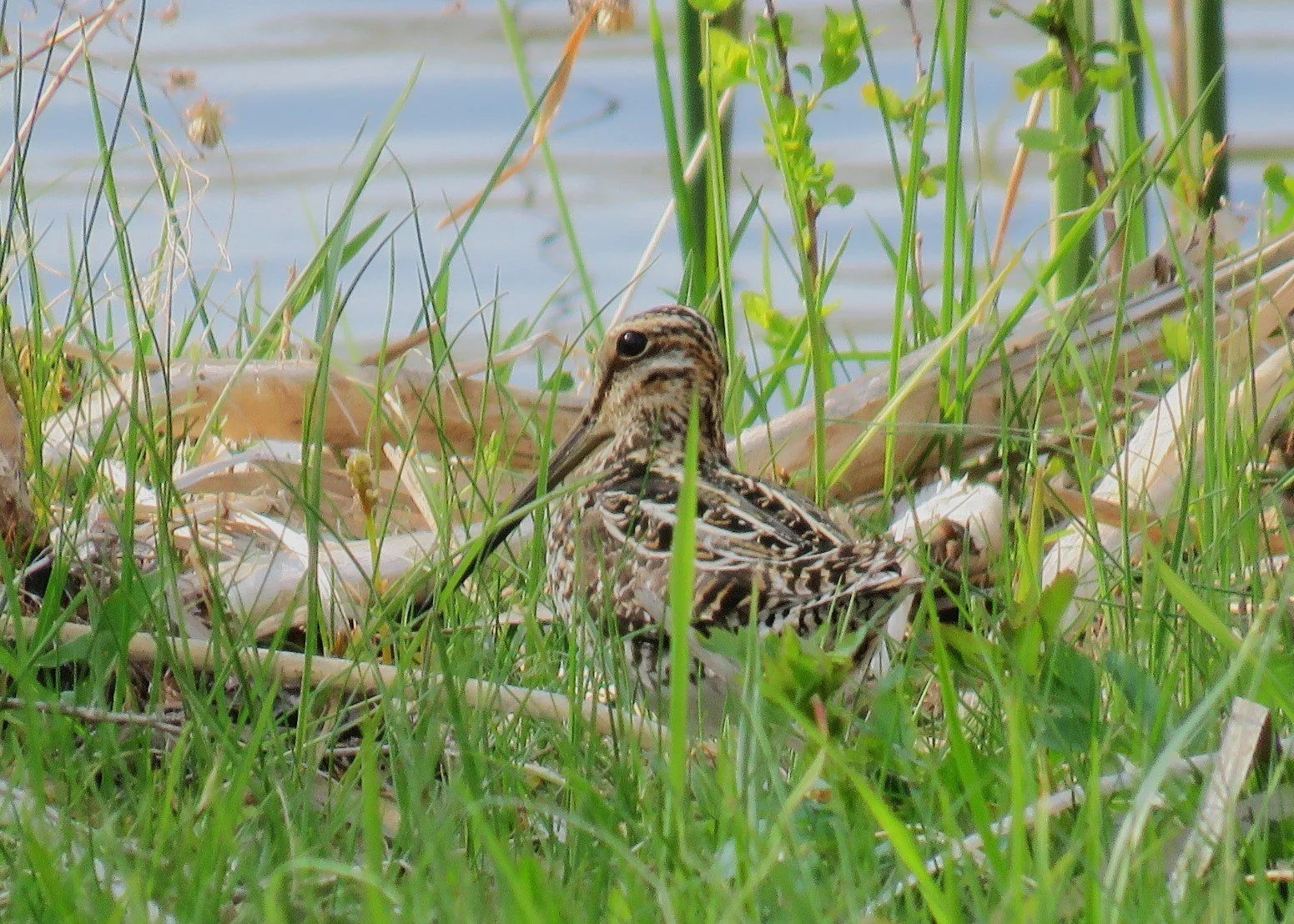
I lack the technology to capture a good photo of a woodcock at dusk, so I’ll close with a rare photo of one of these secretive birds that was looking for a bite to eat by our pond on May 23, 2016.
Photos and text by Carl D. Martland, founding member of ACT, long-time resident of Sugar Hill, and author of Sugar Hill Days: What’s Happening in the Fields, Wetlands, and Forests of a Small New Hampshire Town on the Western Edge of the White Mountain. Quotations from his book and his journals indicate the dates of and the situations depicted in the photos.